
In today’s world, indoor air quality is more important than ever. Dust, pollen, and even wildfire smoke can significantly impact our health and comfort. Air purifiers offer a solution, but navigating the world of product specifications can be confusing. Is product efficiency a sufficient way to rate them, or should we think about effectiveness? This article explains the role of the Association of Home Appliance Manufacturers (AHAM) and the importance of the Clean Air Delivery Rate (CADR) in choosing the right air purifier for your needs, plus an upcoming standard that wants to deliver even better indoor air solutions.
Understanding CADR
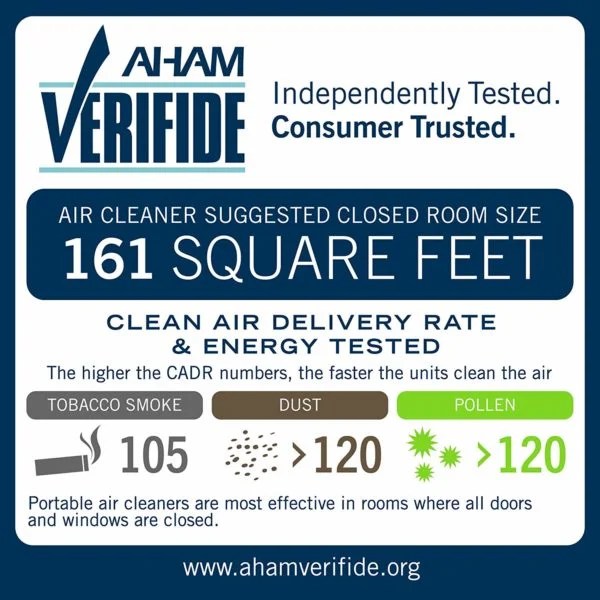
The Clean Air Delivery Rate (CADR) is a crucial metric that indicates how quickly an air purifier can remove specific types of particles from a room. It measures the volume of clean air delivered by the unit and is expressed in cubic meters per hour (CMH) or cubic feet per minute (CFM). AHAM tests air purifiers for three common pollutants; smoke, dust, and pollen. Note: CMH can be converted to CFM by dividing by 1.7.
What is AHAM?
The Association of Home Appliance Manufacturers (AHAM) is an independent, non-profit organization that develops and administers voluntary performance standards for various home appliances, including air cleaners. AHAM’s Verifide® program tests and certifies air cleaners, providing consumers with reliable information to make informed purchasing decisions. This certification ensures that the advertised CADR ratings are accurate and have been verified by a third party.
- Smoke: Fine particles (0.09–1.0 microns) generated by burning materials.
- Dust: Larger particles like dust mites and pollen (0.5–3 microns).
- Pollen: Allergens like pollen spores (5–11 microns).
Each air purifier receives three individual CADR ratings, one for each of these pollutants. A higher CADR indicates better performance.
The 2/3 Rule and Beyond
A common guideline for choosing an air purifier is the “2/3 Rule.” This rule suggests that the CADR of your air cleaner should be equal to at least two-thirds of the room’s area in square feet. For example, a 12-foot (or 3.65 m) by 10-foot (or 3 m) room has an area of 120 square feet (or about 11 m2). Following the 2/3 rule, you should look for an air cleaner with a smoke CADR of at least 80 CFM. Note: The 2/3 Rule is more easily applied when working with airflow expressed in cubic feet per minute (CFM).
Wildfire Smoke Considerations
When dealing with wildfire smoke, AHAM recommends a Smoke CADR equal to the size of the room in square feet. So, for the 120 square foot room, a Smoke CADR of 120 CFM or higher would be preferable during wildfire events.
Important Considerations:
- Higher CADR is Better: While the 2/3 rule provides a good starting point, using an air cleaner with a higher CADR will simply clean the air more frequently and efficiently.
- Ceiling Height: If your ceilings are higher than the standard 8 feet (2.5 m), you’ll need an air cleaner rated for a larger room to achieve the desired air cleaning performance.
- eACH (Equivalent Air Changes per Hour): The US EPA recommends looking for air purifier models that provide at least 4.8 eACH for the recommended room size. This means the air in the room is filtered 4.8 times every hour. For wildfire smoke, at least e4.8 ACH is also recommended.
- AHAM Verifide® Mark: Look for the AHAM Verifide® mark on the air purifier packaging. This mark assures you that the CADR ratings have been independently verified. Claims regarding CADR are only substantiated if the product has been tested to the ANSI/AHAM AC-1 test method through a program that third-party verifies products such as the EPA ENERGY STAR, AHAM Verifide, or U.S. Department of Energy minimum energy performance programs.
- Particle Size: AHAM tests purifiers for particles with an aerodynamic diameter of 0.09 to 11 μm. This range covers many common indoor air pollutants.
Future Standards for Air Purifiers
A groundbreaking upcoming standard, ASTM WK817520, is on the horizon for air purifiers, aiming to shift the focus beyond mere air purification efficiency to holistic air purification effectiveness. This critical distinction, foreseen by initiatives like GO AQS, acknowledges that a filter’s ability to capture particles in a single pass isn’t the sole determinant of cleaner air in a real-world environment. WK817520 will instead encompass a comprehensive set of factors, including the air purifier’s demonstrated efficiency, its airflow capacity (Flow), the volume of the room it’s intended to clean (Room Volume), the time required to achieve target air quality levels (Time), and crucially, the potential for harmful by-products. This last point is very important, as the standard will specifically address the generation or removal of detrimental substances like ozone, formaldehyde, and ultrafine particles, ensuring that air purifiers truly contribute to healthier indoor environments without inadvertently introducing new hazards.
Conclusion
Understanding AHAM and CADR is essential for choosing an effective air purifier. By considering the size of your room, the types of pollutants you want to remove, and the AHAM Verifide® mark, you can select an air cleaner that will significantly improve your indoor air quality and contribute to a healthier home environment. Remember to prioritize higher CADR values, especially during wildfire season or if you have specific concerns about particular pollutants.
Discover more from See The Air
Subscribe to get the latest posts sent to your email.
 See The Air