Review: XT Mini by Ethera Labs

Managing air quality monitors (AQM) in buildings is not always an easy task especially if you have deployed a lot of them. When there are many rooms that you have to take into consideration it can become very costly, very fast to equip all those rooms. Is there a way to monitor rooms without an AQM?

Well, it turns out there is a way to monitor the environmental and air quality conditions in rooms that do not have physical monitors nowadays. How?

Ethera Labs, which is a French company, with over 10 years of experience in professional IAQ solutions has integrated powerful Machine Learning (ML) algorithms that predict the conditions in rooms where air quality monitors are not installed, yes that’s right, you have read correctly. They have trained special neural networks by taking a lot of parameters into consideration in order to predict accurately the conditions and alerts users in case they need to take actions or even address an AQ/Environmental incident automatically.

By connecting the station to BMS, they manage to achieve energy efficiency while directly managing the ventilation system, as well as portable air purifiers or giving building operator the right information in advance so they can take action at the right time. They achieve two goals, great air quality and energy efficiency.

Hardware-wise Ethera Labs offers an arrange of monitors that can address different building specifications and needs. In this article, I will review the Mini XT Basic (MX-KIT020) and the NEMo Cloud/Supervision Cloud platforms.

Read More »
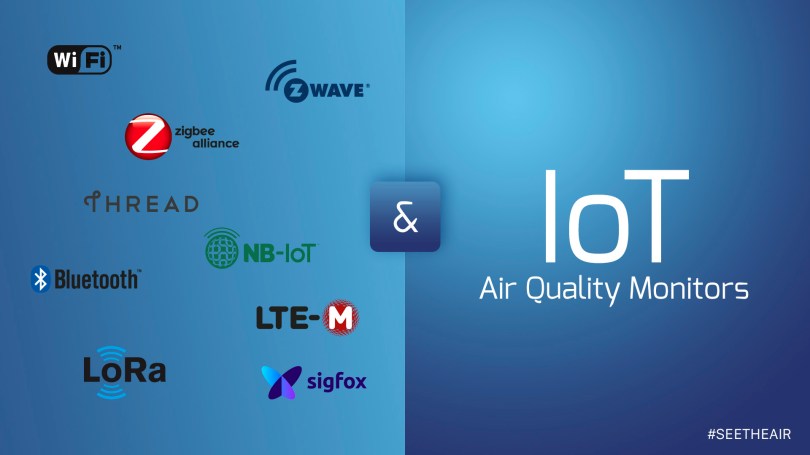
Let’s talk: IoT Wireless Network Protocols for Air Quality Monitors

The Internet of Things (IoT) describes the network of electronic devices (air quality monitors, purifiers, motion detectors, cameras, etc.) that are embedded with sensors, software, and other technologies for the purpose of connecting and exchanging data with other devices over the Internet.

In this article, I am going to describe some of the available networks and physical layers that are used by Air Quality Monitors (AQM), mainly for consumer-based products, and discuss which technologies make more sense in 2021+ for Smart Homes/Buildings and Businesses.

Wi-Fi IEEE 802.11

IEEE 802.11 is part of the IEEE 802 set of local area network (LAN) protocols and specifies the set of media access control (MAC) and physical layer (PHY) protocols for implementing wireless local area network (WLAN) Wi-Fi computer communication in various frequencies including 2.4 GHz, 5 GHz, and 6GHz.

IEEE 802.11a/b/g/n

This standard wireless network protocol is among the most common protocols for communication between the devices and the internet/cloud. Most devices even today use the ~20 years old 802.11b or 802.11g with a linkrate between 1 to 54 Mbit/s and a frequency of 2.4 GHz for power conservation reasons and good wall penetration. The 802.11n transmits the highest data throughput, but at the cost of high-power consumption at 5GHz.

IoT AQMs do not need a high-speed data throughput because the information they transfer is very little and in the range of a few kilobytes. So protocols like the IEEE 802.11ac and IEEE 802.11ax don’t make a lot of sense because they demand energy and they don’t offer good wall penetration in order to cover an entry house/apartment.

IEEE 802.11ax aka WiFi 6 or 6e

There are some claims that IoT devices will adopt the new WiFi 6e (e stands for enhanced) but I don’t think we will see that happening as bandwidth isn’t relevant for AQMs but the range is more essential and the WiFi 6e is designed to cover approximately 30m/98ft indoors. The 6e operates at 6Ghz, as a result, the highest the frequency the shortest the distance a signal can travel within walls. A positive feature of this protocol is that it supports a Low Power Indoor (LPI) mode. In the multi-user scenario, the WiFi 6 module consumes only one-third of that of the Wi-Fi 4 (802.11n) module and they achieve that by shortening wake-up time.

Read More »