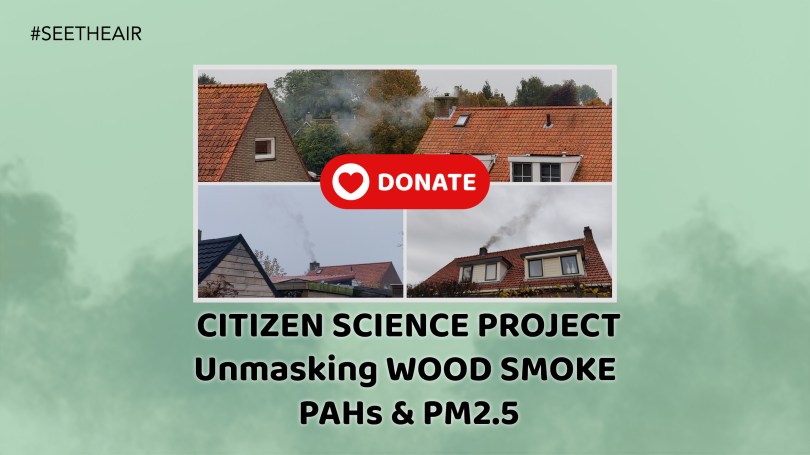
Help Us Breathe Cleaner Air: Citizen Science Project Seeks Donations for Wood Smoke Research

I won’t write a long introduction because this is of urgent matter for people to understand and support. While wood-burning stoves offer a tempting escape from soaring energy costs, they also release harmful substances into our homes and communities. These include fine particulate matter (PM2.5) and Polycyclic Aromatic Hydrocarbons (PAHs), both of which have been linked to serious health issues, including cancer.

Unveiling the Hidden Danger

Despite the known risks, we still lack sufficient data on PAHs concentrations in residential areas where wood burning is common. The location of investigation will be chosen in the Netherlands or Belgium. This is where your help is crucial.

By supporting this citizen science project, you’ll help us gather vital information about the impact of wood smoke on our air quality. The project will measure PAHs and PM2.5 levels in a residential area heavily reliant on wood burning for heating. This data will be invaluable for raising awareness among policymakers and advocating for stronger air quality regulations.

How Your Donation Makes a Difference

Analyzing air for PAHs is a complex process requiring specialized equipment and laboratory analysis. With your support, the project will:

  • Purchase air pumps and ten (10) absorption tubes to collect air samples.
  • Conduct laboratory analysis to identify and quantify PAHs.
  • Measure PM2.5 levels using advanced sensors.
  • Compare PAHs levels in wood-burning areas to background levels.

Join the Fight for Clean Air

Your donation will directly contribute to a healthier community. Together, we can uncover the hidden dangers of wood smoke and work towards cleaner air for everyone. Finally, I want to thank Dieter Pientka for his passion to investigate this crucial subject.

Help us make a difference. Donate today!

Office Study – Tapping Into The Real World Air Quality Data

Nowadays, it is a privilege to have access to a real indoor environment where you can measure and quantify indoor environmental quality (IEQ). It is not an easy task because most companies keep AQ data private, and we totally respect that. However, sometimes tapping into the real world data is fundamental in order to understand the conditions white color employees and employers work in an effort to improve work conditions and productivity.

The owner of the building and the office granted me access to installing the Atmocube IAQ monitor for two months, in order to figure out what improvements shall apply in their effort to mitigate covid19, improve working conditions and boost productivity. The office is located in Almeria, Spain which is a coastal city.

They don’t have any mechanical ventilation systems, so the indoor conditions were subject to their human actions and whether they opened the windows/doors or not.

Read More »

Study: Taking a closer look at the air quality in classrooms

After almost two months of asking local schools for permission to install air quality monitors in their classrooms, on the 4th of December, a local school decided to grant me access.

In my city, Almeria, Spain, there are about 110 schools. I didn’t apply to all of them because each time I managed to find a way to contact them, I had to arrange a meeting in order to explain to them what I wanted to do, and all this process takes time. I managed to contact nine schools.

For this study, schools didn’t have to pay anything, so money wasn’t the issue for their refusal. They were worried about what will happen if the results were disappointing and negative. I tried to explain to them that the aim of the study is to understand what is going on in the classroom, in real conditions, with real students. I don’t want to discredit the school either the local authorities that manage the budget for the school. For this reason, I will keep the name of the school private.

Monitors

The monitors that I have installed for the study are made by Airthings. There are two Wave Plus, which include a CO2 sensor by Senseair. The sensor is called Sunrise, and it is an ultra-low-power, high precision NDIR sensor. Accuracy (CO2) ±30 ppm ±3% of reading. Finally, it features a self-correction system that allows them to auto-calibrate every 180 hours. I also have included a Wave mini monitor in the teacher’s office room. 

Read More »