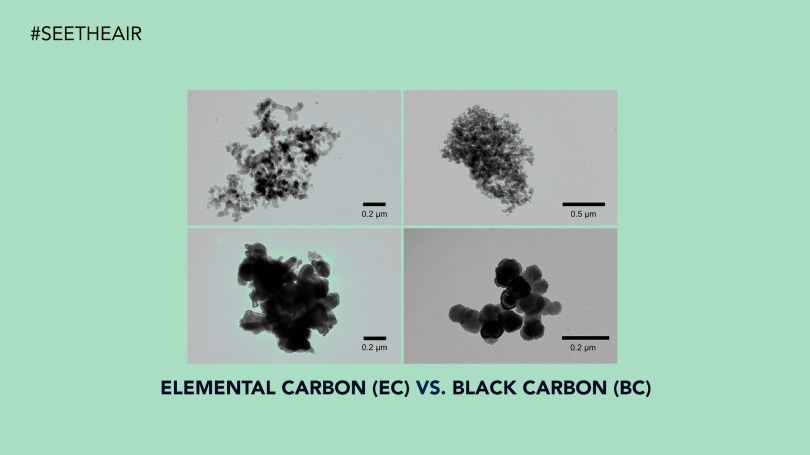
Elemental Carbon (EC) vs. Black Carbon (BC): A Distinction in Measurement and Terminology

The terms Elemental Carbon (EC) and Black Carbon (BC) are both used to describe the product of incomplete combustion of fossil fuels, biomass, and biofuels, which is a significant component of aerosols (airborne particulate matter). While often used interchangeably in general discussion, they represent distinct concepts primarily tied to their respective measurement methodologies. Understanding this difference is crucial in air quality monitoring, climate science, and health studies.

Elemental Carbon (EC): The Reference Method

Elemental Carbon (EC) is the term associated with the reference method for measuring this specific fraction of carbonaceous aerosol.

  • Measurement Method: EC is quantified using thermal-optical analysis. This technique relies on the sequential heating of a filter sample to different temperatures in different atmospheres (non-oxidizing and oxidizing) to distinguish carbon fractions.
  • Standard Protocol: The EN 16909 standard is a prominent European standard for the determination of EC (and Organic Carbon, OC) in ambient air, often employing the thermal-optical reference technique.
  • Specific Protocol: The EUSAAR_2 thermal protocol is a common, specific thermal-optical protocol used to define the temperature steps and atmospheres for the measurement.
  • Charring Correction: A critical part of the thermal-optical method is the charring correction, typically based on the transmittance (or reflectance) of a laser beam through the filter. This corrects for the formation of “pyrolyzed” or “charred” organic carbon during the heating process, which can otherwise be misclassified as EC.
  • Definition: Conceptually, EC represents the carbon in its pure, elemental form—the refractory, graphitic, or amorphous carbon that is the most stable at high temperatures.
Read More »

Have you noticed Climate Change?

I have this simple question. Have you noticed Climate Change?

I believe the summer heat has helped many in the northern hemisphere to notice that something is going on. However, climate change is not only extreme heat but a lot more.

Lots of news are covering the record temperatures that are registered in places never seen before. Lots of articles are talking about the deaths these high temperatures cause. All of them are true, but no one mentions the effects on the environment that supports our food chain and the animals that live on this planet too. Crops and animals, suffer a lot, and they don’t have an air conditioner to cope with the heat or an air purifier to cope with the air pollution.

Ozone (O3)

Ground-level ozone causes more damage to plants and trees than any other air pollutant. Ozone penetrates leaves through stomata (tiny openings present on the epidermis of leaves) during gas exchange. Ozone is a strong oxidant, and it causes several types of symptoms, including chlorosis (yellowing of leaf) and necrosis (the death of the tissue).

Read More »

What Is COP26 & What Does It Mean For Our Climate?

COP26 stands for Conference of the Parties, which are the countries that signed the United Nations Framework Convention on Climate Change (UNFCCC). The 2021 meeting will be the 26th meeting. Initially, it was due to take place in Glasgow in Scotland in November 2020, but it was postponed for a year because of the COVID19 pandemic.

During COP26 governments will demonstrate their commitment by showing how they will keep global temperature rises below 1.5ºC, deliver money promised to countries on the front-lines of the climate crisis, and shift away from fossil fuels.

So far and after the Paris Agreement little has been done in order to reduce greenhouse emissions. The pressure governments receive is even greater than before because the climate crisis is already unfolding in front of your eyes as more and more people demand actions.

Global Warming

Many people with a lack of understanding for the term global warming just believe that some seasons will be warmer, so what! The term global warming has indeed misled the population for many years as it doesn’t describe the real scenarios of the alteration of the climate on a global scale. Today, there are many terms available trying to describe and help people understand better the severeness of the issue.

Read More »