For years, Apple has quietly seeded its ecosystem with a technology whose full potential has yet to be realized: Ultra Wideband (UWB). From iPhones and Apple Watches to HomePods and AirPods, spatial awareness is built into the hardware backbone of Apple’s lineup. Designed primarily for precise device directional tracking and spatial audio, UWB enables devices to map where you are relative to other objects in your immediate physical space.
To air quality advocates, this hardware footprint represents something far greater: the missing infrastructure for absolute indoor exposure assessment.
No other company on earth has the hardware density, spatial technology, and user base to pull off true, personalized exposure tracking. Imagine an ecosystem where your wearable knows your precise distance from an indoor air quality monitor across the room, continuously adjusting your personal exposure profile based on real-time spatial proximity. It is a dream scenario for indoor environmental quality (IEQ) experts, and Apple already has the hardware sitting on millions of nightstands and desks around the world.
The Hesitation
Apple’s interest in environmental sensing is far from hypothetical. Over the years, the company has filed several patents around air quality detection, including specialized designs for particulate matter sensing. Yet, their commercial rollouts have been remarkably cautious.
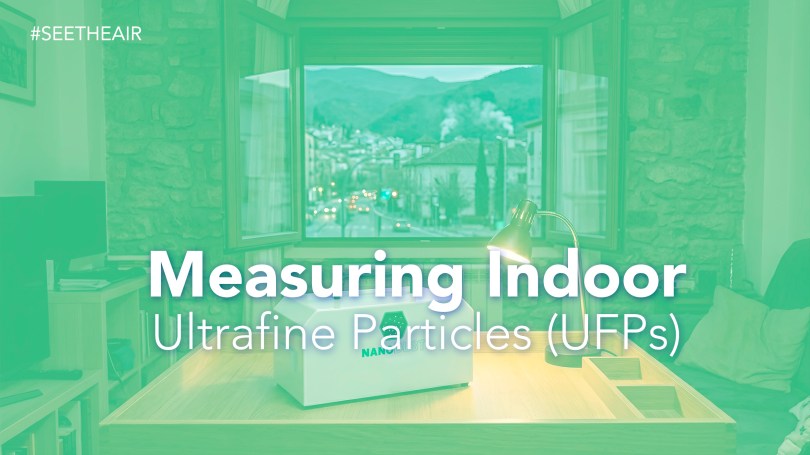
We have spent decades obsessing over PM2.5 —the fine particulate matter small enough to lodge itself in our lungs. We draft laws around it, track it on our phones, and buy home monitors to avoid it. But while our regulatory gaze has been fixed on particle mass, an invisible, almost weightless army of much smaller particles has been slipping through the cracks: Ultrafine Particles (UFPs).
Known technically as PNC0.1, these aerosols have an aerodynamic diameter of 100 nanometers or less. To put that in perspective, they represent a negligible fraction of total ambient mass, yet they often make up over 90% of the total particle number concentration (PNC) in our atmosphere. Because they are so unbelievably small, they don’t just settle in the lungs—they have the unique physical ability to cross into the bloodstream, posing distinct and severe health risks.
Yet, when we step inside our homes, we enter a measurement blind spot. In our current study across two Spanish cities—Granada and Almeria—we exposed a frustrating reality: meeting current PM2.5 standards provides a completely false sense of security when it comes to UFP exposure, and our current measurement tools and guidelines make it nearly impossible to tell if the air we breathe inside is actually safe.
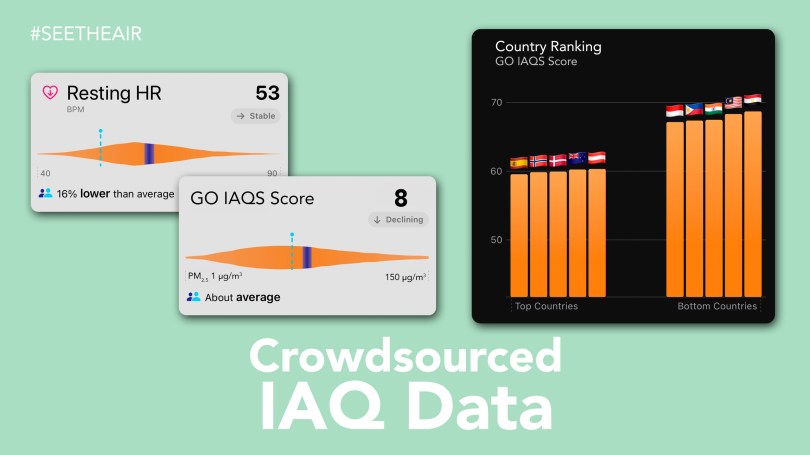
We live in an era of hyper-quantified health. Every morning, millions of us check our wrists to see how we slept, what our resting heart rate looks like, and how many steps we logged yesterday.
Apps like Health Hive have revolutionized this experience. By taking biometric data from tools like the Apple Watch and anonymously pooling it across a massive database of over 65,000 active users, they give us a powerful, context-rich mirror. It’s one thing to see your Resting Heart Rate (RHR) is 53 BPM; it’s an entirely different, highly motivating thing to open Health Hive and see a bell curve showing you are lower than 86% of similar users in your 40–49 age demographic.
At See The Air, we have spent years advocating for a fundamental truth: clean air is a human right, and our children deserve the absolute best protection where they spend most of their day—inside the classroom.
That is why I am thrilled to share a massive milestone in global air advocacy. The Global Open Air Quality Standards (GO AQS) has officially launched GO IAQS for Schools, a groundbreaking strategic plan designed to transform educational environments from passive shelters into active, health-protective zones.
For too long, policy regarding school air has relied on generic, “check-box” ventilation advice. GO AQS is changing the game by shifting the focus toward health-based performance metrics.
The Vision: “Same Air, Same Standards”
The core philosophy behind the GO IAQS for Schools initiative is beautifully simple: Same Air, Same Standards.
Air pollution and airborne pathogens don’t care about geography or economic status. This initiative aims for global adoption, ensuring that children in resource-limited settings are protected by the exact same high-performance metrics as those in the most developed economies. By replacing vague guidance with strict, science-based performance standards, the framework ensures air quality is maintained at levels that protect even the most clinically vulnerable students and staff (such as those managing asthma or compromised immune systems).
In The Time Thief — The Broken Promise of Our Buildings and the Fight for the Air We Breathe, Simon Jones presents a sobering “manifesto” that unmasks a silent systemic failure within our modern built environment. While the title might initially evoke a sense of mystery, Simon meticulously explains throughout the narrative that the “Time Thief” is not a metaphor, but a literal description of how poor indoor air quality and structural failures rob us of our literal lifespan. By detailing the physiological and societal toll of the “invisible pollutants” that compromise human health, Simon justifies his chosen title, demonstrating how the very buildings intended to protect us are, in fact, stealing years of our lives.
Throughout the book, Simon anchors his argument in four fundamental truths that challenge our complacency regarding the built environment.
The Truth of the Inhalable Diet
One of the most striking “truths” shared by experts like Tanya Kaur Bedi is the concept of the “inhalable diet”. While society is obsessed with the quality of the 2,000 calories we eat daily, we largely ignore the 10,000 to 15,000 liters of air we consume every single day. This truth highlights a dangerous double standard: we would never accept lead-contaminated tap water, yet we routinely accept air filled with a “transparent chemical soup” of VOCs, particulates, and nitrogen dioxide.
The Truth of Compliance vs. Safety
A central theme discussed by experts like Nathan Wood and Chris Rush is the “race to the bottom” regarding building standards. The book argues that “compliant” does not mean “safe,” as minimum legal standards often become the maximum ambition for developers. This truth reveals a culture where ventilation is treated as a technical add-on or a “toaster” to be plugged in and forgotten, rather than a critical “life-safety system” comparable to a fire alarm.
The Truth of Data and Visibility
The book champions the “Data Truth” as a primary tool for accountability. Experts like Jenny Danson, myself and others emphasize that because poor air quality is invisible, it does not trigger the same visceral response as a visible threat like a mouldy wall. By using low-cost monitors to make the invisible measurable, residents and workers can finally demand healthier environments and move away from “tenant-blaming” toward evidence-based structural changes.
The Truth of Health Inequity
Perhaps the most painful truth Jones explores is the “postcode lottery” of air quality. Experts note that the ability to breathe clean air has become a luxury tied to wealth and geography, creating a “triple jeopardy” where the most vulnerable people often live in the most polluted, poorly maintained environments with the least power to change them. Jones and contributors like José Luis Castro argue that clean indoor air must be defended as a universal human right rather than a premium feature.
The Time Thief is ultimately an urgent call to break the silos between the medical community and the construction industry. It moves beyond technical jargon to present air quality as a moral issue, forcing us to choose between continuing to normalize building failure or taking collective responsibility for the air that literally shapes our lives.
I highly recommend this book for anyone interested in health, architecture, or social justice. It moves beyond technical jargon to present air quality as a moral issue, forcing us to choose between continuing to normalize building failure or taking collective responsibility for the air that shapes our lives.
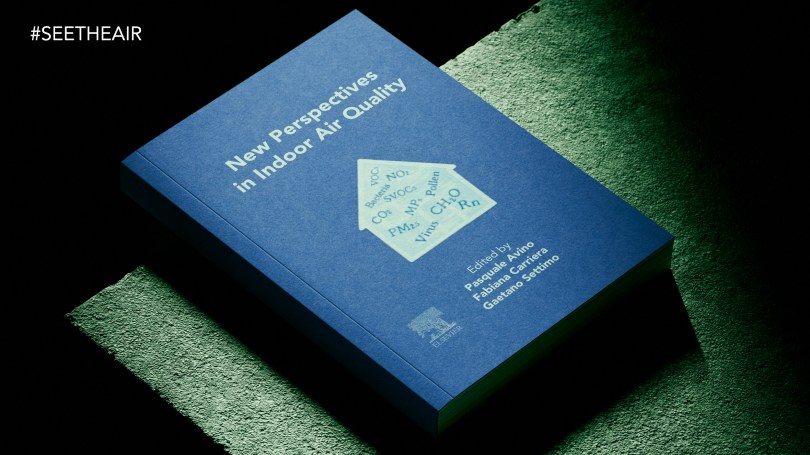
In an era where the average person spends between 80% and 90% of their life inside buildings, ranging from homes and offices to schools and transport, indoor air quality (IAQ) has transitioned from a niche concern to a critical public health priority. The newly released 2025 publication, New Perspectives in Indoor Air Quality, by Pasquale Avino, Fabiana Carriera, and Gaetano Settimo, emerges as a definitive guide for experts navigating this complex landscape. This volume offers a profound synthesis of historical context, cutting-edge monitoring technologies, and future-proof mitigation strategies.
The Invisible Importance of Indoor Air
Indoor air pollution is not a modern phenomenon. Humans have grappled with indoor contaminants since the first campfires were brought into caves 1.5 million years ago. Historically, civilizations developed sophisticated methods to manage air: the Romans used hypocausts to circulate warm air under floors, while ancient Persians pioneered windcatchers, zero-energy towers that capture and redirect wind for natural ventilation.
Today, the stakes are higher. Poor IAQ is linked to a broad spectrum of health issues, including respiratory diseases, cardiovascular problems, and neurological damage. The current global challenge lies in balancing energy-efficient, airtight building designs with the need for fresh, clean air.
We often think of air pollution as something that happens “out there”, smoggy skylines and exhaust fumes. However, for many of us, the most polluted air we breathe is actually inside our own homes. The good news? You don’t need a massive renovation to fix it. A few strategic changes to your daily habits can drastically reduce your exposure to harmful particulates and chemicals.
1. Master the Kitchen: Your Primary Pollution Zone
Cooking is frequently the #1 source of high particulate matter (PM2.5) indoors. Frying, searing, and even boiling on gas stoves release combustion byproducts and grease particles into your breathing zone.
The Fix: Always use your range hood on its highest effective setting. If your hood doesn’t vent outside (recirculating), open a nearby window to create cross-ventilation.
The Tip: Start the fan before you turn on the heat and leave it running for five minutes after you finish.
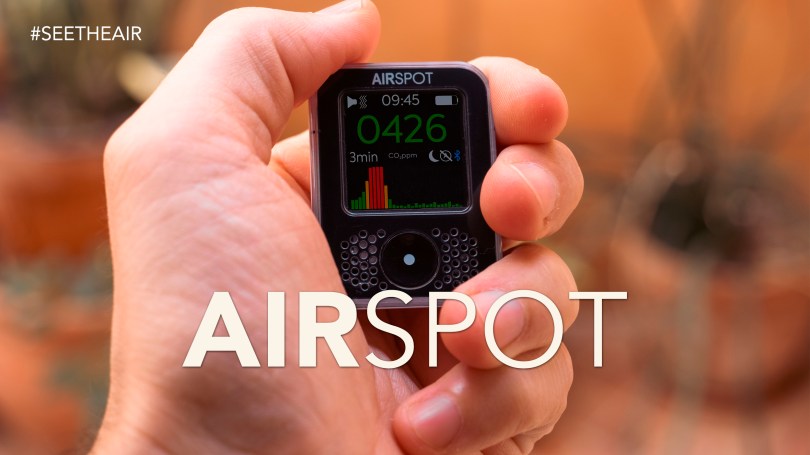
The world of air quality monitoring has long been dominated by bulky, desk-bound units. The AirSpot, a revolutionary small CO2 monitor, shatters that paradigm. Given to me by the CEO of The Safer Air Project, this device is not just a monitor—it’s a truly wearable environmental sensor that brings crucial air quality data right to your wrist or backpack.
Design, Portability, and Hardware
The AirSpot’s most immediate selling point is its diminutive size and featherlight weight. Measuring a mere 3.6cm x 4.8cm x 1.15cm and weighing only 17g (0.6 ounces), it is, to my recollection, the smallest CO2 monitor currently available. This size isn’t just a gimmick; it’s the foundation of its usability.
The device’s true genius lies in its ecosystem of accessories. AirSpot is unique in offering a wide range of mounting options, including a wristband that makes it genuinely wearable. I personally prefer the carabiner-style key ring case, which allowed me to easily clip it onto my backpack or belt—perfect for on-the-go monitoring.
In previous articles, I advocated for a “Tamagotchi-like” approach to air quality awareness, a gamified solution designed to capture the public’s attention. At the time, the goal was simple: engagement. If we could make checking air quality as addictive as feeding a digital pet, we could encourage better habits.
But the world of 2026 is different. Attention is no longer enough; we need connection. While gamification served its purpose, it is time to evolve. We must transition from simple reward systems to AI systems embedded with empathy-based sensor technology.
We need devices that don’t just beep when the air is bad, but devices that feel the environment with us.
The recently updated Energy Performance of Buildings Directive (EPBD) is a pivotal legislative framework aimed at improving the energy efficiency of buildings across the European Union. While its primary focus remains on energy savings and decarbonization, the revised EPBD now formally recognizes the crucial link between energy performance and Indoor Environmental Quality (IEQ). This update requires member states to address IEQ in their national legislation, ensuring that energy-efficient buildings also support the health, comfort, and well-being of their occupants.
A Framework for IEQ, Not a Rigid Standard
A significant aspect of the updated EPBD is its approach to IEQ. Rather than imposing a single, rigid set of Europe-wide limit values for all IEQ parameters, the directive establishes a flexible framework. This approach acknowledges the vast diversity in climate zones, building types, and occupant needs across the EU. The consensus is that a one-size-fits-all model would be counterproductive, potentially leading to suboptimal outcomes and hindering innovation.
The new EPBD defines IEQ as a comprehensive concept that includes several key domains:
Indoor Air Quality (IAQ): Addressing contaminants and ventilation.
Thermal Comfort: Pertaining to temperature and humidity.
Lighting: Considering both natural and artificial light.
Acoustics: Controlling internal and external noise.