Air pollution, a significant environmental health issue, affects everyone. However, there is growing research evidence showing that the health effects of air pollution may not be the same for men and women. This difference is driven by biological, socio-economic, and occupational factors that can influence exposure levels and health outcomes.
Biological Differences
In terms of biological differences, women have a higher percentage of body lipids than men, which can accumulate fat-soluble pollutants. This can lead to a higher concentration of certain pollutants in women, potentially increasing their risk of health effects. For example, a study published in the journal ‘Environmental Research’ in 2018 showed that women exposed to polycyclic aromatic hydrocarbons (PAHs), a group of chemicals released from burning coal, oil, gasoline, and tobacco, had higher levels of DNA damage than men exposed to the same levels of PAHs.
Our outdoor and indoor air is filled with particulate matter (PM) that consists of tiny solid and liquid particles that are often invisible to the naked eye.
But just because we can’t always see these particles, doesn’t mean they aren’t there and negatively affecting our health. In fact, the tinier the particle, the deeper into our bodies it can go!
The good news is there are steps you can take to improve your indoor air quality.
Be sure to check out this interview to learn more about how everything from your gas stove to your humidifier can be contributing to poor indoor air quality and how you can take steps today to improve the air inside your home!
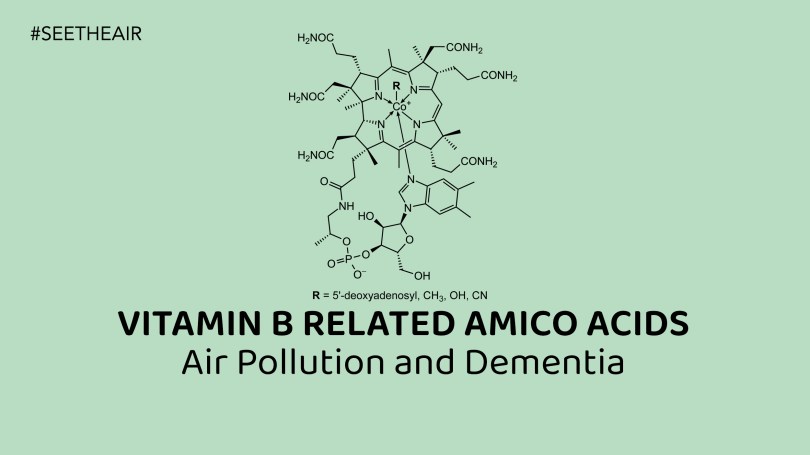
A recent study has unveiled a potential link between exposure to air pollution, the risk of developing dementia, and the levels of certain nutrients in the blood. The research, published in the journal Neurology, suggests that individuals with blood certain concentrations of vitamin B related amino acids (Homocysteine and Methionine) may be more susceptible to dementia after exposure to air pollution.
The study, led by a team of researchers, analyzed data from over 2,500 adults participants aged 60 and above. The participants’ blood samples were examined for levels of certain amino acids, while their exposure to air pollution was assessed using their residential history and air quality data.
Most of us have heard of Bryan Johnson, the Silicon Valley tech mogul who sold his startup for a reported $800 million. But what you may not know is that Johnson is taking an unconventional approach to extending his life span. Excellent indoor air quality is one of the regimes that he is paying very close attention to.
The process, which will cost Johnson a reported $2 million a year, is expected to include a variety of lifestyle changes and medical treatments. Of course, Johnson will likely focus on the basics – healthy eating and exercise. But he’ll also be looking at cutting-edge treatments, such as stem cell therapy and gene therapy, to give his body the best chance of staying healthy.
Moreover, it’s not just about the treatments – Johnson also plans to invest heavily in improving his home environment (IAQ). He wants to make sure his home is free from pollutants and that the air he breathes is of the highest quality. He’s already installed a HEPA air filter and plans to invest in monitoring devices that will allow him to track his health and make informed decisions about the treatments and lifestyle changes he’s making. This will give him an unprecedented level of control over his body and allow him to make the most out of his investment.
The animated image below was created by Mark Parrington and was originally publish on his Twitter account on June 6th, 2023.
I believe it is an eye opening animation as it reveals how easy air pollution travels across states and countries. We call this pollution Cross-Border Air Pollution.
It was brought to my attention by Dr. Howook Chang that most media are talking about wildfires, what the color of the sunset looks like, and that people shouldn’t go outside. However, no one is talking about the fact that smoke can infiltrate houses quite easily. Wildfire smoke can join you during dinner or while you are sleeping.
Air quality matters more indoors where we spend most of our time. So here is a series of things to keep in mind in order to breathe healthy air.
Monitor Air Quality
First of all, measure the air quality indoors and outdoors. The reason we need to measure both environments is that we need to benchmark the conditions and take decisions based on the data we have collected. Pollutants can easily come inside the house during ambient pollution events, whether is a wildfire, traffic, or a dust storm (e.g. Sahara Dust). Windows, doors, HVAC systems, or simply not good insulation are some of the main entrances of pollution indoors.
I wanted some time to pass before I write my thoughts on Dyson’s new product called “Zone”.
For those who don’t know who Dyson is, Dyson is a company known for its innovative and unique products (mainly vacuum cleaners) and it has recently released a new product that combines two seemingly unrelated items: headphones and air purifiers. The Dyson Zone headphones are a pair of noise-canceling Bluetooth headphones with air purification technology built in. I don’t want to focus on the headphone but on the purification capabilities for individuals.
Points
1st Point: We live in a society where individualism becomes stronger and stronger over time and instead of fixing the air pollution for all we are thinking about how to protect only ourselves, not even our kids or family. The device is not capable of stopping pollutants from getting into the wearer’s body and a n95 mask is more effective because it seals better.
Air pollution is an environmental problem that affects everyone in the world, regardless of their socio-economic status. Rich or poor, we all share the same air, and when it is polluted, it affects us all. Whether it is the air of a city or a rural area, air pollution is a problem that cannot be ignored.
Air pollution occurs when harmful pollutants are released into the atmosphere. These pollutants can come from a variety of sources, including factories, cars, wood stoves, and even forest fires. Air pollutants can be in the form of gases, such as nitrogen dioxide and sulfur dioxide, or particles, such as soot, black carbon, and dust.
Let’s forget at the moment that combustion vehicles emit carbon dioxide (CO2), and focus on the occupants that spend time inside a confined space where they emit CO2 due to metabolite of cell respiration. Vehicles form part of the indoor spaces where humans spend a lot of time due to traffic or because they have to travel long distances.
Regulatory bodies have been controlling many aspects of modern vehicles; tires, mirrors, seat belts, airbags, screens, etc. However, they have forgotten to look into the air quality inside the vehicles and how it affects the driver’s cognitive performance.
I had the chance to visit New Delhi and Agra in India due to an annual conference that we had to assist. I was well informed about the poor air quality in the area, so I was prepared to breathe some pollution. I have read many articles and heard many testimonials about the situation there but still, a visit in situ helps someone understand the issue on a whole new level.
Some weeks ago, I published an article on “Why is Air Pollution Invisible” and I think during my visit to India I experienced all of the points clearly.
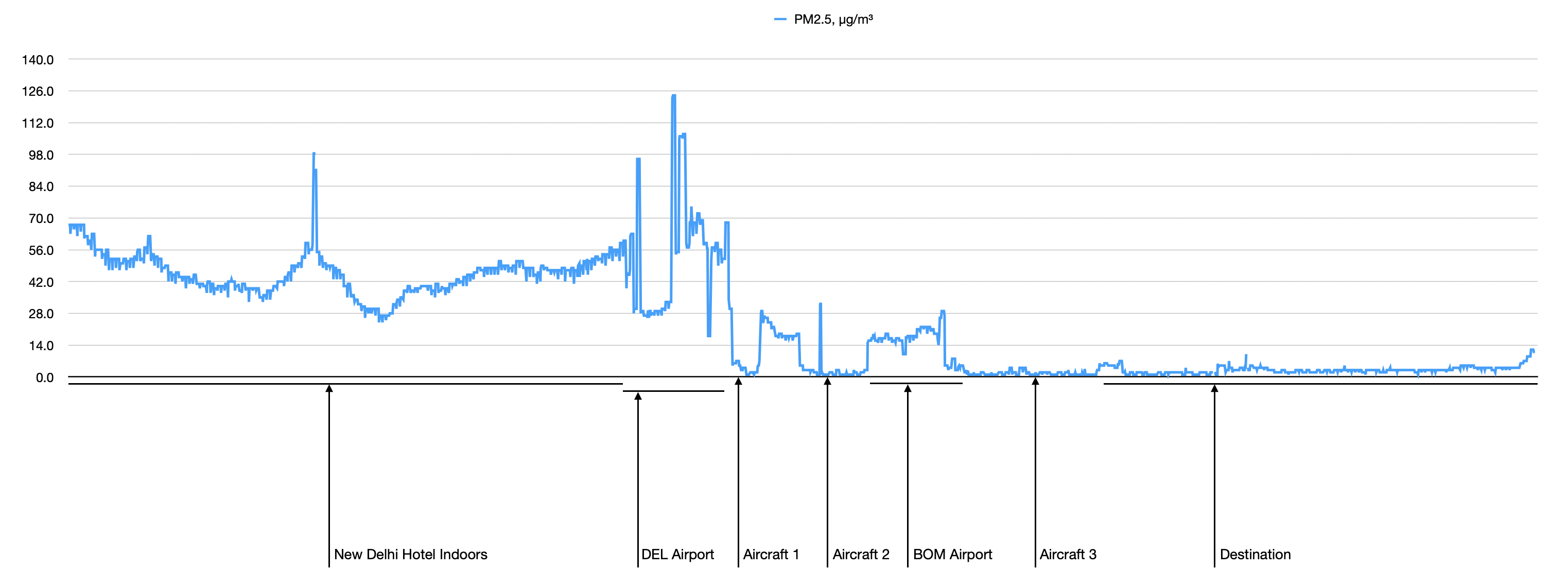
Immediately, once you come out of the aircraft, you can smell the air pollution. It is everywhere, indoors and outdoors. Even waiting in the immigration line for clearance you can smell it. I didn’t have the instrument in hand at that point in order to measure the concentrations, but from my experience and because air pollution was visible due to high levels, I estimate concentrations of 100μg/m3 of PM2.5. I want to make clear that I was still indoors.
From there, I headed to the hotel in a taxi. As you may imagine, the air quality was not better, but quite the opposite as the fumes from the relentless amount of unregulated vehicles were spewing everything they had in their engines. Particles of all sizes and gas fumes. Interestingly, more than 90% of the vehicle in the streets were occupied by only one person, the driver. On top of the air pollution in the streets, you can add noise pollution as the use of car horns is a tradition in India.
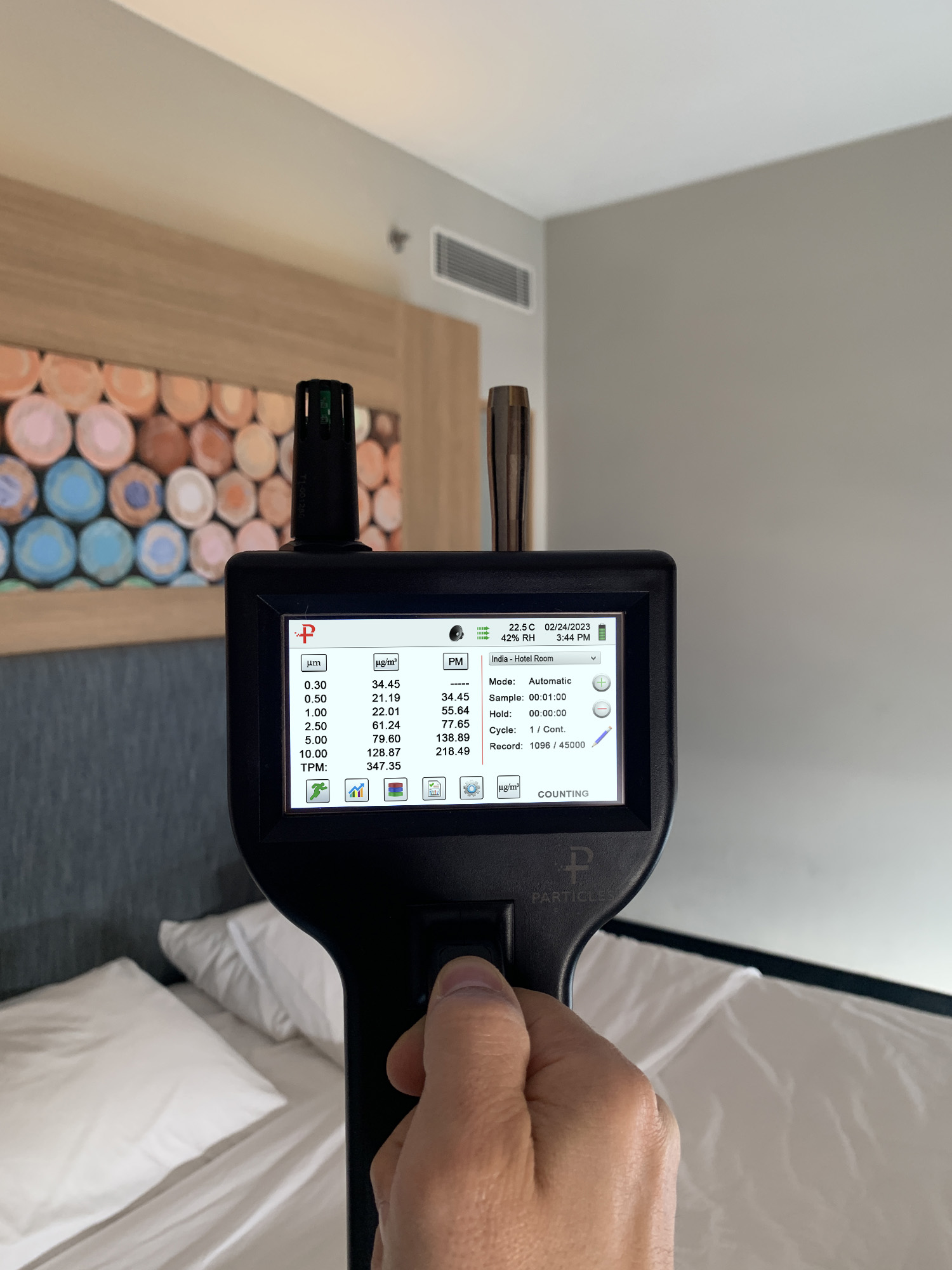
I managed to arrive at the hotel after a small accident with the car (no damages) where I took the air quality monitor out of my luggage in order to measure the conditions in the room. Unfortunately, it wasn’t safe either. The mean PM2.5 concentration during my stay was around 50μg/m3.
The hotel had some small air purifiers in the hallway, but the coverage area was too big for them to handle properly. I looked at the filters and they were pure black, who knows for how long they were running without replacement.
On day two, my nose didn’t register the smell of smoke anymore. I was one of them! Unable to smell the pollution and consequently remind myself that I need to find clean air. This is what happens to locals that don’t have options, eventually, they forget.
For simplicity, here you can see my PM2.5 exposure for the last date of my trip before coming back home. However, the particle counts for the smaller particles like 0.3μm and 0.5μm, which get lost with mass concentration values, were even higher reaching counts of around 400,000,000 particles per m3 and 40,000,000 particles per m3, respectively. By the way, according to the locals, I visited New Delhi during a good AQ time.
Enough with the AQ data, we know it is really bad, my main question was where all this air pollution comes from. Most people will tell me that it is due to vehicle emissions and domestic burning. Still, it doesn’t make sense though because the weather was warm and there was no need to burn logs for heating. Additionally, the issue was persisting all day and night. So after a conversation with a local professor, he pointed out that the main source was waste management. Basically, they burn garbage and these eternal fires create the smog that persists in the city and makes people really sick.
I talked about the car horns, but you will also hear many people cough. It’s normal as their lungs are suffering from chronic exposure to toxic air pollutants.
There is some good news, though. Once the local people realize the source of pollution as I did, they can fix it. New Delhi is populated by 15,000,000 people and I understand that the amount of waste they generate is equivalent to that number, but the management of the waste can’t be “burn it, it will disappear” because it doesn’t. Finally, vehicles need some kind of control and annual revisions that will force the drivers to maintain the car in optimal conditions like EURO 6 compliance does in Europe.







 See The Air