The Essential Guide For Optimal Air Quality In Your Life
After a long time of researching and writing all the essential information about air pollution and how you can improve the air quality for you and your community, the book is ready. I am very thrilled to share this book with you all and I will be even happier if you share it with your friends and family as well. I tried to keep it as simple as possible without unnecessary information. You can see the table of contents below and take a small idea of what is inside this book.Read More »
It was impossible not writing a review about AirVisual Node as it has some unique features that I constantly complaint about the other AQI Monitors. In the past I have written an article about the app AirVisual which doesn’t require the Node device to function and it shows you the outdoor air quality in your area. As a result it’s time to analyze the Node device.
At first, before even consider purchasing it I thought that its size will be big but I was wrong, its size is just fine. It seems bigger on pictures than in real life thanks to the clever futuristic design.
Features:
5-inch Colour LED display
CO2 Sensor 400 to 10,000 ppm
PM2.5 Sensor 0.3 to 2.5µm
Temperature -10 to +40°C or 14 to +104°F
Humidity 0 ~ 100%
WiFi 802.11 b/g/n 2.4GHz
Rechargeable Li-Ion battery
Micro USB power input
• What I love the most about this device is the ability to function without internet connection (off-the-grid). This ability gives an enormous advantage to the user. It incorporates 3GB of internal memory and a battery of 1,850mAh that can hold up to 5 hours. Hypothetical situations: You live in an inaccessible place without internet or electricity or you just want to turn off all the WiFi connections at home during night and continue measuring the air quality, with AirVisual Node this is possible because the device doesn’t depend on any external server to do its job, it even has a SMB server inside which allows you to access the data from any MacOS or Windows or Linux machine.
• The huge 5-inch wide 800 x 480 display is an other great advantage for the productive users because it gives you independency from your phone in case you want to check the air quality instantly while you are working or studying at home/work. The brightness is adjustable with 5 levels but I wish I could turn the brightness down even more. You can turn off the display but you can also set a schedule when the display should be on or off based on your needs.
4 different screens that change automatically or manually
• The device can be used as an indoor monitor or as an outdoor monitor and if you give it permission, it will share the measurements on a collaboration world air pollution map. The Micro-USB allows the usage of an external power pack or solar panel in case you want the device to operate for a long time outside.
• There are 4 buttons on the top of the device that very easily guide you inside the menu so you can adjust the device on your needs. There are 3 ways to changes the setting of the device, obviously from the device itself, then from the phone app and finally from the website on http://airvisual.com .
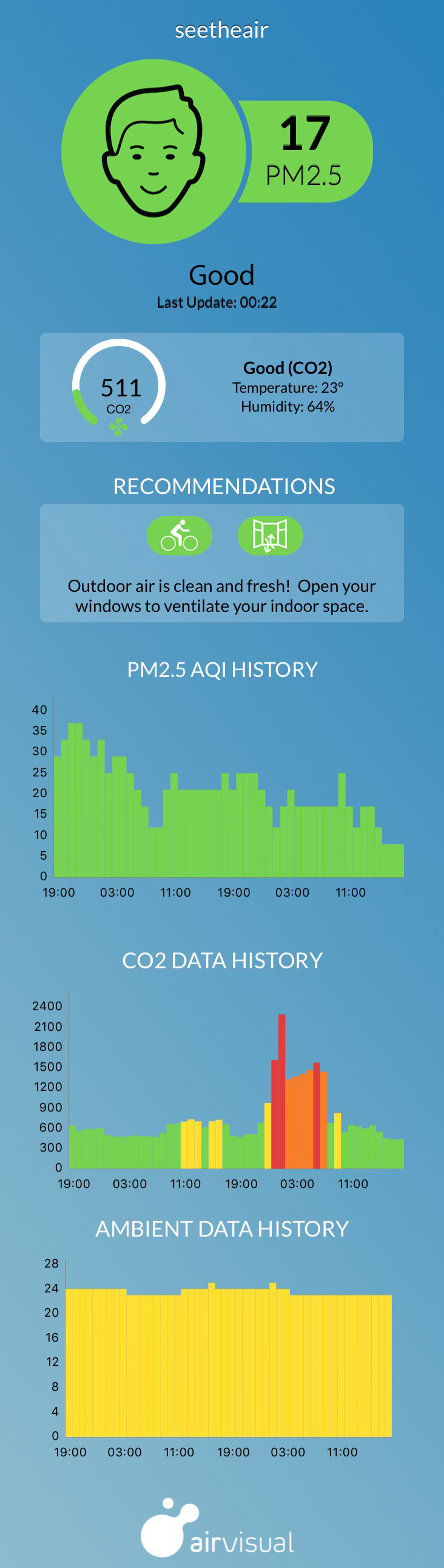
• The measurements are displayed very clearly on the app′s layout as well on the device′s display. You can choose to see the history between hours or days or months. If you click one of the graphic bars, then you see the exact value and time of the measurement. Recommendations on the display and on the app will guide less experienced users.
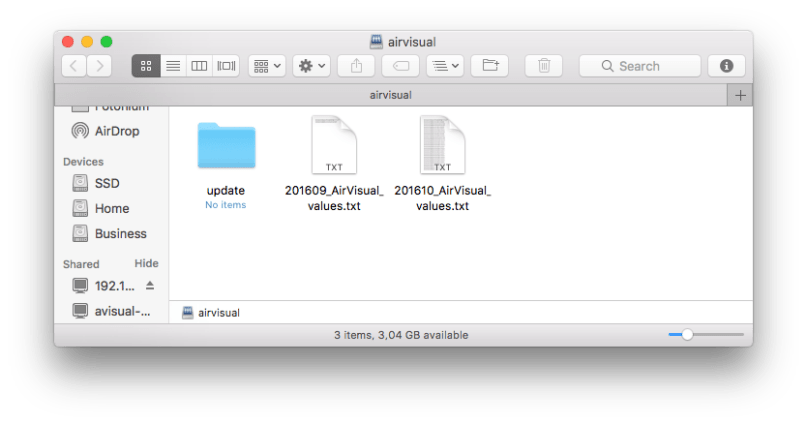
• It turns out that the device can also measure PM10 and on the log file it registers everything. Exact time and date of Indoor and Outdoor (if your area is supported) AQI(US), AQI(China), PM2.5, PM10, Temp/Humidity and CO2.
Sensors:
• They use the SenseAir S8 Sensor for the CO2 measurements. This is a miniature, non-dispersive infrared (NDIR) and individually calibratedABC sensor with an accuracy of ±0.02% volume CO2 ±3% of reading. It has a life expectancy of 15 years. High quality and expensive sensor made in Sweden.
• The PM2.5 sensor is AirVisual own co-developed sensor called AVPM25b.It can detect particles from 0.3μm to 2.5μm. The accuracy range is ±8% of reading. It uses a small fan to draw air inside the laser and throughlight scattering phenomenon the sensor can calculate the quantity concentration of particles. The light refraction is analyzed by the photo-sensor algorithm to output PM2.5 and PM10 values.It has a life expectancy of a minimum of 3 years. AirVisual uses a combination of dust reduction and power saving techniques to preserve the life of the sensor. (The company has put a lot of effort and money into this sensor).
• Unfortunately the Temperature and Humidity sensors are unknown to me for the moment.
Conclusion:
All in all it is a well thought out product with many advantages and some high quality materials which are going to last for a long time. Friendly user interface and with some advance features for the power users.
P.S. Stay tuned because I will write a second article about AirVisual Node with measurements and impressions while I am using it at home, car and gym.
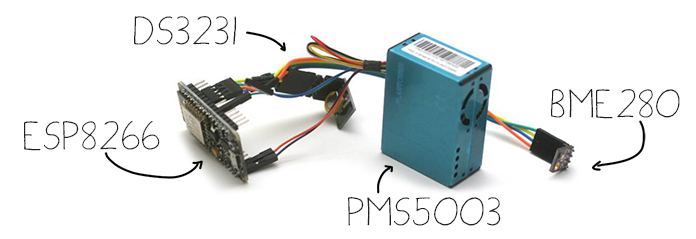
Low cost and quite precise DIY Particulate Matter Monitor. This DIY device will allow to measure PMs, Temperature, Humidity and Barometric Pressure for less than US $30.
I am not going to describe the whole process of building the device because it is well explained by the author at ourairquality.org. You can find a ton of information about the sensors and the electronics on his article.
It uses the PlantowerPMS5003 which is a low cost laser particle counter ∼US $18.5
ESP8266 Nodemcu is a WiFi enabled computer board∼US $3.2
BME280 is a Temperature, Humidity and Barometric Pressure Sensor ∼US $4.9
DS3231 is a Precision RTC Clock Module Memory ∼US $2
I have had the opportunity to have two Awair devices for a short period of time because the old device had a defective PM sensor (that can happen with all electronic devices), so the company was kind enough to sent me a replacement unit, as a result I took this opportunity to compare the sensors between them except the PM sensor as the old one was defective before sent the old unit back to the company.
I took screenshots of the timelines of each sensor and placed them one on top of the other. This way it is very clear and easy to understand the correlation between the old unit and the new one.
Temperature sensors: High correlation.
Humidity sensors: High correlation.
CO2 sensors: High correlation but offset by ∼70ppm.
VOC sensors: Good correlation (VOCs are measured in ppb (parts per billion) and then converted into index value which means that even a small change in the ppd value can affect the index result).
All in all both devices give the same readings, remember that I didn’t make the test inside a lab but in my house and this was a practical test.
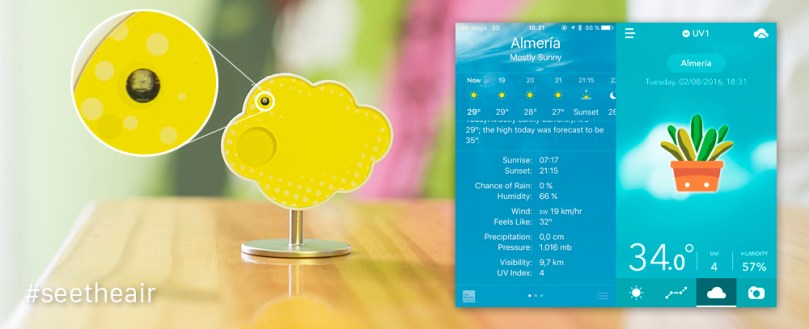
I have purchased a little environment tracker which tracks Humidity, UV light and Temperature. I wanted to write a review about it because I find it really cute cloud-shaped device which I can place it in any place I want and measure HUT and I think it worths its money ($25-$55) in my opinion.
Build
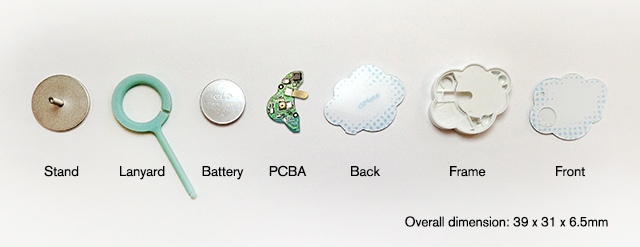
The device’s case is made of plastic and on the box it mentions that it is drip, slash and sweat resistant IPX4. However I wouldn’t mind paying more for an anodised aluminium case.
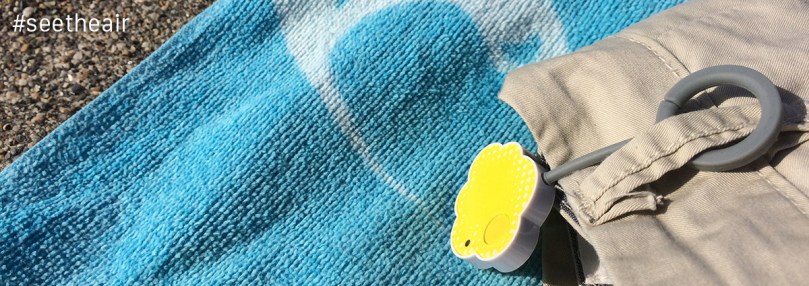
It comes with a Stand in case you want to place it on top of you night stand, table, bookcase, etc and with a Lanyard in case you want to carry it with you. It also has a nice physical feature which is a magnetic back, not enough strong to hold itself but if you own a small neodymium magnet you can combine them and use it on your fridge or placing it on your clothes like a wearable…
Design
As I mention before I find its cloud-shaped form really cute but it doesn’t make it really attractive to the general public or formal enough to wear it with you everywhere.
Energy
It works with a coin-sized Lithium battery CR2032 and it claims that can operate up to 6 months on normal usage. Although I would love if it had a small Solar panel on the front next to the UV sensor, infinity energy.
Sensors
Temperature: The temperature sensor is quite accurate but don’t expect high precision±2ºC. I have compared it with 3 more devices and they mostly coincide.
RH Humidity: It’s less accurate than the temperature sensor by ±5% based on my experiment, but it is Relative Humidity as its name says it is relative!
UV: A bit disappointed about it to be honest and I will explain why. I think the way they have place it on the device isn’t the optimal way to read always the correct UVI value from sun. You see sun’s rays hit the earth on an angle and the device must be on 90º angle with those rays if you want the device to tell you the highest value (highest=right value). One more thing that I don’t like is the frontal face because it can cast a shadow on the sensor and as a result no UVI reading.
UVI 4 by holding the device on the right angle outside.
App UI
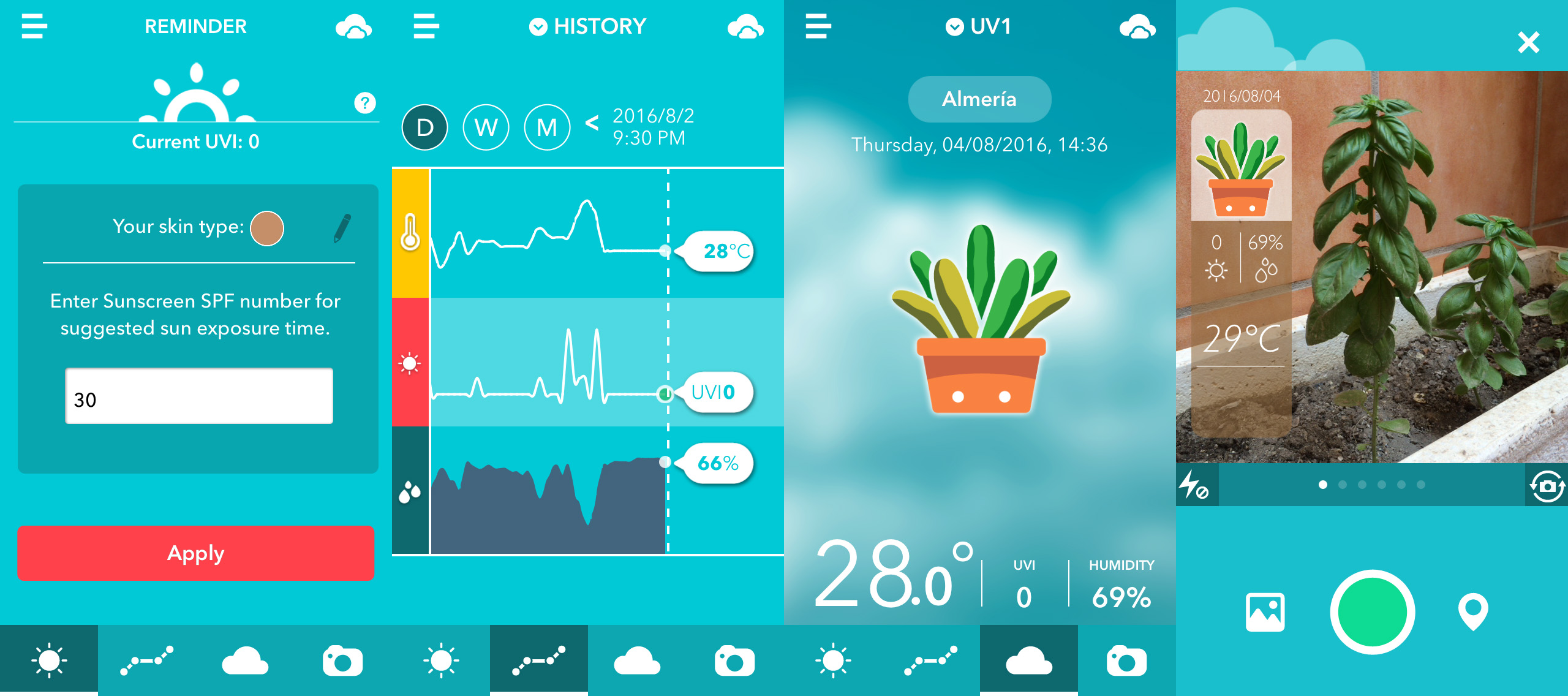
The iOS app that I have been using is super nice, but with some small bugs in the history tab. The app is divided into 4 Tabs. The first calculates the time you should be exposed on UV rays to avoid sun burns, the second is the History tab with Day-Week-Month overview of the HUT, the third tab is the main tab with all the current stats plus a little plant that tells you if it’s confortable or not and the last one is a social tab with a camera integration.
Connectivity
It uses Bluetooth 4.0 technology and it works with iOS 6 or newer devices and any Android 4.3 or newer.
P.S The device is under the brands Adam Elements CliMate and Rooti CliMate.
I know that I have promised you all that I will conduct some experiments but so far I haven’t received my devices. (Sad face!)
Both of them are delayed, even big companies like Apple sometimes have issues during productions so for example Awair told me that the devices are in final process of manufacturing and they will begin shipping in a month. TZOA from the other hand is a lot closer to their initial timeline to deliver their device.
Awair monitors indoor air, gives solutions when air quality turns unhealthy and communicates with other smart home devices so you can stay healthy.
Apart from the beautiful design, Awair’s sensors monitor the six most important factors of indoor air quality & well-being.
Temperature: -40 to +125°C / -40 to +257°F
Humidity: 0 to 95%
CO2: 0 to 4000 ppm
VOCs: Air Hydrogen, Hydrogen Sulfide, Ammonia, Ethanol, Toluene to name a few, ranging b/w 0.1~30 ppm
Dust: Particles PM2.5 from 0 to 500 μg/m3. (On their site they mention, dusts and particles under 2.5mmg)
Ambient light
Awair is one of the tools I will use to monitor my indoor air quality (TZOA is the other one). It has awesome design and I love the walnut timber, high quality of course and is painted without harmful VOCs. It will constantly show me the AQI inside my bedroom which is the most important room in my home. During day we are more aware about air quality but during night we aren’t, so I will be able to see if my bedroom offers me more than a bed and a regular night sleep. During sleep our bodies rebuild and our minds refresh, so do we offer them the best conditions?
During day and night time I will conduct experiments with it. Measuring CO2 with and without plants, VOCs with different cleaning products plus furnitures and dust particles from mattresses and bed clothing. All of these experiments will be published here on #SeetheAir.
Temperature and humidity sensors are very import inside a room for many reasons as well. First by knowing the temperature inside a room you can have optimum sleep during night time, in general is recommended slightly cool temp 65ºF/18.5ºC. Second low humidity may cause respiratory problems, itchy eyes and skin. On the other hand, high humidity will result in molds that serve as breeding ground for bacteria. Also dust mites love high humidity. The optimum humidity level is 35-45%.
I live on the coast and humidity levels are so high here so I had to invest on a dehumidifier but I did a smart purchase because I bought an A/C with dehumidifier, this way I control temperature and humidity. Awair is capable of communicating with smart home appliances and turn them on/off via IFTTT. In case your home appliances aren’t smart enough you can boost them with TADO The Smart A/C Control.
Finally the app is elegant and simple for the everyday use but with valuable infos.












 See The Air