Creativity against Air Pollution

Throughout time researchers have been trying to monitor air pollution and create urban pollution maps as precise as possible. This isn’t an easy task for a couple of reasons. Firstly, a lot of sensors are needed to be spread all around the city and then the researchers have to decide if the sensors will be stationary or will be mobile. Some clever and interesting projects to combat the air pollution with mobile Air Quality Monitors (AQMs) are.

The Pigeon Air Patrol

pigeon air patrol

A creative way for mobile Air Quality Monitors to be spread around the city. The pigeons wear a small device with O3, VOC and NO2 sensors. While they are flying around the city or sitting on a traffic light to rest, the sensors are constantly logging air quality data. The data will be later analysed by the researchers when the pigeons return to the base. This air monitoring campaign run for 3 days only and the pigeons are now back to their normal life.

More info at: http://www.pigeonairpatrol.com


The Taxi Air Quality Monitors

taxi air monitoring

This innovate idea for monitoring urban air quality was made by James Puderer. The idea is to place Air Quality Monitors on top and inside the Taxis/Cabs sign and allow them to do their normal and daily trips around the city while they are logging air quality data. Basically it is an Android Things based data logger with a host of environmental sensors, GPS, and battery. In this project he uses temperature, humidity, pressure, and air-borne particulate PM10 – PM2.5 sensors.

More info at: https://www.hackster.io/james-puderer/distributed-air-quality-monitoring-using-taxis-69647e

5th Graders Monitor Their Air Quality

kids school pollution.jpg

We all know how busy school roads can be, especially during peak hours when parents leave and pick up their kids from schools. Definitely the air quality is very bad during that time. Some universities, colleges and organizations have decided to track the air pollution from a different perspective by giving special backpack to some of the students, backpacks with a GPS and air quality sensors. Students are responsable to carry the backpack AQM with them and monitor the air quality. Later the experts will analyze the data that the students had logged on their backpack AQM.

https://www2.le.ac.uk/colleges/scieng/research/airquality/monitoring

http://www3.imperial.ac.uk/newsandeventspggrp/imperialcollege/newssummary/news_1-2-2012-11-4-5

https://kithub.cc/2017/03/train-kids-monitor-air-quality/

http://www.ucdenver.edu/academics/colleges/PublicHealth/About/news/ResearchNews/Pages/Fort-Collins-kids-test-air-pollution-for-CSU-researchers.aspx

uHoo vs AirVisual vs Awair

On this article I am going to compare three AQI monitors: AirVisual, uHoo and Awair.

All the monitors were placed together in the guest room in my house, as you can see on the picture above. I chose that room because I wanted to be able to isolate the devices from the rest of the house and from human interaction especially for the first 21 measurements. No one was allowed in that room during those measurements. After those 21 random measurements which were taken during 4 days period of time I opened the door and I created some “air pollution”. The whole experiment lasted 10 days. Below you can see the graphs with all the sensors and monitors.

Read More »

The Air in New York

In my recent visit in New York and in other USA cities I decided to take with me a portable carbon monoxide device and measure the air quality across the cities during my trip.

The CO Sensor was placed on a net pocket that I had sewed on my backpack. I am quite the craftsman! The experiment had to be done correctly to ensure that the air flowed easily and the measurements were taken correctly and constantly.Read More »

CO2 Candles Experiment

CO2 Candles Experiment

In this experiment I will demonstrate how fast Carbon Dioxide CO2 rises inside a room by lighting two small candles.

bedroomday1_0000 copy

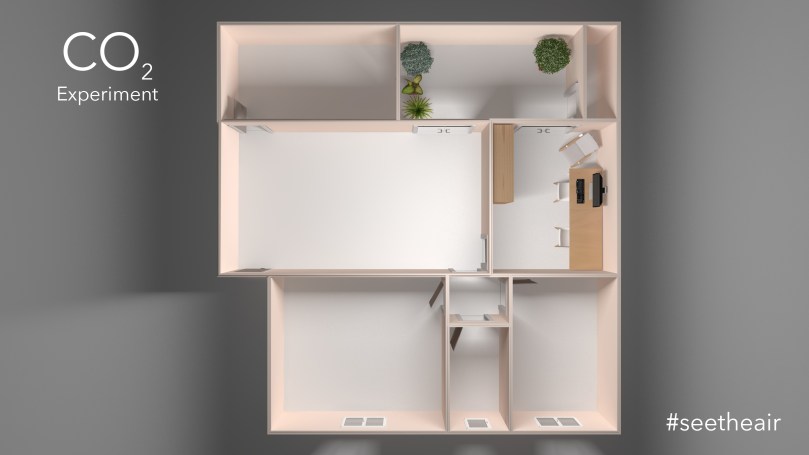
I chose my study room as it can be easily isolated, plus I have got all the AQI monitors inside this room for the purpose of the experiment. The room is 7.3m². The experiment is easy, I lit 2 candles and closed the door and window of the room. Then I waiting with myself inside the room till the CO2 reached 1200ppm. Basically I logged the time when the CO2 was 430ppm and when it reached the 1200ppm with and without the candles.

With the candles the CO2 needed 35 minutes to reach the 1200ppm limit as you can see on the graph below and without any candle and with exactly the same conditions as before the CO2 needed 59 minutes to reach the upper limit.

Conclusion

You gain 25 minutes of more oxygen and less CO2 until the room reaches the 1200ppm limit which means more productive time and fewer headaches.

Gray Slate

Do Zeolite Rocks absorb VOCs?

_1010725

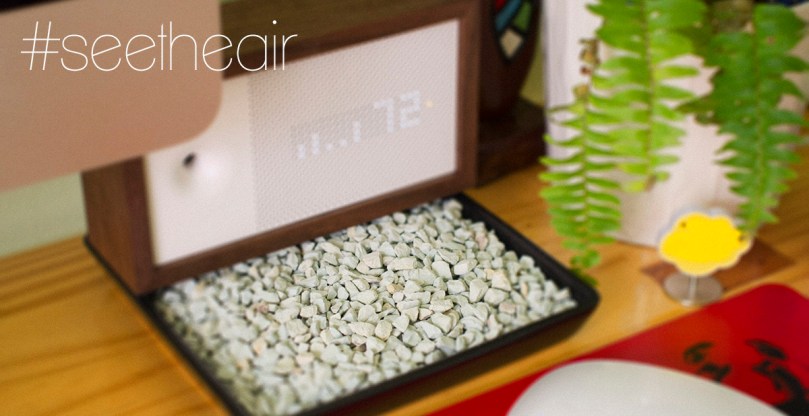
I was doing a research for ways to remove VOCs from the atmosphere without using electronic devices like air purifiers but through passive material. As a result I found about Zeolite Rocks which are claimed that can absorb formaldehyde, ammonia and other VOCs from the air or water passively.

As you may expect I purchased 500gr of small Zeolite Rocks to conduct an experiment. I want to mention here that is hard to find these rocks because they aren’t commercialized, it’s easier to find them as filters for aquarium because in general are used to remove ammonia from the water.

They also claim that the rocks are “rechargeable” by heating them in the oven in 200°C/400°F for 30min they can be used again and again.

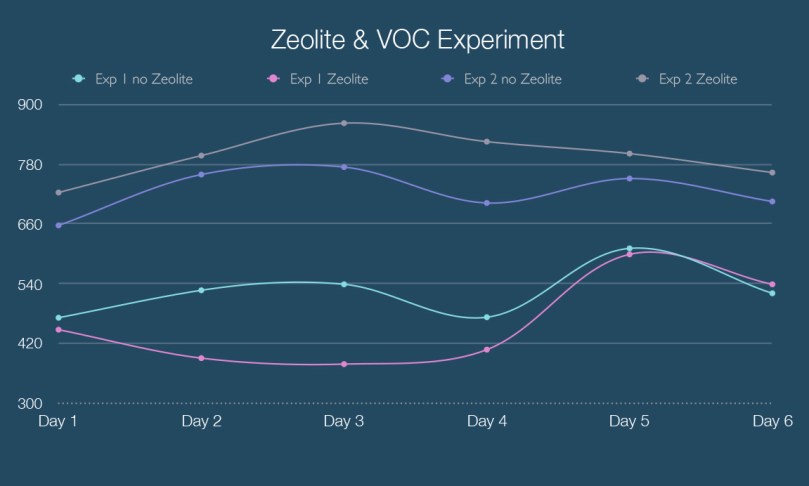
I took daily measurements for 6 days without having the rocks anywhere near the sensor and the average result for the VOCs was 524ppb. After a week I placed under the AQI monitor 400gr of Zeolite Rocks and again I logged the measurements for a week. The average result for a week of VOCs with the rocks is 461ppd. A difference of 63ppb less VOCs.

After that I repeated the experiment, 6 days without rocks and 6 days with rocks but this time I isolated the room and I kept it without ventilation. The values were higher in this case and the rocks seemed like they couldn’t absorb VOCs any more.

In conclusion the rocks may absorb gases but you need a great quantity of rocks to achieve a good result, for example 100ppd less VOCs something which make it hard. Remember by opening the windows for a few minutes you can refresh the air quality immediately in case the outdoor air is in better conditions than the indoor.

Zeolite chart

Awair vs Awair

_1010399-Edit-2

I have had the opportunity to have two Awair devices for a short period of time because the old device had a defective PM sensor (that can happen with all electronic devices), so the company was kind enough to sent me a replacement unit, as a result I took this opportunity to compare the sensors between them except the PM sensor as the old one was defective before sent the old unit back to the company.

I took screenshots of the timelines of each sensor and placed them one on top of the other. This way it is very clear and easy to understand the correlation between the old unit and the new one.

sensorcomp.jpg

  • Temperature sensors: High correlation.
  • Humidity sensors: High correlation.
  • CO2 sensors: High correlation but offset by ∼70ppm.
  • VOC sensors: Good correlation (VOCs are measured in ppb (parts per billion) and then converted into index value which means that even a small change in the ppd value can affect the index result).

All in all both devices give the same readings, remember that I didn’t make the test inside a lab but in my house and this was a practical test.


Month of CO2 experiment Results

The indoor CO2 experiment has ended and the results are quite interesting. Let’s recall what was the experiment about for those that don’t remember. During February I took CO2 measurements for 24 nights (12 nights without plants and 12 nights with plants) by recording the highest CO2 values during night time.

The main questions were:

  1. Is the atmosphere inside the house getting worse during night?
  2. Can specific plants help the air quality during night?

Answers:

  1. Yes, The atmosphere is getting x3 times worse, at least the CO2 levels are increasing x3 times each night. It’s winter and the house stays closed during all that time, so CO2 builds up during night.
  2. Yes, there are some plants such as the Snake Plant that can help us. In my experiment I used 2 Snake plants one small and one medium size. The CO2 didn’t decrease dramatically, but there was a significant difference.

There was a difference of ∼170ppm less CO2 when I placed the plants near the CO2 Sensor. In the measurements that I took, I decided to add some notes because during windy nights I noticed that CO2 levels were lower than during normal nights, I guess because of the air pressure and the lack of isolation in some windows.

Conclusion:

The right plants are helpful and if you think that we are growing up and we are developing during our night sleep then it worths the effort to re-evaluate the air quality during night.

CO2 levels experiment