What’s new? Well, lots of new Outdoor Air Quality Monitors have been released into the market for various purposes and different budgets. Air quality monitors for professional use in cities and industrial sites and homeowners who want to supervise the ambient air quality outside their houses/apartments.
This time, I have included the General Star Score from the AIRLAB Challenge 2021 for the monitors that took part. The Ethera NEMo Outdoor monitor scored the highest with 4.5 Stars out of 5.
uRADMonitor with the Smoggie and City models scored 4/5 and 3.5/5, respectably. Also the Kunak Air Pro which I will review soon scored 4/5. It is great to see that all these solutions deliver accurate results.
Subscribe to get access to the link of the document
If you would like to download the document please consider donating or subscribing to my blog in order for me to continue creating helpful content for all.
In 2021, IKEA made available an indoor air quality monitor, which is very very affordable. I bought one because I was curious to answer some basic questions like how did they manage to build and sell a particulate matter sensor that costs only 14€ or US$12 but also how smart and reliable is it in relation to other monitors.
IKEA is obsessed with naming all their products with Swedish words, so the AQ monitor VINDRIKTNING (which I can’t pronounce) translates as Wind Direction. Obviously, they don’t aim to create names memorable to people’s minds.
Let me share a story with you. Long before covid19 (2018 if I remember well) I and a company I worked for, decided to pitch IKEA into building an AQ monitor as I saw their interest in air quality because they designed some photocatalyst curtains that neutralized VOCs back then. Unfortunately, they turned us down, but I think we planted a seed into them. Long story short in 2021 they released the VINDRIKTNING.
Long story short gamification works and should be adopted by IoT Air Quality Monitor and their Air Quality apps in order to achieve a behavior change.
What is gamification?
Gamification is adding game mechanics into non-game environments, like a website, a fitness app, or air quality apps to increase participation. The goal of gamification is to engage with users to inspire, collaborate, share, and interact.
Let’s take as an example Apple’s fitness app, those who wear an Apple Watch they know what I am talking about. Each month the application engages users by offering them a digital award, as a result, last month I had to burn actively 19.300 calories in order to win a shine yellow badge. On special days the app encourages you to complete a specific workout to win a special award like for the World Environment Day or Earth’s Day.
Back in April, I and uRADMonitor shipped 5 Smoggie-PM to 5 volunteers in order to help them raise awareness but also to investigate what people breathe in other parts of the world, like in Belgium, Uganda, Azerbaijan, the USA, and Spain. Unfortunately, the US volunteer doesn’t respond to my emails and he hasn’t set the monitor up yet. I hope he is fine and covid-19 or any other possible problem hasn’t affected him.
In this article, I will analyze the data from two of the locations in order to determine the Air Quality (AQ) and get some conclusions that will help my volunteers. Here are some of the photos the volunteers have sent me.
It is always recommended to place the AQ monitors under the shade as sunlight can increase the internal temperature and consequentially the measurements of temperature and humidity will be incorrect.
Someone may ask what more they can offer to an already saturated market of air quality monitors. The answer is simple: Experience! TSI Incorporated is a USA-based company with more than 60 years of experience and knowledge thanks to the 1000 researchers and engineers that work for the company worldwide. They hold more than 50 patents.
Recently, TSI released the AirAssure which is an IoT-enabled Indoor Air Quality Monitor (AQM) designed specifically for buildings that really need to have an in-depth and accurate view of the indoor air quality. The monitor comes in two versions the 4-gas and 6-gas variation. I am going to review the 4-gas AirAssure IAQM that comes with a Formaldehyde, Carbon Monoxide, Carbon Dioxide, and Total Volatile Organic Compounds sensors. Apart from the 4 or 6 gas sensors configurations, all versions come with a particulate matter sensor and a temperature/humidity/barometric pressure sensor. Also, a new CO2 and VOC model will be released this autumn.
Technical Specs 4-Gas AirAssure
Formaldehyde (CH₂O)
Carbon Monoxide (CO)
Carbon Dioxide (CO2)
Total Volatile Organic Compounds (tVOC)
Particulate matter (PM)
Temperature, Relative humidity and Barometric pressure
On 22nd September 2021, the World Health Organization released the so long-awaited update of the Air Quality Guidelines (AQGs). They are bold and ambitious but will governments adopt them?
Let’s see how the updated AQGs compare to the old ones, which were released in 2005. The classical pollutants (Particulate Matter PM2.5/10, and NO2) have been reduced significantly. They have introduced additional AQG levels, such as for peak season Ozone (O3), 24-hour averaging time for Nitrogen Dioxide (NO2), and Carbon Monoxide (CO). On the contrary, they have increased the Sulfur Dioxide (SO2) levels from 20 μg/m3 to 40 μg/m3.
In August 2021 (summer in Northern Hemisphere), I travelled from Spain to Greece in order to visit my parents as I hadn’t see them for a long time due to the pandemic. I visited 10 countries and I evaluated the air quality with a portable air quality monitor (Atmotube PRO) but as well as the behavior of the people in these countries as they tend to have different customs when it comes to cooking or transporting around the cities.
This evaluation is very narrow because of the fact that I didn’t stay longer than a day or two in each city so take it with a pinch of salt. Also, the climatological conditions were entangled to the summer month of August and high temperatures were expected in the Mediterranean coastline. Wildfires are more likely to occur during the dry month of August and indeed I witnessed a few in the Balkans.
Autumn and Winter are almost here for the Northern Hemisphere which means a vast majority of the population is going to leave terraces and other open outdoor spaces for indoor spaces (offices, classrooms, homes, indoor restaurants, etc). Covid-19 is still present, but most importantly, we are going to breathe lots of indoor air. We need to take control of the air we breathe as indoors is much easier to diminish the quantity of pollutants we inhale than been outside.
Covid-19 has ruined the lives of many people, personally, I believe that it is very easy to combat the spread of the virus in enclosed spaces, but we need to follow the rules of proper ventilation and purification combined. Scientists have developed various kinds of technologies that can capture pollutants and pathogens. I don’t want to focus very much on the pandemic rather than how important is to breathe clean and fresh air indoors for so many other reasons.
On 1st August 2021, I will attempt to travel from Spain to Greece in a hybrid car. I aim to reach my parent’s home (yes, I miss them a lot, damn you covid19) and then return to Spain by sea on a ferry.
It is a month-long road trip of about 3799 km (2360 miles) and I hope I will have the chance to meet new places and during this process, I will document the air quality/pollution in different countries/cities in my effort to raise awareness. I will carry with me a portable air quality monitor that measures, particulate matter (PM1.0/PM2.5), volatile organic compounds (VOC), temperature, and humidity. The monitor is the Atmotube Pro which I have already reviewed here and it correlates very well against reference monitors. Personal and 3rd party field evaluations reveal that the monitor correlates very strongly against GRIMM data PM1.0 r2 ~ 0.93, and PM2.5 r2 ~ 0.89 (1-hr mean). PM2.5 data against a FEM BAM correlate strongly as well r2 ~ 0.78.
I feel confident about the data that I will obtain and as the device saves everything on internal storage and in the phone with GPS coordinates, I won’t lose anything and I will be able to answer some questions, like which counties are more Air Quality friendly based on my data, what was my average exposure to PM during the trip in total and in different countries, or if I had stayed at home, would I have been exposed to less PM, etc. Let’s find the Mediterranean country/city with the cleanest air.
I will visit some cities in Spain, France, Monaco, Italy, Slovenia, Croatia, Bosnia and Herzegovina, Montenegro, Albania, and Greece.
Stay tuned on social media like Twitter and Instagram, as I will post very frequently photos of the trip with AQ data and comments!
Wish me good luck and if you are interested in learning about the air quality in one of the places I will visit or you have any questions please write below.
In a previous post, I mentioned how important is to monitor the environmental conditions inside a classroom in order to minimize the spread of the virus. Temperature, relative humidity, particulate matter, and carbon dioxide values can serve as indicators, and thanks to them we can have an estimation of the possible propagation of the virus in a classroom.
It seems to me that most people and governments are convinced that the virus is in the air (finally), and although masks work (in most cases), we all know that it is difficult to demand from kids to wear them 8 hours a day without touching their face or each other. Definitely, the virus will affect the psychology of the kids in the classrooms, and most importantly their social skills.
In Madrid, Spain, the authorities have decided to install 6000 cameras in schools. I am totally against this decision. Are they going to fine a kid when he/she touches his/her face? Who is going to watch the footage from 6000 cameras in real-time to determine that a breach of the protocol has occurred? A complete waste of money as later they will have to remove them because of privacy concerns, mark my word on that.
We have to realize that is important to give “some freedom” to kids for their mental sake and for them to grow. Technologically, we can achieve that by offering them the best air possible. In my previous post, a colleague of mine told me that schools in Spain and schools in the UK are not the same because the weather conditions are not the same, and he is right. In south Spain, schools don’t invest in heating, and they could rely on window ventilation, but in the UK (and north Spain) because temperatures drop low earlier, schools need to invest in mechanical ventilation that will recover heat as well.
Either way and although I love an open window for fresh air, I recognize the need for mechanical ventilation systems that will introduce fresh and clean air to a classroom keeping particulate matter and CO2 low and at the same time temperature and relative humility at optimal levels for kids to study and teachers to work.
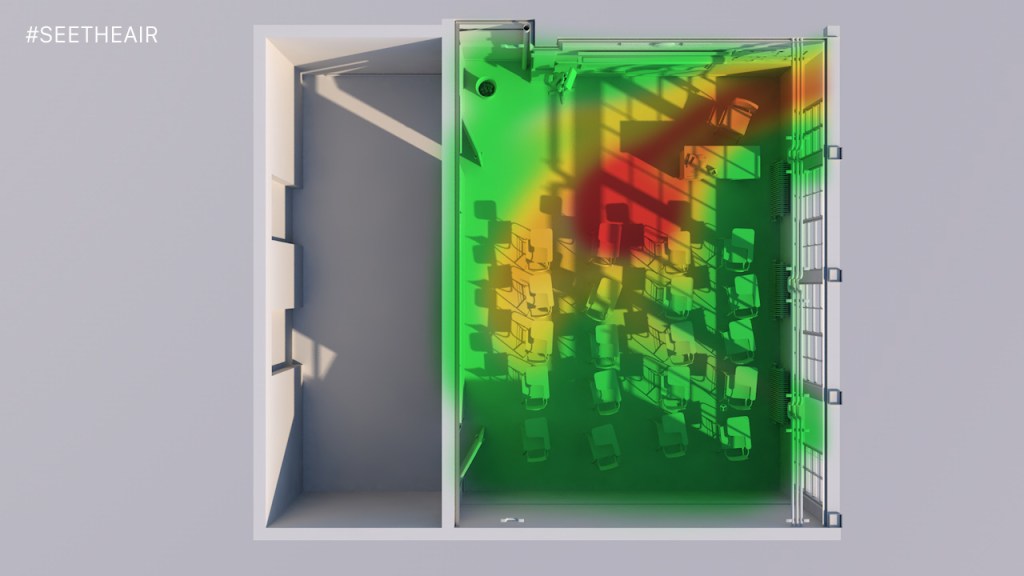
Hypothetical simulation: Fresh air comes from the back window and stale air exits from the front window, an asymptomatic student is sitting on the front row
The SARS-CoV-2 virus travels inside the tiny droplets we exhale while speaking, sneezing, or coughing. Those droplets aka aerosols have different sizes and can travel from a few centimeters to a few meters far. Most importantly, they can float and be suspended on the air for various minutes depending on their mass, increasing the chances of infection. The conditions inside a room play an important role.
Number and size distribution of the droplets exhaled by talking, sneezing, and coughing
Keep in mind, most of the time, we can’t see the exhaled aerosols below 50μm in diameter.
Currently, there is a lot of debate on which technology should be adopted by schools, medical centers, airports, etc in the area of the ventilation and air treatment as some of them offer some drawbacks.
You see, some of these technologies like pure UVC lamps, ion generators, or similar unregulated photocatalytic oxidation (PCO) technologies may produce a large concentration of unwanted gases like Ozone (O3), which is an irritant for the respiratory tract. CO2 is another by-product that may occur during the oxidation process. Many manufactures (but not all) regulate the concentrations of ozone their purifiers produce to safe levels.
Personally, I have a few important criteria to consider when it comes to which air purification/ventilation system a school should invest. First is the price, public schools can’t afford to install expensive HVAC systems. They need to reply on affordable solutions, and most likely systems that don’t require a lot of hassle to install and maintain (old building, poor infrastructure, no staff), the same applies to some private schools.
Secondly, the performance of the system (air volume m3/h) and the energy it uses (watts/h) must be optimal to keep the energy bill down and get the most out of it in each classroom.
Depending on how air ventilators/purifiers are designed and move the airflow in a room it may increase the chances of spreading the virus before removing it from the room. Simulations have demonstrated that downflow systems are more efficient than overhead systems. In simple words, we need to suck the air from the lower level in a room and introduce fresh and clean air from the top.
Hypothetical simulation: Fresh and clean air is introduced from the ceiling and the stale air is discarded from the vents below
There are so many options right now for someone to choose from. Standalone air purifiers, window ventilators with filtration systems, light fixtures that purify the air while they illuminate the space, central HVAC with quantum plasma that kills 99.9% of the viruses and up to 1000 m3 /hour C.A.D.R, or even special designed devices that can capture all type of particles in outdoor environments like a playground. I can’t tell you which one is the best because it depends on various parameters like the available budget, the infrastructure of the building, location, the size of the classrooms, and the number of students.
An expert is very important during the decision making to plan wisely and deliver the best air for kids. There are a lot of regulations regarding the air ventilation standards in buildings, and each country has its own. For example, in Spain, the UNE-EN 13779 states that a classroom of 45 m² with a height from floor to ceiling of 2.5 meters, occupied by 25 students and a teacher in primary school should renew the air 10.4 times in an hour.
45 m³/h per person (IDA 2) x 26 people = 1,170 m³/h.
Classroom volume: 45 m² x 2.5 m = 112.5 m³.
Number of air changes in a classroom: (1,170 m³/h) / 112.5 m³= 10.4 air changes in an hour
The same regulation states that the CO2 concentrations inside a classroom shouldn’t be above 500 ppm. Here come the real-time, low-cost indoor monitors that can measure constant fluctuations and warn teachers about the air quality in a room.
Conclusion
It will be very naive of us to think that only alcohol and masks (which not all of them are equally made) will protect our kids during the course of a day in a classroom. Most importantly, we have to think about their mental health too.
Below you will find a list of companies that have developed various systems for air ventilation and air treatment and each of them offer a different technology and experience.






 See The Air