
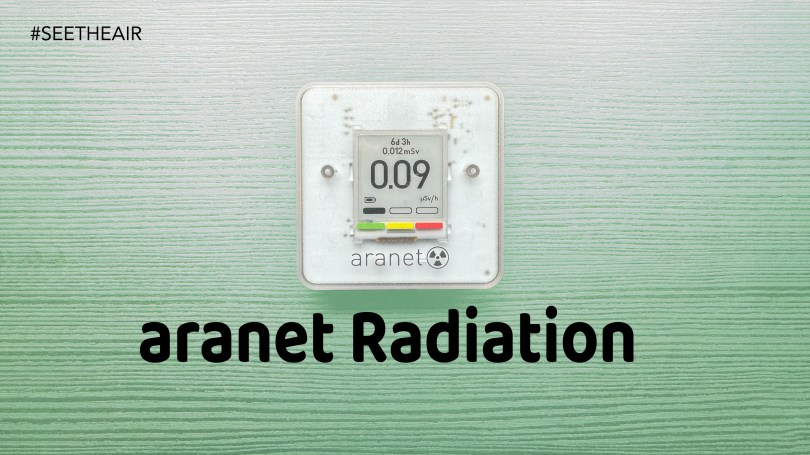
The aranet Radiation tackles a whole new frontier: personal radiation safety. This device promises to empower you by monitoring gamma (γ), beta (β), and x-ray levels, giving you insights into your environment’s radiation for years.
Pros:
- Peace of Mind: Being aware of radiation levels can be a major stress reliever, especially in areas where radiation concerns might exist like near nuclear power plants.
- Long-Term Tracking: With a two-year data tracking capability, the Aranet Radiation allows you to identify trends and build a picture of your overall radiation exposure.
- Battery Life: Aranet devices are known for their impressive battery life, and the Radiation model is likely to follow suit.
Cons:
- Niche Use Case: Unless you have specific concerns about radiation exposure in your environment, this device might be overkill for everyday use.
- Price Point: The Aranet Radiation tends to be on the expensive side because it doesn’t combine any additional sensor capabilities like the integration of a simple and inexpensive temperature and humidity one.
Specifications:
- PIN Diode (γ, β, x-rays)
- Photon energy range 70–1500 keV
- 2 AA Alkaline batteries
- e-ink Display
- Bluetooth
- Dimensions 71×71×24 mm (2.8×2.8×0.94 in)
- Weight 107 grams (3.8 oz)
App
The app follows the same easy to use and configure architecture as the aranet4, the well known CO2 monitor. You can view the current radiation measurement but also your overall exposure for up to 2 years. A histogram also allows you to browser past measurements. You can change the sample frequency, name, buzzer and Bluetooth range. You can also download your data for further analysis.

Case Study
Flying
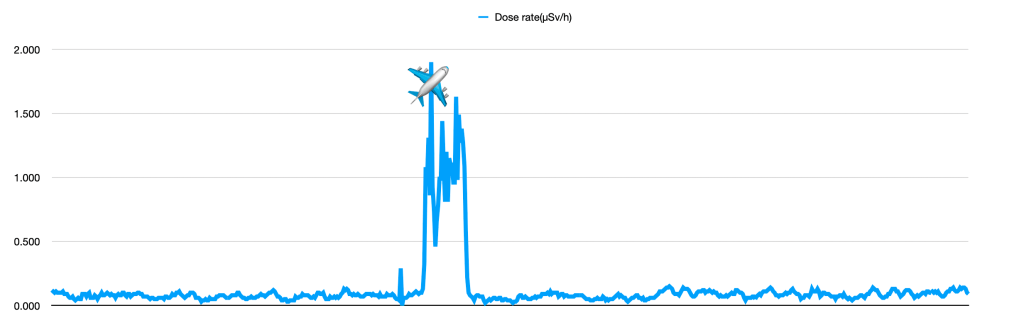
At cruising altitudes, where commercial airplanes operate, the Earth’s atmosphere provides significantly less shielding from natural cosmic radiation than at ground level. This means that both passengers and, more notably, aircrew are exposed to higher levels of radiation during flights. While the amount of radiation received by occasional flyers is generally considered very small and poses no observable health effects, frequent flyers and especially aircrew can accumulate doses comparable to or even exceeding those of ground-based radiation workers. The intensity of this cosmic radiation varies with altitude, latitude (being higher near the poles due to the Earth’s magnetic field), and solar activity, though solar flares only occasionally contribute significantly. Efforts are made to monitor and manage these exposures, particularly for aircrew, to minimize potential long-term risks, even though a definitive causal link between low-level cosmic radiation exposure and specific health outcomes like cancer is still under ongoing research.
Food
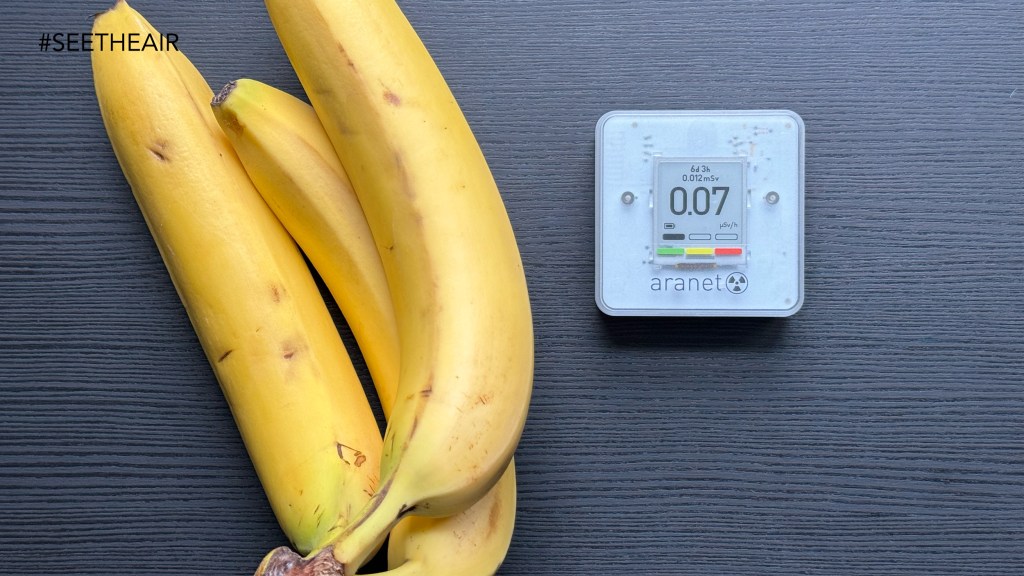
Did you know that bananas are radioactive like spinach, potatoes, brazil nuts, oranges from the Potassium (K), but only very small fraction of its atoms (aka K-40 atoms), about 0.012%, being radioactive with beta (β) radiation. However, some mushrooms can accumulate higher levels of radiocesium (Cs) than potassium (K), even though Cs and K are chemically similar and are often absorbed by organisms through the same pathways. This is particularly evident in wild mushrooms after nuclear events like Chernobyl.

Overall
The aranet Radiation is a great tool for those who need to monitor radiation exposure. With its long-term tracking it can provide valuable data and peace of mind. However, the niche use case because of just one environmental parameter means it may not be for everyone.
Accuracy is around ±20 % as it uses a PIN diode for gamma (γ), beta (β), x-rays and the device is calibrated using a Cs-137 radiation source, which is primarily an emitter of γ radiation. The measurement range is between 0 and 1000 μSv/h and the resolution 0.01 μSv/h.
The device operates on a default measurement interval of 5 min but I believe a 10 min interval is better in order to prolong battery life as radiation changes are not tend to happen very quickly for the average users. With 2 alkaline batteries it operates for 2.1 years and it can keep up to 60 days historic data. Users can turn off the Bluetooth that can expand battery life to 4.4 years with 10 min interval.
Keep in mind, this device cannot measure Radon, but the aranet Rn+ does measure radon. When radon gas decays, it emits radioactive radiation (aka ionizing radiation) in the form of an alpha (α) particles/waves.
The Verdict
If you’re concerned about radiation in your environment, the aranet Radiation is a strong option. However, consider your specific needs and budget before investing. It might be wise to research average radiation levels in your area to see if this device is truly necessary.
Discover more from See The Air
Subscribe to get the latest posts sent to your email.


[…] Review: aranet Radiation […]
LikeLike