Review: BRISE C200 Air Purifier

It was time to review an air purifier because it is a vital device for those who suffer from air pollution and allergies. The purifier that I am going to review is called BRISE C200. It was first launched in Taiwan in 2017, although the company’s headquarter is in the Netherlands with team members in Germany and Taiwan. I have been following this company since their first steps into the air quality market.

The reason I wanted to review this purifier first is because it is the first air purifier with artificial intelligence aka A.I. and because it combines two devices in one, an air quality monitor and a purifier, obviously.Read More »

Giveaway AQ Monitor

It has been over a year since the last time I used the Awair an Air Quality Monitor. As a result, I believe it is time for someone else to use it instead of waiting inside its box. I am offering it for free to a lucky reader of my blog.

It is not a new product but it has been well maintained by me. It is a great AQ Monitor with a lovely design for monitoring CO2, Temperature and Humidity. You can read my comparison tests 12 and 3. It features a PM sensor which unfortunately isn’t very good (Don’t rely on the PM sensor too much) and a VOC sensor in case you would like to get a broader picture of gases inside your house. The device comes with a EU Type C plug.

Instructions

To be able to win the AQ Monitor you have to follow me on Twitter and retweet the original tweet that includes the hashtag #SeeTheAirAQM.

Additionally, for those who will leave a comment below they will have double chances of winning, remember to mention your twitter name.

The winner of the prize draw will be selected at random on 15th April 2018 at 12pm.

Shipping costs and possible customs fees are not included. The winner has to pay for the parcel and he/she is free to choose a postal service of his/her choice. The box with the device and cable weighs 920grams/2.03pounds.

VOC & Formaldehyde Correlation

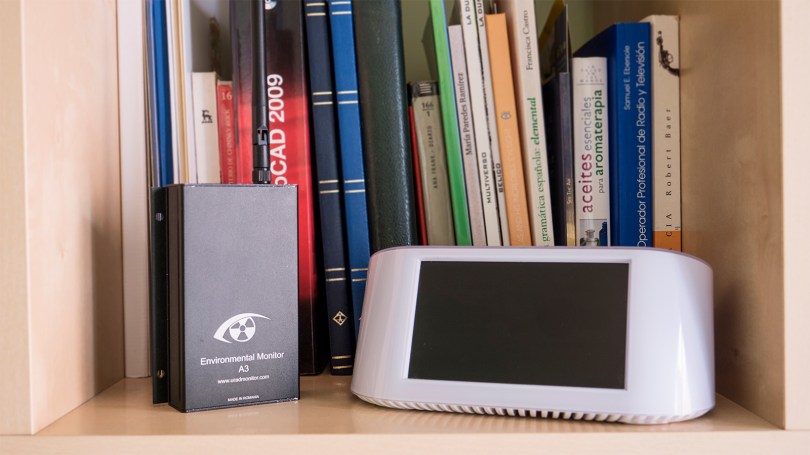
Many times I have mentioned that a simple VOC sensor isn’t enough to determinate if the air quality is good or not especially in interior environments. Formaldehyde CH2O is a VOC and since I have an AQ monitor uRAD A3 that features both a Formaldehyde sensor and a VOC sensor I will try to find out if there is a correlation between them.

I have been monitoring my house for Formaldehyde for over a month now by leaving the AQM on including while I was out on a trip for 4 days and during that time the house was well closed. This kind of experiment allowed me to determinate if my furniture, paint, etc outgassing Formaldehyde.Read More »

uRAD A3 vs AirVisual

I have featured both devices on my blog uRAD A3 & AirVisual and since both devices allow the user to download a .csv/.txt file with all the registered measurements and as they both have a laser PM2.5 sensor and a CO2 sensor, I decided to compare both of them farewell.

Although I connected both devices side by side on 28/02/2018 at 10:40 am, I will compare the measurements from 5th March 2018 to 7th March 2018 because I wanted to allow the devices to adjust on the new environment, which was my bookcase.

Each device takes measurements at a different time rate. AirVisual, for example, was set to take measurements every 10-15min and uRAD every minute. Unfortunately, I couldn’t set both devices at the same time rate.

Read More »

Review: uRAD Monitor A3

Who says that everything is made in China or USA? Well, let me introduce you the uRAD Monitor A3 an Air Quality Monitor which is made in Romania, Europe since 2012. The design, firmware design, server software and big data database maintenance and development are all made there and amazingly enough even the unit that I have on my hands is made personally by the CEO Radu Motisan. As a result I am very proud to review it and talk about the cons and pros.

Features:

  • Temperature Sensor -40°C to +85°C / 40°F to 185°F
  • Humidity Sensor RT 0-100%
  • Air Pressure Sensor 300-1,100mbar
  • VOC Sensor 0 mg/m³ to 100 mg/m³ reducers – 10 mg/m³ oxidizers
  • PM2.5 Sensor 0 μg/m³ to 1000 μg/m³
  • Formaldehyde Sensor 0 ppm to 5 ppm
  • Carbon Dioxide Sensor 400 ppm to 5000 ppm
  • γ (gamma), x-rays Sensor 0.01μSv/h to 9999.99μSv/h
  • WiFi or LoraWAN or Ethernet or GSM
  • Built-in Speaker
  • LED Light

Read More »

3 Technologies to Measure Particulate Matter

In this article we will analyze all the available Technologies to Measure Particulate Matter such as PM1, PM2.5 and PM10. This article is trying to answer which type of technology is better and how they work.

First: The Laser Diffraction

Many companies use this kind of technology for their PM sensor like IQAir-AirVisual, Xiaomi, Dylos, Kaiterra-LaserEgg etc. With this technology the sensor is able to figure out the size of the particles and the quantity. This technology is also known as Optical Light Scattering because each time a particle passes and hits the laser beam then an optical sensor, like a camera’s sensor, and with the help of an algorithm will translate how many particles were in the air at that moment. This technology is very stable and the sensor can take measurements fast, typically between 3-10 seconds.

One of the problems that the laser diffraction technology has is how each pollutant is determined by the sensor. For example Black Carbon BC which is an absolute black colored pollutant will absorb some of the light from the laser beam, so it doesn’t react the same as will do a white colored particle which will reflect more light. This problem can be solved with the right algorithm but again the device won’t be able to use the right algorithm for the right pollutant unless we told it which one to use.

Second: The Infrared

The infrared technology is common in less expensive indoor AQ monitors like Foobot, Awair etc. Basic the sensor is a small chamber with two holes on opposite directions which allow the air to pass through. An infrared light is crossing the air there and an infrared sensor is able to determine the light intensiveness. Dimmer light means that pollution is passing through the holes.

One of the problems that the infrared technology has is the estimation of the particles, this technology can’t count particles, it is just guessing. There could be 1200 PM2.5 particles or 300 PM10 particles or 1 gram of sand, either way the infrared sensor will give the same measurement.

Third: The β Beta Attenuation Mass

The β Beta Attenuation Mass technology or BAM is as big and expensive as the length of its name and very uncommon to be found in an indoor environment. Governmental bodies use this kind of instrument like in UK, China etc. Basically, it samples air on a blank piece of filter paper. Then the trapped PM pollution on the paper will be bombarded with some beta radiation. Some of the PM2.5 pollutants absorb the radiation, and the differences on the other side are measured. After that, some mathematical equations are used to determine how the weakening of the β rays translates into a mass of PM2.5. Attenuation is a general term that refers to any reduction in the strength of a signal and in this case the β radiation. The BAM technology is far more accurate than the other two technologies.

There are some disadvantages with this technology too. Humidity can affect the results so proper calibration is always needed.

Some general info to have in mind that applies to all three technologies. If you have two units of the same technology side-by-side, you will still get small variations in results even between 2 BAM monitors. That’s simply because particles in air, especially PM10, aren’t necessarily uniformly dispersed.

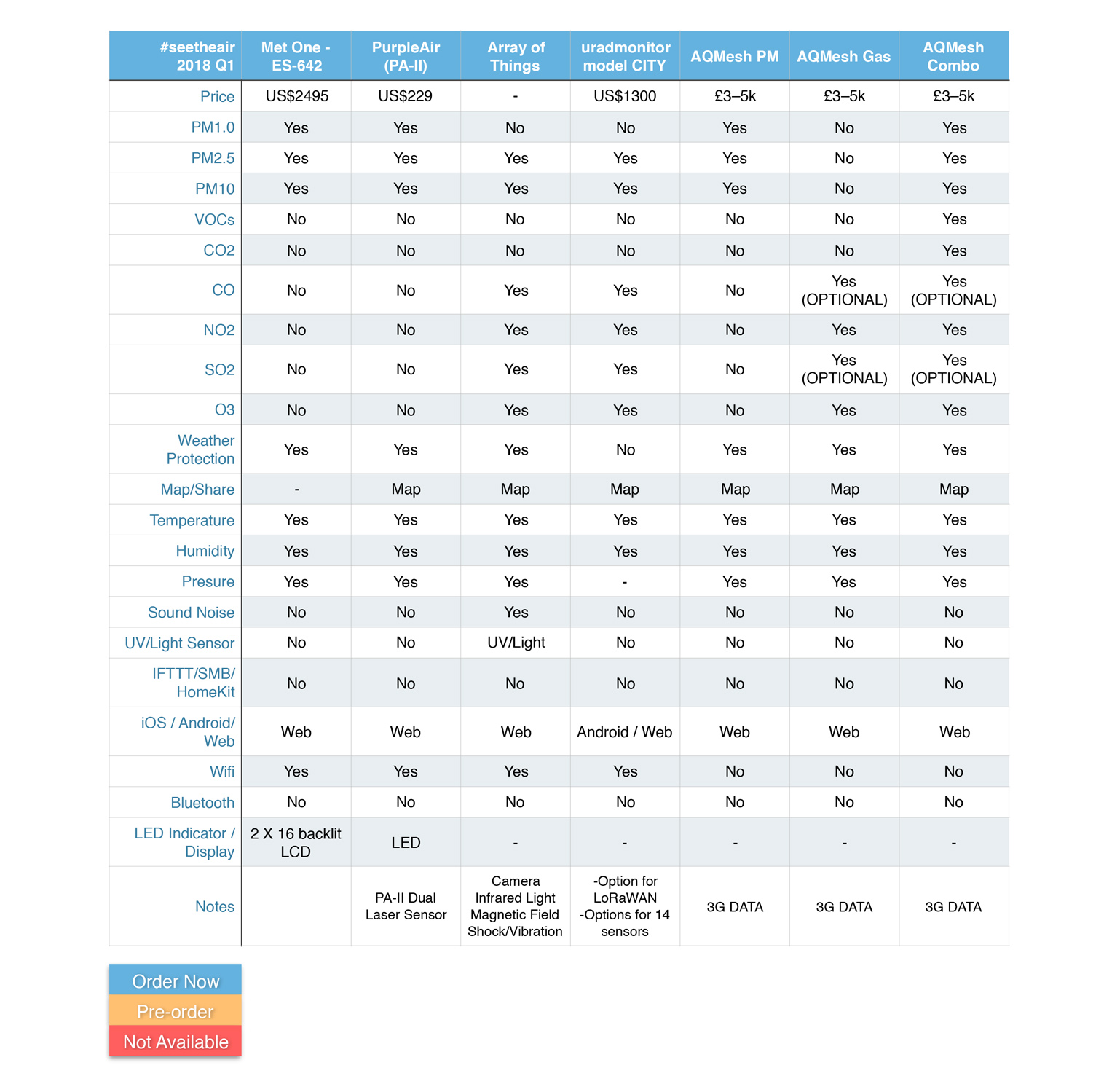
Outdoor AQ Monitors 2018Q1

This is a new kind of Air Quality Monitor list, here you can find all the outdoor AQ Monitors. These kind of monitors are suitable for outdoor air quality monitoring and most of them feature weather protection.

comparison air 2018 Q1

Creativity against Air Pollution

Throughout time researchers have been trying to monitor air pollution and create urban pollution maps as precise as possible. This isn’t an easy task for a couple of reasons. Firstly, a lot of sensors are needed to be spread all around the city and then the researchers have to decide if the sensors will be stationary or will be mobile. Some clever and interesting projects to combat the air pollution with mobile Air Quality Monitors (AQMs) are.

The Pigeon Air Patrol

pigeon air patrol

A creative way for mobile Air Quality Monitors to be spread around the city. The pigeons wear a small device with O3, VOC and NO2 sensors. While they are flying around the city or sitting on a traffic light to rest, the sensors are constantly logging air quality data. The data will be later analysed by the researchers when the pigeons return to the base. This air monitoring campaign run for 3 days only and the pigeons are now back to their normal life.

More info at: http://www.pigeonairpatrol.com


The Taxi Air Quality Monitors

taxi air monitoring

This innovate idea for monitoring urban air quality was made by James Puderer. The idea is to place Air Quality Monitors on top and inside the Taxis/Cabs sign and allow them to do their normal and daily trips around the city while they are logging air quality data. Basically it is an Android Things based data logger with a host of environmental sensors, GPS, and battery. In this project he uses temperature, humidity, pressure, and air-borne particulate PM10 – PM2.5 sensors.

More info at: https://www.hackster.io/james-puderer/distributed-air-quality-monitoring-using-taxis-69647e

5th Graders Monitor Their Air Quality

kids school pollution.jpg

We all know how busy school roads can be, especially during peak hours when parents leave and pick up their kids from schools. Definitely the air quality is very bad during that time. Some universities, colleges and organizations have decided to track the air pollution from a different perspective by giving special backpack to some of the students, backpacks with a GPS and air quality sensors. Students are responsable to carry the backpack AQM with them and monitor the air quality. Later the experts will analyze the data that the students had logged on their backpack AQM.

https://www2.le.ac.uk/colleges/scieng/research/airquality/monitoring

http://www3.imperial.ac.uk/newsandeventspggrp/imperialcollege/newssummary/news_1-2-2012-11-4-5

https://kithub.cc/2017/03/train-kids-monitor-air-quality/

http://www.ucdenver.edu/academics/colleges/PublicHealth/About/news/ResearchNews/Pages/Fort-Collins-kids-test-air-pollution-for-CSU-researchers.aspx

Zooming out – NO2 Pollution

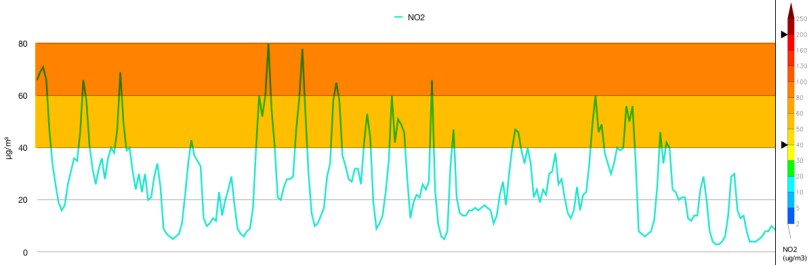
It hasn’t been a long time since one of the AQ monitors that I have, the uHoo, activated the NO2 sensor and helped me realize that the air quality isn’t so good regarding the levels of Nitrogen Oxide inside my house. I had to do some research and find out if the sensor was right and where this NO2 comes from.

Mainly, NO2 is produced by road traffic and energy production like power plants, with that in mind I began investigating. It wasn’t an easy possess, I had to consider many factors.

Firstly, I thought the source of this particular pollutant NO2 was the neighbors’ cars as early in the morning they will all go to work and some of them they will turn the engines on and they will wait till the engines are warmed up enough to set off. The buildings in my neighborhood create a U and cars are parked inside that U where the NO2 could be trapped temporally until it enters inside the houses, through the windows or escapes. Partly, I was right some spikes of NO2 were registered by the sensor at this time of the day. Source #1 was found but unfortunately the NO2 wasn’t high only at that time of the day, so I had to search further.

Screen Shot 2017-11-12 at 16.29.45
Buildings forming a U

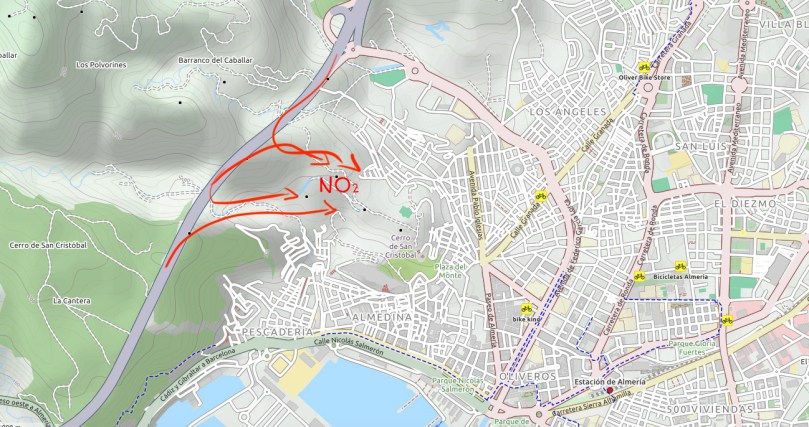
Next, I analyzed the topography of my area. I had to find all the possible sources because I wanted to understand it as good as possible. A highway is very close to my neighborhood, about 650m but we are separated by a natural hill. I am not able to hear any road noise but I guess some pollution finds its way here depending the weather and wind conditions. Source #2


Screen Shot street no2
Highway A7

Then I had to see the greatest picture and with some further examination I was able to find all the factories / power plants in my region. There are quite many as you can see on the map below. My city Almeria doesn’t have as many factories as Sevilla for example but here is produced a enormous quantity of vegetables and fruit as a result the transportation is quite active. Source #3

Screen Shot 2017-11-12 at 12.04.16
Industries across Andalusia

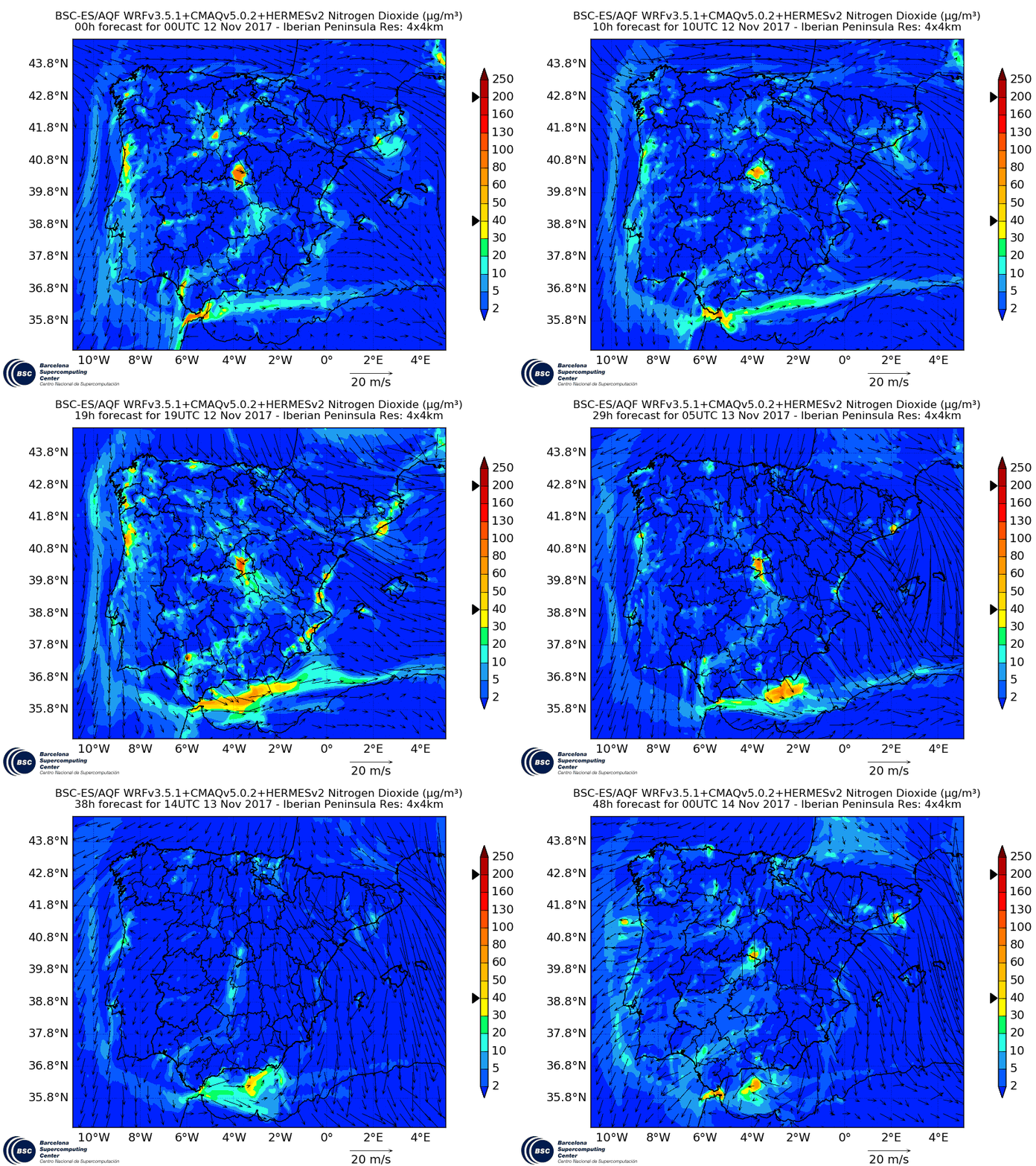
Finally, the winds can bring a great amount of NO2 from as far as 300km away. As you can see from the animated GIF below, in Gibraltar were many boats enter into the Mediterranean sea a huge concentration of NO2 is created there. Source #4

BSC-ES_FORECAST_NOx_ANIM

no2 graph

Conclusion

By starting super locally inside my bedroom I was able to zoom out and see the whole picture of the air pollution and how it expands. It is amazing how the pollution can travel long distances and reach our lungs. This is the reason we have to raise awareness globally. Regarding the sensor, although the NO2 values that the sensor took weren’t very precise, due to the lack of calibration, the device was able to detect the fluctuations of the pollutant and alert me. This is a domestic or an office device and I think the results are expected because you can’t compare it with a laboratory instrument that cost thousands of dollars. The importance here is the value that the device will bring to the user, and it is substantial.

Air Quality Monitors – Comparison 2017 Q4

Holidays are coming and people are searching for gifts or for ways to protect themselves from air pollution. A great way to start 2018 is by seeing the air around you. Once more new companies offer more choices to the costumers and the old ones offer mature products through solid updates. On this update I have removed the Design row and I have added the Application Programming Interface API row, for those who want to know if the companies support this feature. Click on the image and download the PDF document.

comparison air 2017 Q4


  • Prices may vary during time.
  • Some Companies don’t specify on their data sheet if their devices are capable to measure PM2.5 or PM10 and they just mention the word dust.
  • Some other companies say: Our product goes beyond CO₂ by analyzing substances that directly affect your well-being by measuring VOCs. They aren’t clear if their devices have CO₂ sensor.
  • Some of the devices are AQI Monitors and Air Purifiers Combo. On this list you can only read the features as an AQI monitor.