Building an IoT Air Quality Monitor that will survive the competition

Building a hardware startup is a hard business, we are well aware of that. Right now, there are a lot of indoor/outdoor Air Quality Monitors in the market that support low-cost sensors, unfortunately, even when the cost of the materials (aka BOM) is low, companies struggle to survive because of an initial bad business model.

If you want to enter into the game of the air quality or in general of the IoT, you have to ask yourself: How do I turn what I do into a compelling service?

When you sell a product you earn some money, typically three times more of what you have spent. However, your income relies only on that model and the problem with technology is that it evolves constantly, so tomorrow a new company will sell a product a bit better than yours because there will be a new sensor in the market and all future clients will shift their attention towards that device. Then you have to wait for a year or more in order to realize that you have to shut down your product and taking down with you a few hundred to thousand clients that have bought your AQM — More e-waste and frustration for the end-users.

For this reason, you have to invest in software development as well, and here comes my expertise. I have seen a lot of Air Quality Monitors, and I have collaborated with a fair number of companies in the field, but I always see the same mistake.

Some companies believe that they have to give customers free data support and services for life and if they turn their product into a paid service and they ask money based on a subscription model then they will lose costumers, but this is not necessarily correct. You are not going to ask someone to subscribe to your service to get just numeric values of a pollutant, you have to offer them something more than that. Something the competitors can’t offer because this feature is unique in your ecosystem. Maybe it could be restricted with a patent too.

Consumers really value good products especially when they can’t find something similar.

You are going to ask me, “What can I offer them?” You have two options, stay tuned for future articles or contact me in order to discuss how we can collaborate.

 

Review: BRISE Multi-Shield Mask

Another great mask to wear against air pollution and the COVID-19 disease. BRISE the company behind the air purifiers just released the BRISE Multi-Shield Mask and they come in three different colours, Dark Black, Peach Red, and Sky Blue.

BRISE Multi-Shield Masks have some key characteristics that separate them from the competition. A certified filter against PM2.5 pollutants, which can block oily and non-oily pollutants, keep in mind that the most common N95 masks are not resistant to oil). Double water-resistant washable layer that can withstand up to 200 times of hand-washing by maintaining excellent filtration efficiency and long-term effectiveness. Finally, the organic cotton inner layer offers a gentle and comfortable touch to the skin.

The mask offers 3 layers of protection.Read More »

Review: Airthinx IAQ for Homeowners

This review is dedicated to the end-users (homeowners) as I present the tools (Smartphone app) and functionalities of the device for the average user and some basic features on the dashboard. Later on, I will review the same monitor for businesses where we will have the chance to see and analyze the more advanced tools which are present on the dashboard for all.

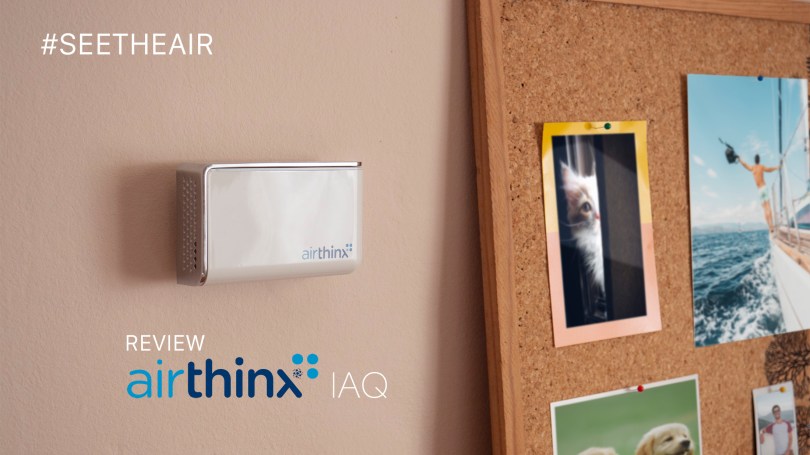
Airthinx IAQ is an Air Quality Monitor (AQM) that was built for experts with many communication protocols in order to ensure that users will be able to access air quality measurements from anywhere and air quality sensors that matter in the indoor environment.

Technical Specifications

  • PM1 / PM2.5 / PM10 Sensors (0~500 μg/m3)
  • CO2 Sensor (0~3000 ppm)
  • CH2O Sensor (0~1 mg/m3)
  • TVOC Sensor (1-10ppm of EtOH) (0-1ppm of Isobutylene)
  • Temperature Sensor (-10-85°C)
  • Humidity Sensor (25-90 %RH)
  • Barometer Sensor (300-1100 hPa)
  • Cellular (GSM/GPRS/EDGE/UMTS/HSPA)
  • WiFi (802.11 b/g)
  • Bluetooth 4.0
  • Zigbee
  • GPS
  • Accelorometer 16g (13-bit resolution)
  • 2 Micro-USB Power Ports

Read More »

uHoo – Virus Index (Update)

Some of you have contacted me because you wanted to know my opinion on uHoo’s latest update. Since June 2020, uHoo has implemented a Virus Index which is a patent-pending technology that uses the power of air quality data to help you know how suitable your close environment is for a virus to survive and spread.

uHoo is an air quality monitor that features nine environmental and pollution sensors. If you want to learn more, read my review here.

uhoo app 2020 virus index

Read More »

UV Filtration During COVID-19 with BRISE C200 Air Purifier (English/Español)

(Scroll down for the Spanish version/Desplácese hacia abajo para la versión en español)

Two years ago I reviewed the BRISE C200 and I have been using it everyday but I had never thought before that the UV sterilization process will come so handy. It provides an extra layer of protection in a house or in small office especially during this covid-19 pandemic.

I don’t know about your experience during the lockdown, but mine was quite frustrating when I had to go out for grocery shopping and return home or even when I ventilate my house. A lot of things had been written about the SARSCoV2 virus, like that it could survive on clothes, on surfaces (keys, phones, money, etc) and that it can be an airborne pathogen.

Airborne means that a virus is transmitted between people through respiratory droplets and contact routes.Read More »

Why is it so hard to ditch private vehicles from cities?

We all know that cars contribute a lot to air pollution in urban environments, like particulate matter and nitrogen dioxide, among the most common. I see many fellow environmentalists who try to push cities towards a future without cars, but I think with the current means it is very difficult to win the battle.

The automotive industry spends millions on advertising, and they always target the emotional connection that forms between a driver and a car. They will never tell you that cars are important tools that will help you on your work or any other everyday tasks, but they will tell you that a car will offer you freedom as you will be able to escape away from your problems or it will make you a powerful human being and so on.

Take, for example, the first three ads I got as a result when I googled “Car ads”. Powerful subliminal messages to lure you into thinking that a car will make you a new person.

car ads
Just by Googling “Car ads”

When environmental scientists urge communities to leave cars behind they don’t actually do a great job of spreading the message around because they are not trained to do this kind of task. Allow me to elaborate on that. Atmospheric scientists are good at their job which is the study of the Earth’s atmosphere and its various inner-working physical processes. They are able to investigate cases and write papers base on actual facts and among experts, we are able to understand what they want to share but we miss the science of physiology, something that the automotive industry relies on for a century now.

Every day people are not going to read those papers and studies, and if they do, they aren’t going to understand a lot. By giving them the information in a form that they can understand, and without alarming them, we have more chances of making them understand the issue.

Conclusion

When carmakers launch new cars on the market, they are going to involve many more experts on how to make their product more appealing to the costumers, aka everyday people, as a result, we have to fight with the same tools and team up with marketing experts.

Examples of campaigns, we can deploy if we want more people to join the #CarFree movement. Feel free to share them!

Bicycle Power3

Bicycle Power2

Bicycle Power1

Dear city of Almeria (Spain) or any other city in the world (English/Español)

(Scroll down for the Spanish version/Desplácese hacia abajo para la versión en español)

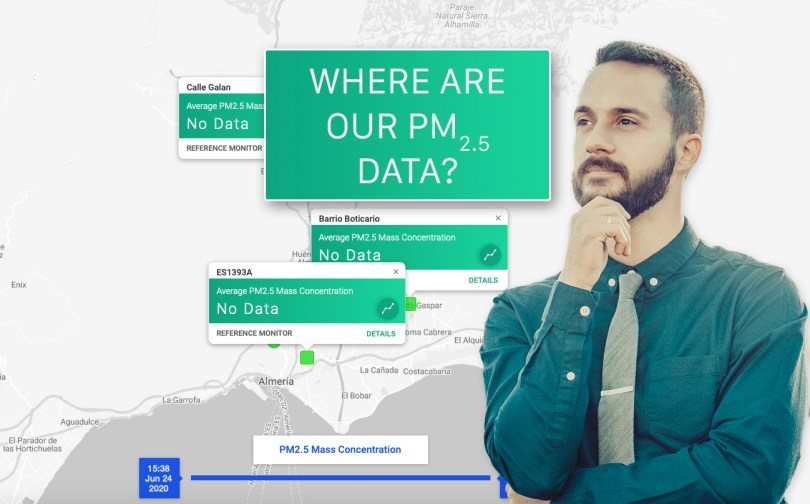
I am writing this article because I would like to help you understand the importance of the issue as the whole province and consequently my city Almeria doesn’t have an official air quality station with a sensor capable of measuring particulate matter with an aerodynamic diameter of 2.5 μm or less (PM2.5) in real-time.

What is Particulate Matter (PM)?

Particulate Matter (PM) are solids material (sometimes liquid too) that float in the air. Some PM is released directly from a specific source − combustion in Diesel engines − while others form in complicated chemical reactions in the atmosphere.

Particles in the PM2.5 size range can travel deeply into the respiratory tract, reaching the lungs. Studies also suggest that long term exposure to fine particulate matter may be associated with increased rates of chronic bronchitis, reduced lung function and increased mortality from lung cancer, and heart disease. People with breathing and heart problems, children and the elderly may be particularly sensitive to PM2.5.

The Problem

In the province and city of Almeria, there are three Air Quality Stations that measure many pollutants one of which is PM2.5. Unfortunately, these sensors are outdated and the results we get are ONE daily average value which is basically useless in my opinion. Apart from that, we need to wait for a month to get the results back after filing a form. I guess the same thing applies to the 68 stations all around Andalucia in total.

Citizens need real-time data in order to take action and reduce their exposure to air pollution. They also need better tools and maps where they can visualise where pollution is in order to avoid harmful exposure. There are already many studies supporting the correlation between air pollution and COVID-19 cases.Read More »

Could an Air Quality Monitor save your life when it is paired with a Smart Light bulb?

Have you ever wondered how to use the RGB LED bulb you have purchased in a more productive way? Sure, you can control the lights via your phone but this is not “smart” plus if you manage your lights with your phone it may take longer to turn off and on a light fixture than just by hitting the switch.

The obvious is to set up a visual (light) indicator each time the air quality is poor in your house, for example, when PM2.5 is high, then the lights flash twice with orange colour. However, the ultimate way to give real value to a smart light bulb is when the combination of an AQ monitor and a light bulb can save your life in a real-life threatening situation. How?

Read More »

Review: Airthings Solutions

Airthings is a pioneer company as they have developed an in-house sensor for Radon detection but their expertise doesn’t stop there. They have expanded their product-line with domestic and business solutions with one thing in mind, how to enhance indoor life.

Since the beginning of the pandemic, I have received countless messages from people all over the world who have found themselves stuck inside for a long time and asking me to help them improve their indoor environment. Domestic users but also businesses that want to go a step further and offer a more productive environment for their employees after the lockdown.

I have already reviewed the Airthings Wave Plus and today I would like to review how each product offers a solution inside the house.

Airthings teen room

The Wave Plus is equipped with a Temperature/Humidity, VOC, Radon, and more importantly a CO2 sensor which is the first sensors to have in mind when you think teenagers. Teens tend to spend a lot of time inside their room, listening to music, studying, doing homework, watching countless videos on TikTok and Youtube, and messaging with other teens at the same time via Instagram. Teens don’t worry about air quality but I bet you all have experienced the musty smell every time you open their room door. Part of the smell is a crazy high CO2 concentration combined with VOCs.Read More »

Review: Node-S by Clarity

I love clean air and even when we are indoors the air we breathe comes from the outdoor environment, like streets, small neighborhoods, city superblocks, etc. There are high probabilities that you, the reader, live in a city and the air you breathe isn’t clean enough to support your healthy lifestyle.

Most cities in Europe, as far as I know, have two state reference stations (a background and an urban) for air quality monitoring. They are great, with highly accurate and expensive equipments inside. Unfortunately, most of the time they are old and outdated which limit their ability to engage people to look into the air quality problems we are facing.

My city hosts around 200,000 people and the one urban reference stations we have isn’t capable of measuring PM2.5, at least not as most people will expect. It registers ONE daily average PM2.5 measurement (and not always). Data are free but in order to get these daily measurements you need to file a form and wait a month as manually a lab examines the filters were PM2.5 particles are captured.

Of course this is a tedious way to report data in 2020 at least in my opinion, I understand the “accuracy” obsession that surrounds some scientists, they can keep doing that but also they need to report real-time data to citizens if they want them to change the way they think and behave. I mean, what can I do if I learn that the air was dirty a month ago?

Here comes a outdoor monitor like Clarity Node-S. In my opinion, cities have no excuse not to install such monitors around the city and allow citizens to see the air they breathe. Literally, it is so easy to pick a place in a city and install a monitor. Clarity takes advantage of the low-cost sensors and has developed a solution hard to resist.

Read More »