Air pollution, a significant environmental health issue, affects everyone. However, there is growing research evidence showing that the health effects of air pollution may not be the same for men and women. This difference is driven by biological, socio-economic, and occupational factors that can influence exposure levels and health outcomes.
Biological Differences
In terms of biological differences, women have a higher percentage of body lipids than men, which can accumulate fat-soluble pollutants. This can lead to a higher concentration of certain pollutants in women, potentially increasing their risk of health effects. For example, a study published in the journal ‘Environmental Research’ in 2018 showed that women exposed to polycyclic aromatic hydrocarbons (PAHs), a group of chemicals released from burning coal, oil, gasoline, and tobacco, had higher levels of DNA damage than men exposed to the same levels of PAHs.
The animated image below was created by Mark Parrington and was originally publish on his Twitter account on June 6th, 2023.
I believe it is an eye opening animation as it reveals how easy air pollution travels across states and countries. We call this pollution Cross-Border Air Pollution.
I had the chance to visit New Delhi and Agra in India due to an annual conference that we had to assist. I was well informed about the poor air quality in the area, so I was prepared to breathe some pollution. I have read many articles and heard many testimonials about the situation there but still, a visit in situ helps someone understand the issue on a whole new level.
Some weeks ago, I published an article on “Why is Air Pollution Invisible” and I think during my visit to India I experienced all of the points clearly.
Immediately, once you come out of the aircraft, you can smell the air pollution. It is everywhere, indoors and outdoors. Even waiting in the immigration line for clearance you can smell it. I didn’t have the instrument in hand at that point in order to measure the concentrations, but from my experience and because air pollution was visible due to high levels, I estimate concentrations of 100μg/m3 of PM2.5. I want to make clear that I was still indoors.
From there, I headed to the hotel in a taxi. As you may imagine, the air quality was not better, but quite the opposite as the fumes from the relentless amount of unregulated vehicles were spewing everything they had in their engines. Particles of all sizes and gas fumes. Interestingly, more than 90% of the vehicle in the streets were occupied by only one person, the driver. On top of the air pollution in the streets, you can add noise pollution as the use of car horns is a tradition in India.
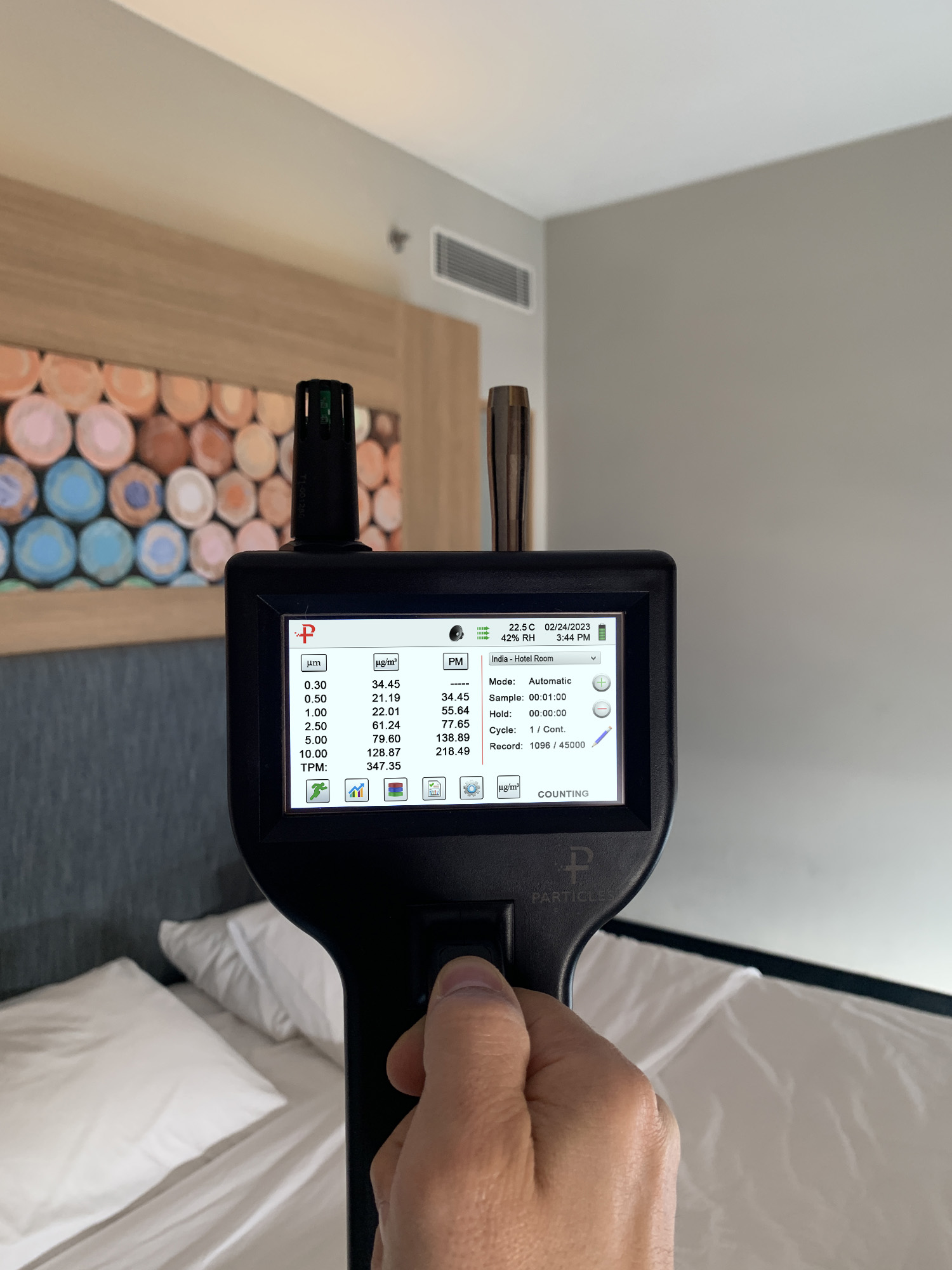
I managed to arrive at the hotel after a small accident with the car (no damages) where I took the air quality monitor out of my luggage in order to measure the conditions in the room. Unfortunately, it wasn’t safe either. The mean PM2.5 concentration during my stay was around 50μg/m3.
The hotel had some small air purifiers in the hallway, but the coverage area was too big for them to handle properly. I looked at the filters and they were pure black, who knows for how long they were running without replacement.
On day two, my nose didn’t register the smell of smoke anymore. I was one of them! Unable to smell the pollution and consequently remind myself that I need to find clean air. This is what happens to locals that don’t have options, eventually, they forget.
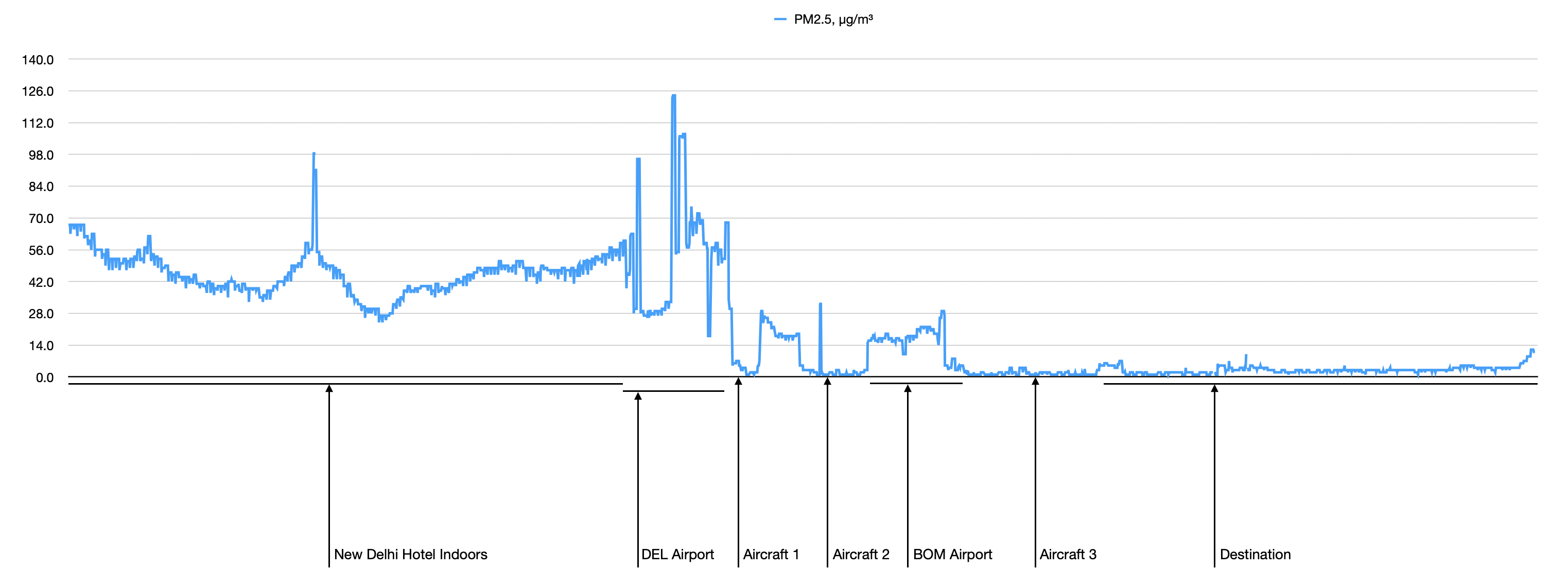
For simplicity, here you can see my PM2.5 exposure for the last date of my trip before coming back home. However, the particle counts for the smaller particles like 0.3μm and 0.5μm, which get lost with mass concentration values, were even higher reaching counts of around 400,000,000 particles per m3 and 40,000,000 particles per m3, respectively. By the way, according to the locals, I visited New Delhi during a good AQ time.
Enough with the AQ data, we know it is really bad, my main question was where all this air pollution comes from. Most people will tell me that it is due to vehicle emissions and domestic burning. Still, it doesn’t make sense though because the weather was warm and there was no need to burn logs for heating. Additionally, the issue was persisting all day and night. So after a conversation with a local professor, he pointed out that the main source was waste management. Basically, they burn garbage and these eternal fires create the smog that persists in the city and makes people really sick.
I talked about the car horns, but you will also hear many people cough. It’s normal as their lungs are suffering from chronic exposure to toxic air pollutants.
There is some good news, though. Once the local people realize the source of pollution as I did, they can fix it. New Delhi is populated by 15,000,000 people and I understand that the amount of waste they generate is equivalent to that number, but the management of the waste can’t be “burn it, it will disappear” because it doesn’t. Finally, vehicles need some kind of control and annual revisions that will force the drivers to maintain the car in optimal conditions like EURO 6 compliance does in Europe.
Do you remember the Tamagotchi from the 90s? A small and portable digital pet that you had to take care of in order to keep it “alive”?
Wouldn’t it be great to create the same pet but with the only difference that it breathes air and air quality information is taken into account in order to determine its survival chances? I think it will engage people and help them not to get accustomed to the presence of poor AQ. Poor air quality can be due to the presence of particle pollution but also high CO2 levels indoors which will make the character sleepy.
A while ago, I wrote a similar article on Gamification and Air Quality. Same approach but even more fun! Kids will definitely try to keep the character alive, and it doesn’t even require hardware as it can be an app on your phone. Outdoor air quality data are available all over the world, so there is no problem there, but we need to think about how to implement indoor AQ data into the algorithm that calculates Tamagotchi’s health. Remember we spend most of our time indoors.
In this case, a small wearable monitor would be the best. However, 3rd party companies with Indoor AQ monitors will need to give access to the application that runs the companion character. That way, the character can be updated and engage with the user more often based on real data.
A software service will rise here as the company that decides to commercialize such a feature will have to build something similar to what Amazon, ecobee, or Apple with HomeKit provides in order to feed the app with air.
I don’t like the name Tamagotchi a lot, plus there are some copyright issues there, so let’s name our character Nicholas from the titular character of my kid’s books. Nicholas has superpowers and can see particulate pollutants. I cannot imagine a better companion!
You may have heard the term “air pollution is invisible” which was first told by Dr. Gary Fuller (if I am not mistaken), but apart from the fact that the composition of the pollution is made from tiny particles and gases that are not visible to the naked eye, I think the real reason is different.
People forget easily, and even when they see stuff, repeatable patterns get canceled out by the brain. A clear example are perfumes. When you wear the same perfume over and over, you lose the ability to smell it. Another example is the smell each house has as the owners/occupants of the house are unable to smell it. Visitors, on the other hand, can and sometimes is very potent.
I believe the same thing happens with air pollution. When you expose yourself to the same pungent odors (e.g nitrogen dioxide) because you go to work or school every day, your brain becomes familiar with the odor and it cancels it out. Same thing with wood burning smoke, as I have encountered people that live inside clouds of wood smoke which doesn’t bother them. Eventually, their lungs/heart cannot cope anymore and they die prematurely.
Another reason air pollution is invisible is that the majority of people lack education in order to see the problem. Scientifically speaking air pollution is a very complex topic that involves knowledge in chemistry, physics, statistics, and more. It is not expected for people to have this kind of knowledge and this is the reason we have to communicate the impact it has on human health in simple terms. Environmental education has to come from the early stages of school education which is absent in most countries, even the developed ones.
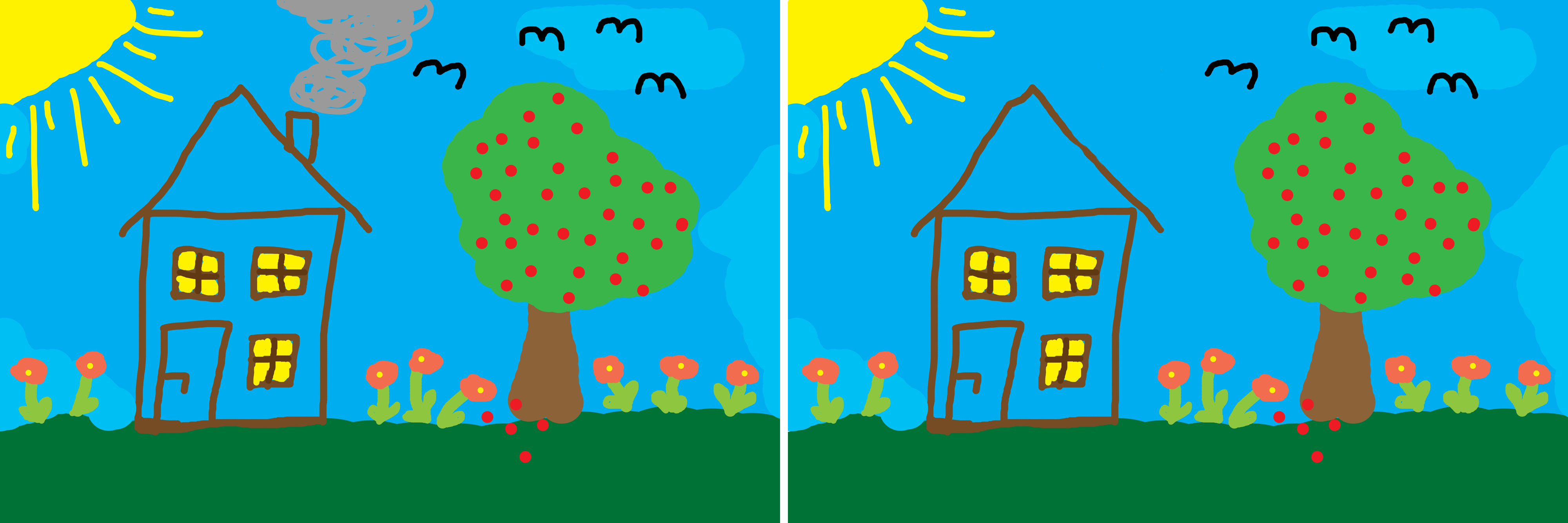
We cannot allow any more drawings with a chimney and smoke as something normal
Sensor technology has allowed us to see the air we breathe yet many public/private organizations are scared of the information we collect and share. Accurate information is a powerful tool. Inaccurate, or the absence of information, is dangerous.
Believe it or not, there is a lot of misinformation about air pollution. For example, wood stove pellets do not produce air pollution nor CO2! This is what the industry of wood burners tells people. Pure lies.
I will close this article with a question, are you allowed to breathe clean air?
2022 was a year full of air quality news. Lots of scientific research and publications on how air pollution influences the health of individuals, but also the same bad patterns; wildfires, traffic, wood burning, crop burning, industrial malpractices, etc. For reference, kids who breathe polluted air can fall behind in school link, air pollution linked to a million stillbirths a year link, tiny particles in the air can cause sudden heart attacks link, air pollution during pregnancy and neurodevelopment in children link, and unfortunately many many more.
An important good piece of news was the new ‘Ella Bill’ to enshrine right to clean air. Thank you Rosamund Adoo Kissi Debrah.
I live in an area where wood burning is an unfortunate “cozy” habit for the people around me. So, I decided to see if patterns appear after monitoring the ambient air quality for 30 days in order to identify if there is any window that will allow me to open the windows and get some fresh & clean air. For the sake of simplicity, I will use only PM2.5 values.
I don’t mind if I have to wake up at 3:00 AM in order to allow some outdoor air to come inside and dilute some VOC and CO2 that build up. Indoors, PM2.5 concentrations are kept well under 5μg/m3 because I run the air purifiers 24/7. By the way in a recent, poster the position of the air purifier inside the house plays an important role in how well particles are captured.
Anyway, let’s jump into the data I collected and analyzed.
In a constant effort to educate the community, I highly recommend you to attend my upcoming webinar “Size Matters: Why is important to know the Particle Size Distribution“. The webinar is scheduled for the16th of November, 2022 at 8am EST.
Although it is a business oriented webinar, I will also try to educate in simple terms the attendees on what is PM2.5 and why it falls short as it doesn’t reveal in detail the make up of air pollution.
You probably have seen “cozy” images of fireplaces or wood stoves with happy people, a blanket around them, and a hot beverage and you may have thought that’s something very appealing, I want that! Well, I would suggest thinking twice before taking that decision and if you have already taken it, maybe it’s time to undo your mistake.
You see, people get sick thanks to these “cozy” elements in houses. It’s very hard to undo the brain wash the wood stove industry has done all of these years but we have to realize that wood burning is neither sustainable nor healthy.
Many claims that biomass is sustainable but this is a myth. A story designed to push people into spending money for status or simple ineffective heating. You see, clean energy (wind, solar, etc) doesn’t require the user to buy fuel, logs, or pellets every season. It is there for us but doesn’t generate constant revenue for the companies.
I think we have come to a point in time where we are well aware of the dangers internal combustion engine (ICE) vehicles hide as they emit a tremendous amount of toxic pollutants that have a direct health impact on dwellers, especially in cities.
Nowadays, going to the center of a city by car is unnecessary and very impractical. However, many still insist on taking their huge SUVs even for a trip within a walking distance. Walking distance means going from one point to another no farther than 1,5 km / 1 mile or 15 minutes in time. I don’t think you will go any faster if you take your car because of all the hassle that it involves (parking, getting on board, load stuff, etc).
Schools here in Europe are within walking distances. This is the reason your kid cannot go to a school in a different district. Even then though, parents form huge queue outside of the schools in order to drop off their kids every single morning. No! It’s time to walk!
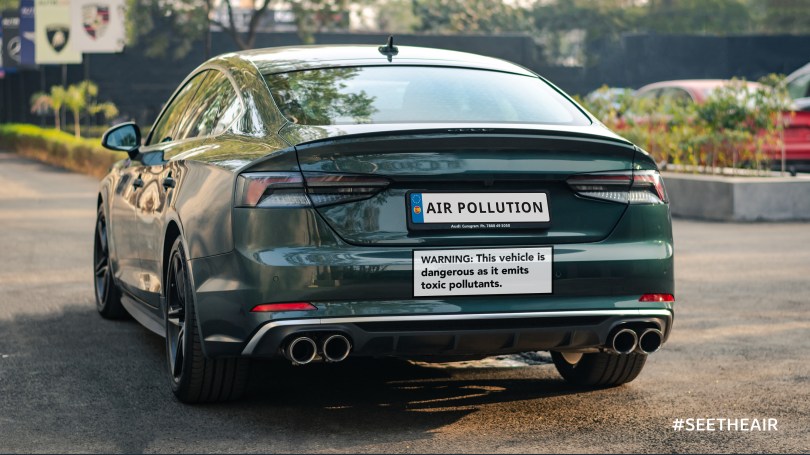
I believe cars should come with a permanent sticker on the rear side similar to the tobacco packaging in order to make people think and react. The sticker cannot be removed or covered by law. Maybe you will turn off the engine while waiting or not forcing the car to start even when new cars hibernate the engine automatically in traffic lights.








 See The Air