I have been talking about air quality monitors and air purifiers in this blog for a long time. They help us see the air we breathe and mitigate pollution. However, is there a way to measure the impact of pollution on our lungs?
Well yes, thanks to technological advances and spirometry, which measures lung function, doctors can use these data in assessing breathing patterns that identify conditions such as asthma, pulmonary fibrosis, cystic fibrosis, and COPD.
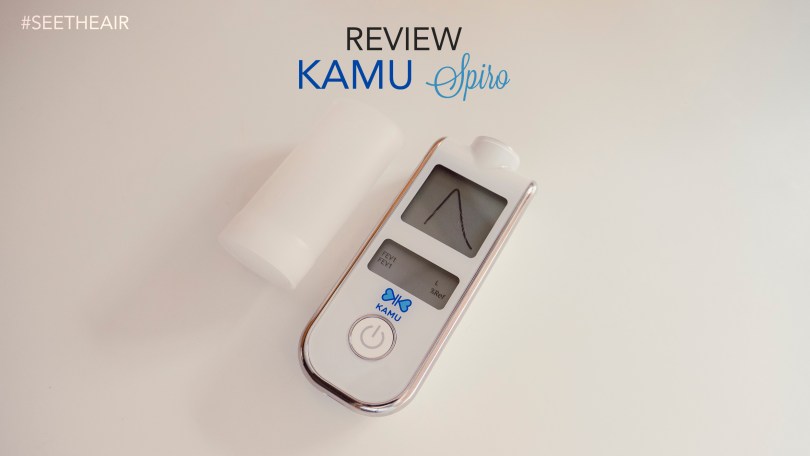
In this review, I am going to present to you the KAMU Spiro. It is a handheld bluetooth device that helps us test our lung function at home with a hospital-grade mobile spirometer.
With a single test, we can get FEV1, FEV1/FEV6, FVC, and PEF values. The spirometry results are saved in KAMU Spiro’s memory until we upload them to our KAMU Asthma app, where we can view them at any time.
There are a few things you can do to reduce air pollution indoors like keeping things tight and clean, not smoking, using exhaust fans when you cook, and ventilating the rooms, but at the end of the day if the air pollution comes from outside sources then you need to take drastic measures and there is only one solution, investing in an air purifier.
There are many air purifiers on the market for all types of budgets but you shouldn’t expect a cheap air purifier to offer the same features and purification results as a high-end purifier. By the way, air cleaners and air purifiers are the same things.
BRISE C360 is a high-end purifier capable of purifying up to 95 m2 or 1022 ft2 room and rated CADR at 390 m3/hr or 230CFM. It is recommended for medium size rooms and it packs a ton of features.
Over the years, I have spoken with many companies in the field of air quality and once in a while, companies will tell me that they want athletes to purchase their devices in order to improve performance. I am always skeptical about this because I haven’t seen any integration of fitness data with the AQ monitors so far that could give some possible adverts or ways for the athlete to improve their performance. You don’t expect people to make assumptions you have to give them results and guide them in the right direction.
During covid-19 lockdown, I worked out at home and as I have access to a lot of data (fitness and air quality) I decided to make some experiments and see how my body reacts to poor indoor air quality and good indoor air quality and if the whole hypothesis works.
Smartwatches are very common these day and all of them feature a heart rate monitor and many more sensors. Recently, Apple and Fitbit released pulse oximeter sensors in their latest wearables. These new sensors in the smartwatches could unlock many more potentials and provide us with data that could save lives.
Let’s continue with the argument of what current AQMs could do if they combine fitness data. First of all, there is a possible problem. In case the monitor is stationary then it won’t be able to tell if the user was near the device or not during the workout session but this could be addressed as most times fitness data come along with GPS coordinates. By allowing the device to access the location data only when the user is in the same location as the AQM (home, gym, etc.) we solve the issue. Another possible solution is if the monitor comes with a Bluetooth/Ultra Wideband chip then it can easily sense the presence of the athlete/individual.Read More »
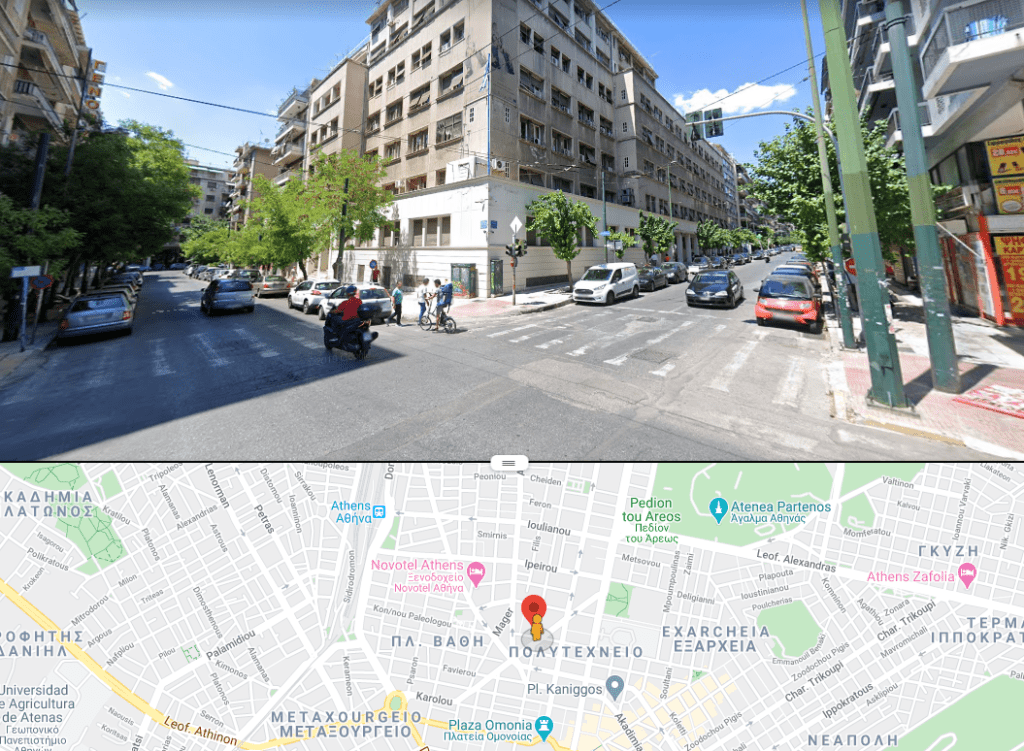
Well, in winter and early spring never, period! If you are thinking of running or even walking in the center of Athens in Aristotelous street and around then prepare yourself to breathe a lot of pollution.
There is an official air quality station there and I pulled all available data for local statistical analysis from the European server (GR0003A). Unfortunately, 2019 nor 2020 measurements are available to the public yet, maybe in a decade, they will share the data for the Greeks to read. (Τι κάνεις έλληνα και δεν παραπονιέσαι για τον αέρα που αναπνέεις;).
Air Quality Station on top of the building Aristotelous street, Athens
In a previous post, I mentioned how important is to monitor the environmental conditions inside a classroom in order to minimize the spread of the virus. Temperature, relative humidity, particulate matter, and carbon dioxide values can serve as indicators, and thanks to them we can have an estimation of the possible propagation of the virus in a classroom.
It seems to me that most people and governments are convinced that the virus is in the air (finally), and although masks work (in most cases), we all know that it is difficult to demand from kids to wear them 8 hours a day without touching their face or each other. Definitely, the virus will affect the psychology of the kids in the classrooms, and most importantly their social skills.
In Madrid, Spain, the authorities have decided to install 6000 cameras in schools. I am totally against this decision. Are they going to fine a kid when he/she touches his/her face? Who is going to watch the footage from 6000 cameras in real-time to determine that a breach of the protocol has occurred? A complete waste of money as later they will have to remove them because of privacy concerns, mark my word on that.
We have to realize that is important to give “some freedom” to kids for their mental sake and for them to grow. Technologically, we can achieve that by offering them the best air possible. In my previous post, a colleague of mine told me that schools in Spain and schools in the UK are not the same because the weather conditions are not the same, and he is right. In south Spain, schools don’t invest in heating, and they could rely on window ventilation, but in the UK (and north Spain) because temperatures drop low earlier, schools need to invest in mechanical ventilation that will recover heat as well.
Either way and although I love an open window for fresh air, I recognize the need for mechanical ventilation systems that will introduce fresh and clean air to a classroom keeping particulate matter and CO2 low and at the same time temperature and relative humility at optimal levels for kids to study and teachers to work.
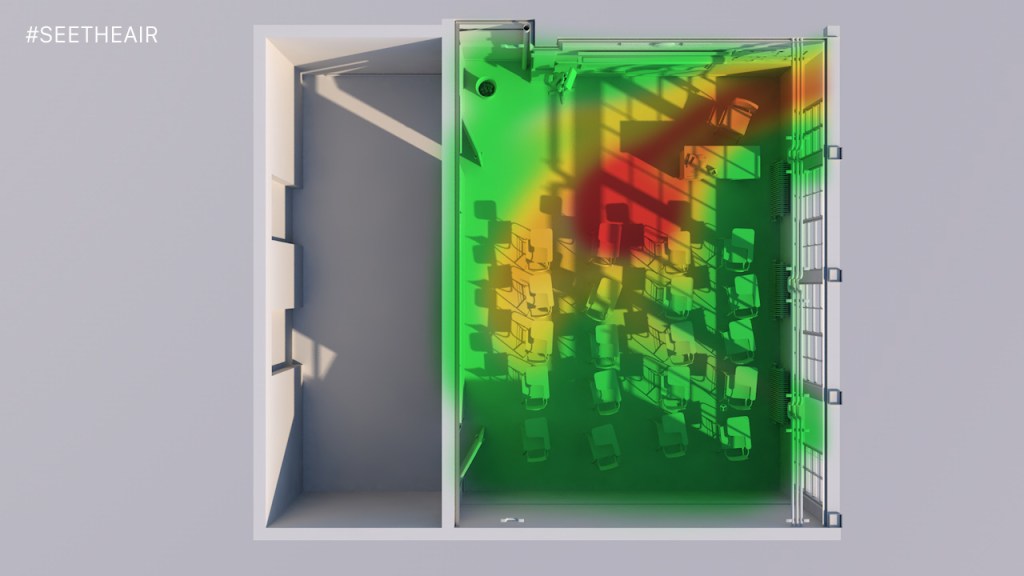
Hypothetical simulation: Fresh air comes from the back window and stale air exits from the front window, an asymptomatic student is sitting on the front row
The SARS-CoV-2 virus travels inside the tiny droplets we exhale while speaking, sneezing, or coughing. Those droplets aka aerosols have different sizes and can travel from a few centimeters to a few meters far. Most importantly, they can float and be suspended on the air for various minutes depending on their mass, increasing the chances of infection. The conditions inside a room play an important role.
Number and size distribution of the droplets exhaled by talking, sneezing, and coughing
Keep in mind, most of the time, we can’t see the exhaled aerosols below 50μm in diameter.
Currently, there is a lot of debate on which technology should be adopted by schools, medical centers, airports, etc in the area of the ventilation and air treatment as some of them offer some drawbacks.
You see, some of these technologies like pure UVC lamps, ion generators, or similar unregulated photocatalytic oxidation (PCO) technologies may produce a large concentration of unwanted gases like Ozone (O3), which is an irritant for the respiratory tract. CO2 is another by-product that may occur during the oxidation process. Many manufactures (but not all) regulate the concentrations of ozone their purifiers produce to safe levels.
Personally, I have a few important criteria to consider when it comes to which air purification/ventilation system a school should invest. First is the price, public schools can’t afford to install expensive HVAC systems. They need to reply on affordable solutions, and most likely systems that don’t require a lot of hassle to install and maintain (old building, poor infrastructure, no staff), the same applies to some private schools.
Secondly, the performance of the system (air volume m3/h) and the energy it uses (watts/h) must be optimal to keep the energy bill down and get the most out of it in each classroom.
Depending on how air ventilators/purifiers are designed and move the airflow in a room it may increase the chances of spreading the virus before removing it from the room. Simulations have demonstrated that downflow systems are more efficient than overhead systems. In simple words, we need to suck the air from the lower level in a room and introduce fresh and clean air from the top.
Hypothetical simulation: Fresh and clean air is introduced from the ceiling and the stale air is discarded from the vents below
There are so many options right now for someone to choose from. Standalone air purifiers, window ventilators with filtration systems, light fixtures that purify the air while they illuminate the space, central HVAC with quantum plasma that kills 99.9% of the viruses and up to 1000 m3 /hour C.A.D.R, or even special designed devices that can capture all type of particles in outdoor environments like a playground. I can’t tell you which one is the best because it depends on various parameters like the available budget, the infrastructure of the building, location, the size of the classrooms, and the number of students.
An expert is very important during the decision making to plan wisely and deliver the best air for kids. There are a lot of regulations regarding the air ventilation standards in buildings, and each country has its own. For example, in Spain, the UNE-EN 13779 states that a classroom of 45 m² with a height from floor to ceiling of 2.5 meters, occupied by 25 students and a teacher in primary school should renew the air 10.4 times in an hour.
45 m³/h per person (IDA 2) x 26 people = 1,170 m³/h.
Classroom volume: 45 m² x 2.5 m = 112.5 m³.
Number of air changes in a classroom: (1,170 m³/h) / 112.5 m³= 10.4 air changes in an hour
The same regulation states that the CO2 concentrations inside a classroom shouldn’t be above 500 ppm. Here come the real-time, low-cost indoor monitors that can measure constant fluctuations and warn teachers about the air quality in a room.
Conclusion
It will be very naive of us to think that only alcohol and masks (which not all of them are equally made) will protect our kids during the course of a day in a classroom. Most importantly, we have to think about their mental health too.
Below you will find a list of companies that have developed various systems for air ventilation and air treatment and each of them offer a different technology and experience.
Masks provided decent protection against the SARS-CoV-2 but if a carrier of the virus (40% of them are asymptotic) stays inside a home/business for a long time then the chances of transmitting the virus are higher because some particles may escape.
According to experts the best way to prevent the spread of the virus is to keep introducing fresh air inside a room.
Unfortunately, most rooms don’t meet the recommendation of 8 air changes an hour for a 10 square meter (107 square foot) room occupied by 4 people. A clear example is a classroom that doesn’t meet the recommended ventilation rates. This is a common mistake across all schools in the world.
Another great mask to wear against air pollution and the COVID-19 disease. BRISE the company behind the air purifiers just released the BRISE Multi-Shield Mask and they come in three different colours, Dark Black, Peach Red, and Sky Blue.
BRISE Multi-Shield Masks have some key characteristics that separate them from the competition. A certified filter against PM2.5 pollutants, which can block oily and non-oily pollutants, keep in mind that the most common N95 masks are not resistant to oil). Double water-resistant washable layer that can withstand up to 200 times of hand-washing by maintaining excellent filtration efficiency and long-term effectiveness. Finally, the organic cotton inner layer offers a gentle and comfortable touch to the skin.
The mask offers 3 layers of protection.Read More »
We all know that cars contribute a lot to air pollution in urban environments, like particulate matter and nitrogen dioxide, among the most common. I see many fellow environmentalists who try to push cities towards a future without cars, but I think with the current means it is very difficult to win the battle.
The automotive industry spends millions on advertising, and they always target the emotional connection that forms between a driver and a car. They will never tell you that cars are important tools that will help you on your work or any other everyday tasks, but they will tell you that a car will offer you freedom as you will be able to escape away from your problems or it will make you a powerful human being and so on.
Take, for example, the first three ads I got as a result when I googled “Car ads”. Powerful subliminal messages to lure you into thinking that a car will make you a new person.
Just by Googling “Car ads”
When environmental scientists urge communities to leave cars behind they don’t actually do a great job of spreading the message around because they are not trained to do this kind of task. Allow me to elaborate on that. Atmospheric scientists are good at their job which is the study of the Earth’s atmosphere and its various inner-working physical processes. They are able to investigate cases and write papers base on actual facts and among experts, we are able to understand what they want to share but we miss the science of physiology, something that the automotive industry relies on for a century now.
Every day people are not going to read those papers and studies, and if they do, they aren’t going to understand a lot. By giving them the information in a form that they can understand, and without alarming them, we have more chances of making them understand the issue.
Conclusion
When carmakers launch new cars on the market, they are going to involve many more experts on how to make their product more appealing to the costumers, aka everyday people, as a result, we have to fight with the same tools and team up with marketing experts.
Examples of campaigns, we can deploy if we want more people to join the #CarFree movement. Feel free to share them!
(Scroll down for the Spanish version/Desplácese hacia abajo para la versión en español)
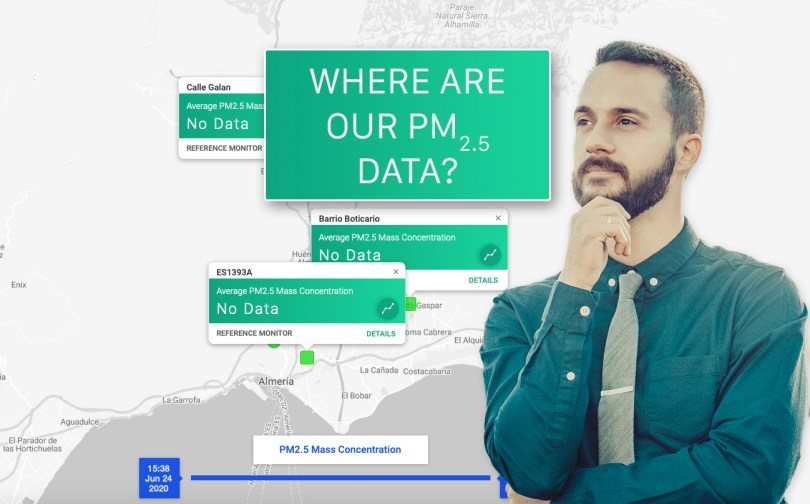
I am writing this article because I would like to help you understand the importance of the issue as the whole province and consequently my city Almeria doesn’t have an official air quality station with a sensor capable of measuring particulate matter with an aerodynamic diameter of 2.5 μm or less (PM2.5) in real-time.
What is Particulate Matter (PM)?
Particulate Matter (PM) are solids material (sometimes liquid too) that float in the air. Some PM is released directly from a specific source − combustion in Diesel engines − while others form in complicated chemical reactions in the atmosphere.
Particles in the PM2.5 size range can travel deeply into the respiratory tract, reaching the lungs. Studies also suggest that long term exposure to fine particulate matter may be associated with increased rates of chronic bronchitis, reduced lung function and increased mortality from lung cancer, and heart disease. People with breathing and heart problems, children and the elderly may be particularly sensitive to PM2.5.
The Problem
In the province and city of Almeria, there are three Air Quality Stations that measure many pollutants one of which is PM2.5. Unfortunately, these sensors are outdated and the results we get are ONE daily average value which is basically useless in my opinion. Apart from that, we need to wait for a month to get the results back after filing a form. I guess the same thing applies to the 68 stations all around Andalucia in total.
Citizens need real-time data in order to take action and reduce their exposure to air pollution. They also need better tools and maps where they can visualise where pollution is in order to avoid harmful exposure. There are already many studies supporting the correlation between air pollution and COVID-19 cases.Read More »
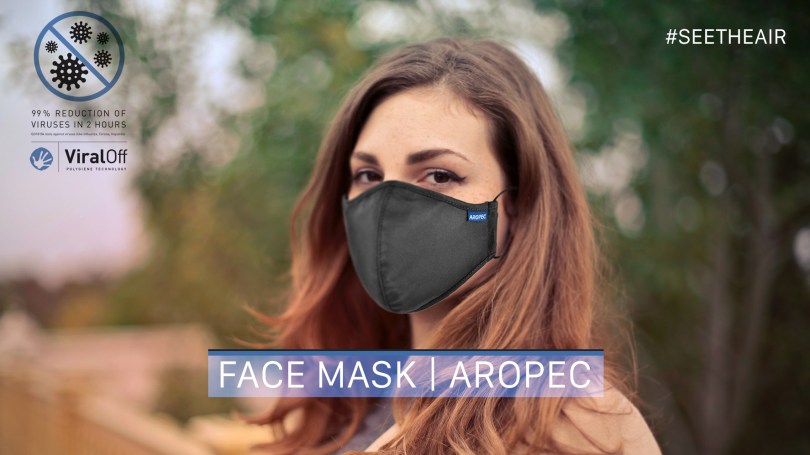
A lot of people are still reaching me and asking me to advise them on which masks should they purchase as they want to protect from the COVID-19 disease without breaking the bank, as some of the masks out there are quite expensive.
1st Outer Layer: Water repellent fabric with Polygiene “ViralOff” treatment. This is certified to kill 99% of viruses (like hepatitus, Influenza, Corona) and other bacteria. It has been tested against Influenza A, BirdFlu, Norovirus and Corona (SARS) over the years, and in all cases, have achieved 99% levels of reduction. It is certified to the ISO18184:2019 standard, which makes it legit and it is not just a claim.
2nd Middle Layer: Non-woven fabric with dust and particles filtration. Non-woven fabric is used generally in masks and is proving to be effective at capturing respiratory droplets and filtering PM2.5 particles.
3rd Inner Layer: Soft, moisture-absorbing and breathable fabric treated with Silver Ion Polygiene. Again, the Polygiene treatment captures and breaks down unpleasant odours, and is certified antibacterial, meaning it can protect the user from bacteria and transmission of droplets.









 See The Air