
Episode 9: Q&A – See The Air | Real Life Stories
This is the last episode of season 1 where I answer your questions!
This is the last episode of season 1 where I answer your questions!



This is the last episode of season 1 where I answer your questions!
My guest today is Robert John aka HUMAN SPACEMAN who is a purpose driven entrepreneur, visionary leader and innovator of human health improving solutions for property technology. Many say he was born do to make indoor environment better due to his severe childhood asthma and getting into the air cleaning industry with only 19 years of age. Today, over 20 years later he is the founder of Terraform Global based in London, UK
Linkedin: https://www.linkedin.com/in/robert-john-spaceman/
My guest today is Christian Saravia who is an Industrial Engineer, Master’s Degree in Water Resources Management; Postgraduate in Environmental Management from the University of Dresden Germany; Founder of the scientific project A M B E N T E in Guatemala.
This episode is available in English and Spanish.
Linkedin: https://www.linkedin.com/in/christian-saravia-s/
Twitter: @Chrisaravia

After the fiasco with the exposure notifications on smartphones which was designed by Apple and Google to facilitate digital contact tracing during the COVID-19 pandemic, we realized that governments weren’t ready to accept the terms of the service for privacy reasons probably and also users weren’t keen on enabling such feature probably for the same reasons.
We have to be able to monitor the situation in indoor environments beyond the location of an individual and we already do that with air quality monitors. Indoor air quality monitors help us see the air we are exposed to and when something isn’t right like high CO2 concentrations, we get notified to act by opening the windows or turning on the ventilation system, or eventually leaving the room if none of the latter are an option.
I propose to bring that kind of awareness to the indoor environments of transports, especially, in long-distance buses, airplanes, and trains as we spend substation time inside these transports and we all share the same air.
Most vehicles allow drivers to choose between outdoor air or recycled air. They never ever mention the benefits of fresh air (but not clean) to the drivers, so in most cases, drivers never change the settings. Have you ever been in a car for a long time, having the recycled air turned on? The drivers always complain about the lack of focus or energy and many passengers fall asleep. In most cases, this is due to the lack of oxygen and the high CO2 concentration which is scientifically proved to affect and decrease cognitive function.
The same thing applies inside an airplane. However, the pilots get the most oxygen from the rest of the occupants in the plane, but still, I am not sure if the bus drivers know about the indoor air quality (IAQ) of their buses and the outdoor air or where is the recycled air switch.
Not only that, we know that CO2 is a great indicator of ventilation rates and consequently indicates the viral load inside a transport. A viral load is a numerical expression of the quantity of virus in a given volume of air. The higher the viral load the most likely is to catch the virus, any virus, or pathogen.
Air quality data like CO2/PM2.5 are not as privacy-sensitive as location information and they can help us in mitigating the spread of diseases and improving our cognitive abilities and health. Clean air means healthy lungs, heart, and brain.
Indoor air quality monitors are relatively inexpensive and CO2 sensors can operate for up to 15 years. They will also reveal the truth about the air we breathe in cities. I know that not many council members want people to know that the air they are exposed to daily is poor and unhealthy but if you are a good politician with real morals and compassion for your fellow dwellers then you want the best for them.
So maybe it is time to start designing indoor air quality monitors for transports. They can work offline or online depending on the transport. Passengers can access the information as their ticket can host a QR code with the link of the specific monitor/transport/route. In the case of an off-line monitor then a display with clear readings will allow passengers and the staff/cabin crew of the transport to adjust the indoor conditions.
My guest today is Abhiir an active youth environmentalist from India.
Abhiir has worked on climate change for over 8 years – particularly on air pollution and waste segregation and has been identified by the BBC as among the foremost international youth environmentalists.
Twitter: @abhiirbhalla
Linkedin: https://www.linkedin.com/in/abhiirbhalla/
In this episode, James Heydon, who lives in Sheffield UK, will share with us his professional thoughts on air pollution.
James is an Assistant Professor in Criminology.
You may think, how can a criminologist shed light on air pollution!
Well, James is currently researching air pollution regulations, and his academic studies in human behavior could help us understand better why most people neglect to think about the air they breathe.
Twitter: @Jwheydon
[EN]
This is a dual-language episode. If you want to listen to the Spanish version please go to minute 18.
In this episode, Luis, who lives in Murcia Spain, will share with us his everyday experience with air pollution.
The main source of air pollution in his city and the general region is agricultural burning as citizens face the political unwillingness to address the issue. There is a law that prohibits the practice but it is not enforced.
[ES]
Este es un episodio de doble lenguaje. Si desea escuchar la versión en español, por favor, vaya al minuto 18.
En este episodio, Luis, que vive en Murcia España, compartirá con nosotros su experiencia cotidiana con la contaminación del aire.
La principal fuente de contaminación del aire en su ciudad y la región general es la quema agrícola, ya que los ciudadanos enfrentan la falta de voluntad política para controlar el problema. Hay una ley que prohíbe la práctica de quemas, pero no se hace cumplir.
Por favor, comparte y califica este episodio con 5 estrellas.

Impact-Site-Verification: 8822d984-d7e0-4efd-9190-e8b1d8a8a633
(Scroll down for the Spanish or Greek version of the review/Desplácese hacia abajo para la versión en español o Griega/ Μετακινηθείτε προς τα κάτω για την ισπανική ή την ελληνική έκδοση της αξιολόγησης)
_________________________________________________
It is not a coincidence that everywhere you look nowadays you see a small, square, and white monitor with a screen in the middle that displays some numbers! Well, this is Aranet4 which was developed by a Latvian company.
Aranet4 is a small and mighty CO2 monitor that surprise people for two reasons. First of all, it is very comprehensive, and secondly, most people are intrigued by the technology of the display as it uses an e-ink display and, to the untrained eye, looks like a simple sticker.
The commonly found AA batteries can operate the monitor for up to 2 years so you don’t have to worry about them. It uses a single channel non-dispersive infrared (NDIR) sensor technology for accurate CO₂ measurements, read more here.
I am very happy to announce that I am launching a new series of Podcast episodes where people from all around the world will be able to share their experience with air pollution and how it affects their lives.
The episodes will be available in all big Podcast distributional channels like Apple Podcast, Google Podcast, Spotify, and Spreaker.
In the first episode, we will hear Ediz from London, UK. Ediz is a clean air campaigner and he and his family members have to breathe lots of traffic-related air pollution as his neighborhood is jammed by hundreds of cars every day.
Read More »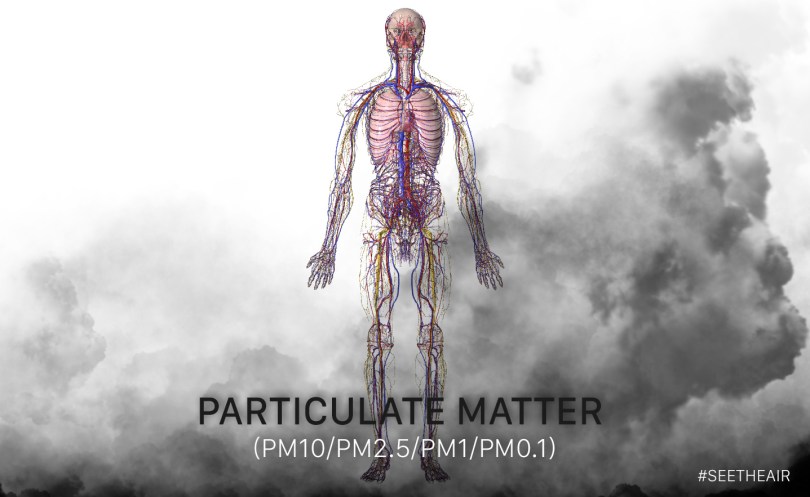
How deep can pollution particles go into the human body?


