Let’s forget at the moment that combustion vehicles emit carbon dioxide (CO2), and focus on the occupants that spend time inside a confined space where they emit CO2 due to metabolite of cell respiration. Vehicles form part of the indoor spaces where humans spend a lot of time due to traffic or because they have to travel long distances.
Regulatory bodies have been controlling many aspects of modern vehicles; tires, mirrors, seat belts, airbags, screens, etc. However, they have forgotten to look into the air quality inside the vehicles and how it affects the driver’s cognitive performance.
I had the chance to visit New Delhi and Agra in India due to an annual conference that we had to assist. I was well informed about the poor air quality in the area, so I was prepared to breathe some pollution. I have read many articles and heard many testimonials about the situation there but still, a visit in situ helps someone understand the issue on a whole new level.
Some weeks ago, I published an article on “Why is Air Pollution Invisible” and I think during my visit to India I experienced all of the points clearly.
Immediately, once you come out of the aircraft, you can smell the air pollution. It is everywhere, indoors and outdoors. Even waiting in the immigration line for clearance you can smell it. I didn’t have the instrument in hand at that point in order to measure the concentrations, but from my experience and because air pollution was visible due to high levels, I estimate concentrations of 100μg/m3 of PM2.5. I want to make clear that I was still indoors.
From there, I headed to the hotel in a taxi. As you may imagine, the air quality was not better, but quite the opposite as the fumes from the relentless amount of unregulated vehicles were spewing everything they had in their engines. Particles of all sizes and gas fumes. Interestingly, more than 90% of the vehicle in the streets were occupied by only one person, the driver. On top of the air pollution in the streets, you can add noise pollution as the use of car horns is a tradition in India.
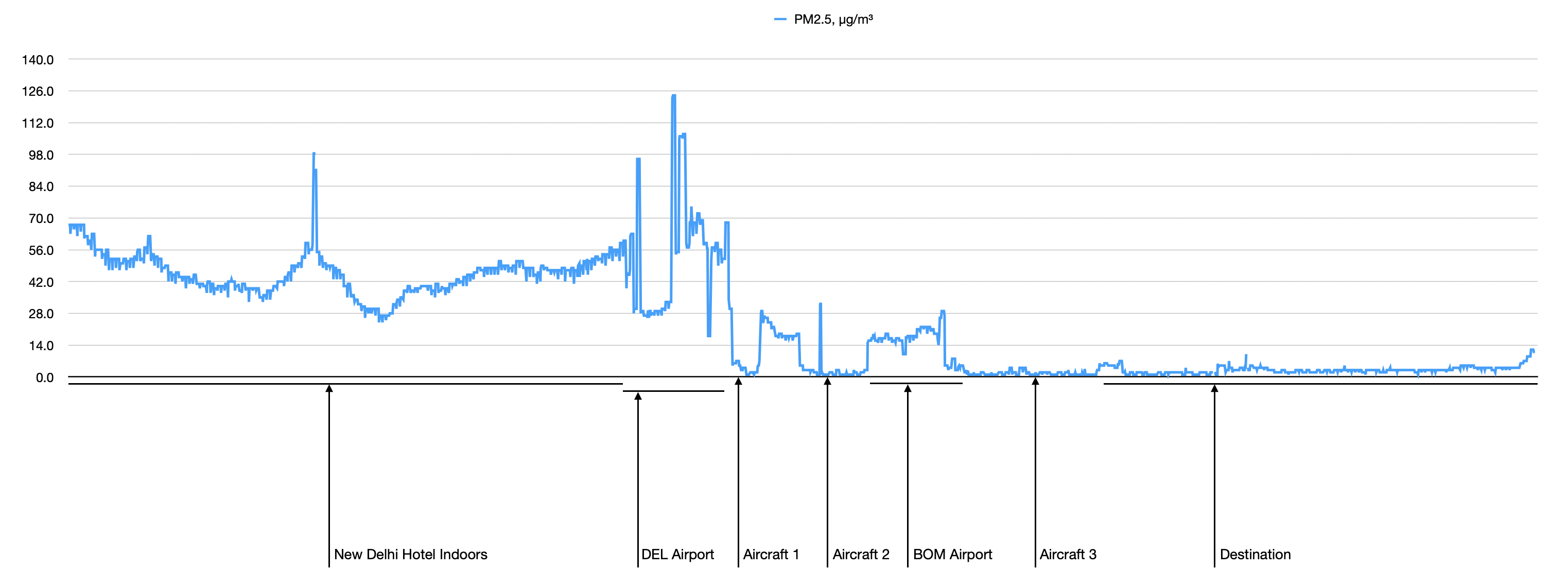
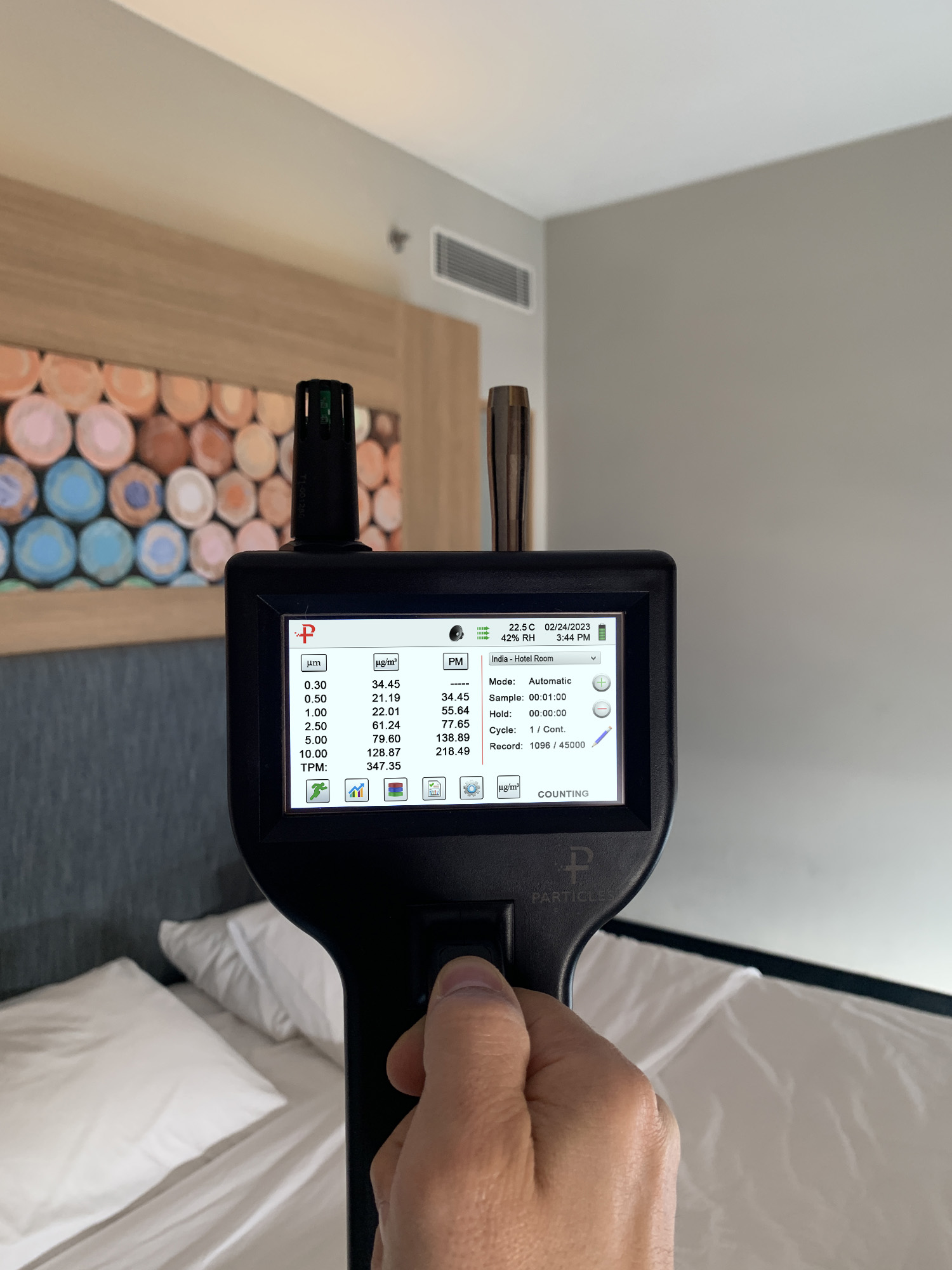
I managed to arrive at the hotel after a small accident with the car (no damages) where I took the air quality monitor out of my luggage in order to measure the conditions in the room. Unfortunately, it wasn’t safe either. The mean PM2.5 concentration during my stay was around 50μg/m3.
The hotel had some small air purifiers in the hallway, but the coverage area was too big for them to handle properly. I looked at the filters and they were pure black, who knows for how long they were running without replacement.
On day two, my nose didn’t register the smell of smoke anymore. I was one of them! Unable to smell the pollution and consequently remind myself that I need to find clean air. This is what happens to locals that don’t have options, eventually, they forget.
For simplicity, here you can see my PM2.5 exposure for the last date of my trip before coming back home. However, the particle counts for the smaller particles like 0.3μm and 0.5μm, which get lost with mass concentration values, were even higher reaching counts of around 400,000,000 particles per m3 and 40,000,000 particles per m3, respectively. By the way, according to the locals, I visited New Delhi during a good AQ time.
Enough with the AQ data, we know it is really bad, my main question was where all this air pollution comes from. Most people will tell me that it is due to vehicle emissions and domestic burning. Still, it doesn’t make sense though because the weather was warm and there was no need to burn logs for heating. Additionally, the issue was persisting all day and night. So after a conversation with a local professor, he pointed out that the main source was waste management. Basically, they burn garbage and these eternal fires create the smog that persists in the city and makes people really sick.
I talked about the car horns, but you will also hear many people cough. It’s normal as their lungs are suffering from chronic exposure to toxic air pollutants.
There is some good news, though. Once the local people realize the source of pollution as I did, they can fix it. New Delhi is populated by 15,000,000 people and I understand that the amount of waste they generate is equivalent to that number, but the management of the waste can’t be “burn it, it will disappear” because it doesn’t. Finally, vehicles need some kind of control and annual revisions that will force the drivers to maintain the car in optimal conditions like EURO 6 compliance does in Europe.
This is the first Artificial Intelligent (AI) written article on Indoor Air Quality. I was interested to see if technology understands the issue. I have done zero corrections. What do you think?
Indoor air quality (IAQ) is an important but often overlooked aspect of a home’s environment. Poor IAQ can lead to a variety of health issues, such as asthma, allergies, headaches, and other respiratory and cardiovascular problems. Given the health risks associated with poor IAQ, it’s important to understand the sources of indoor air pollutants, the measures you can take to reduce them, and the steps you should take if you suspect your home has a IAQ issue.
Indoor air pollutants come from a variety of sources, including mold, dust mites, pet dander, pollen, chemicals, and building materials. These pollutants can enter your home through open windows, ventilation systems, and other pathways. Poor maintenance of these sources can lead to an increase in the amount of pollutants in the air. For example, failing to regularly clean carpets and filters can lead to an accumulation of dust and other contaminants.
One source of indoor air pollution that is often dismissed is wood burning. Wood burning can produce both direct and indirect air pollutants, such as smoke, soot, and other particulate matter. The smoke can contain a variety of hazardous compounds, such as carbon monoxide, nitrogen dioxide, and formaldehyde. In addition, the smoke from wood burning can also contain other pollutants, such as volatile organic compounds (VOCs). All of these pollutants can be hazardous to human health, particularly if the exposure is prolonged.
Fortunately, there are several steps you can take to reduce the levels of indoor air pollutants and improve the quality of your home’s air. Regularly cleaning carpets, upholstery, and other surfaces can help reduce the amount of dust and other allergens in the air. Additionally, regularly changing the air filters in your air conditioning and heating systems can help reduce the amount of dust and other particles in the air. Finally, using an air purifier can also help reduce the amount of indoor air pollutants.
If you suspect your home has a IAQ issue, it’s important to take steps to investigate and address the problem. The first step is to identify the source of the problem. This can involve hiring professionals to assess the air quality in your home, as well as conducting tests to identify the specific pollutants in the air. Once the source of the problem has been identified, you can then take steps to address it, such as improving ventilation, cleaning regularly, and using air purifiers.
In conclusion, poor IAQ can lead to a variety of health issues, including asthma, allergies, headaches, and other respiratory and cardiovascular problems. Therefore, it’s important to understand the sources of indoor air pollutants, the measures you can take to reduce them, and the steps you should take if you suspect your home has a IAQ issue. By taking steps to reduce indoor air pollutants and address the sources of IAQ issues, you can help ensure your home’s air quality is as healthy as possible.
When it comes to indoor air we have to be very careful because common activities can deteriorate the air quality very fast. Apart from the fact that we spend a lot of time indoors, an indoor environment needs more time to recover once air pollution become present because houses tend to be very tight and don’t allow the dilution of pollutants as fast as ambient air.
Even people that are very conscious, like myself, commit mistakes. The other day, for example, I was preparing caramel syrup for a holiday dessert, and as I wasn’t paying attention to the caramel (because I was multitasking), the caramel burnt. In a matter of seconds, IAQ dropped significantly. VOCs and PMx concentrations rose. At that moment and based on the outdoor conditions, I decided that it was more appropriate to open all windows in order to dilute the pollutants fast. Cross ventilation to the rescue!
Join my webinar on January 11th 2022 at 10:00 AM EST as I discusses Indoor Air Quality (IAQ) from A to Z. Effective measurement of IAQ reduces the health risks associated with poor indoor air, creating a safer, more harmonious environment for people to thrive.
We spend up to 87% of our time indoors. In some cases, exposure to indoor air pollution can lead to acute and chronic respiratory illnesses, including asthma, lung cancer, pneumonia, systemic hypertension, and chronic obstructive pulmonary disease (COPD).
Finally, I will discuss the common sources and pollutants indoors, international IAQ standards, and many more.
Let me tell you from the beginning it is not an easy task. Odors are VOCs, sulfur-containing compounds, and nitrogen-containing compounds. In most cases, odors come from rotten food inside the garbage bin or off-gassing materials that are new and of a low-quality like furniture, paint, and flooring.
Sulfur-containing compounds like hydrogen sulfide (rotten eggs smell), dimethyl sulfide (rotten cabbage smell), etc are produced during the anaerobic breakdown of food waste. They have a low odor threshold, which means that we can smell them even in only very small amounts.
Nitrogen-containing compounds like putrescine (rotting meat smell), trimethylamine (fishy smell), etc have a low odor threshold. Unlike ammonia (pungent smell) which is produced in large quantities, it has a higher odor threshold, so doesn’t contribute to indoor smell as much.
Another source of unpleasant odor indoors is the combustion of cigarettes/wood as the chemicals released from the burning biomass can infuse inside the walls and textiles. They call it thirdhand smoke as the residual contamination from smoke lingers indoors, and the cancer-causing substances such as formaldehyde can harm us.
There are countless times that I stretch the importance of monitoring and managing indoor air quality by keeping an eye on the outdoor air quality/conditions.
In this experiment, I want to demonstrate that it is hard to manage indoor air. I want to state that indoor spaces should be subject to 24/7 monitoring and not a periodic inspection.
The graph below demonstrated that indoor AQ gets influenced by outdoor air and on top of that, the polluted air lingers for a longer time indoors unless there is a mitigation plan (aka filtration) in place.
You probably have seen “cozy” images of fireplaces or wood stoves with happy people, a blanket around them, and a hot beverage and you may have thought that’s something very appealing, I want that! Well, I would suggest thinking twice before taking that decision and if you have already taken it, maybe it’s time to undo your mistake.
You see, people get sick thanks to these “cozy” elements in houses. It’s very hard to undo the brain wash the wood stove industry has done all of these years but we have to realize that wood burning is neither sustainable nor healthy.
Many claims that biomass is sustainable but this is a myth. A story designed to push people into spending money for status or simple ineffective heating. You see, clean energy (wind, solar, etc) doesn’t require the user to buy fuel, logs, or pellets every season. It is there for us but doesn’t generate constant revenue for the companies.
One will think that the more modern the house, the better the indoor air quality. However, that’s not always the truth as recently I discovered that many houses have inadequate appliances that will create harmful air pollutants and some of them will falsely mitigate contaminants by creating a false sense of remediation.
Example #1
Gas cooktops are a must according to good chefs as the pans are able to heat immediately and you have more control of the heat. That’s not true as the new induction cook tops are able to heat the bottom of the pans as fast without releasing harmful pollutants like Nitrogen dioxide.
Not lots of people are ready to accept the truth or understand it. We dismiss important information when it is not visible “out of sight, out of mind” and we get influenced when something is shiny and pretty.
Productivity
Poor air quality won’t kill you (at least not immediately and depending on the pollutants), but do you want to be an average employee, athlete, parent, student, or the best? Do you want your employees to work in mediocre conditions and perform poorly, or do you want them to be vibrant and productive?








 See The Air