More and more people choose to ride a bike for their daily commutes and although SODAQ AIR is not the first air quality monitor for a bike, it is the first to have collected over 20M data points. This is particularly import for the development of an IoT air quality monitor as the developers have enough information to debug and develop a super stable product that needs very little troubleshooting from its users.
SODAQ is not a new company as it was founded back in 2013, and they have been working on this particular project (SODAQ AIR) alone since 2015. It seems that consumer satisfaction is always their priority, which is very important nowadays as we need sustainable products that will last for a long time.
In the space of ambient air quality monitoring, there are two basic and distinctive categories of professional air quality monitors; the High-End Professional and Low-Cost Professional monitors. I have been asked multiple times to recommend monitors for scientific studies and the deployment of them in cities.
It is very important to understand the strengths and weaknesses of both categories. It is also mandatory to recognize the fact that we will never get the exact same measurement from either category of sensors.
High-End Professional AQA
High-End Professional ambient air quality analyzers are used mostly by governments inside the air quality stations we have in most cities. Their strength is that they meet international standards for accuracy and they are certified by the EU (and similar bodies) to meet minimum performance requirements, in order to ensure that the measurement methods comply with the Data Quality Objectives set down in the Ambient Air Quality Directive (2008/50/EC) and in the amending Directive (EU) 2015/1480. Their weakness is that they require lots of energy to operate. In most cases, they are inside a fixed container with a refrigeration system to keep conditions stable. They are big and boxy in size and very expensive to purchase and operate. Additionally, they need constant maintenance by a technician. Another weakness is that in most cases these analyzers are not smart enough to broadcast measurement in real-time to the Cloud and they require other pieces of equipment to do that job, as a result, the cost of operation increases.
The need for indoor air quality monitoring solutions hasn’t stopped increasing due to two main factors. The market is constantly demanding tailored solutions to meet Green Building standards and, of course, Covid19. Many have bought cheap and generic indoor AQ monitors from big retail stores, but after a while, they realized that their money went down the drain as there is nothing they can do with the data they obtained for two reasons. The AQ monitors didn’t keep the measurements or the accuracy of the data was poor.
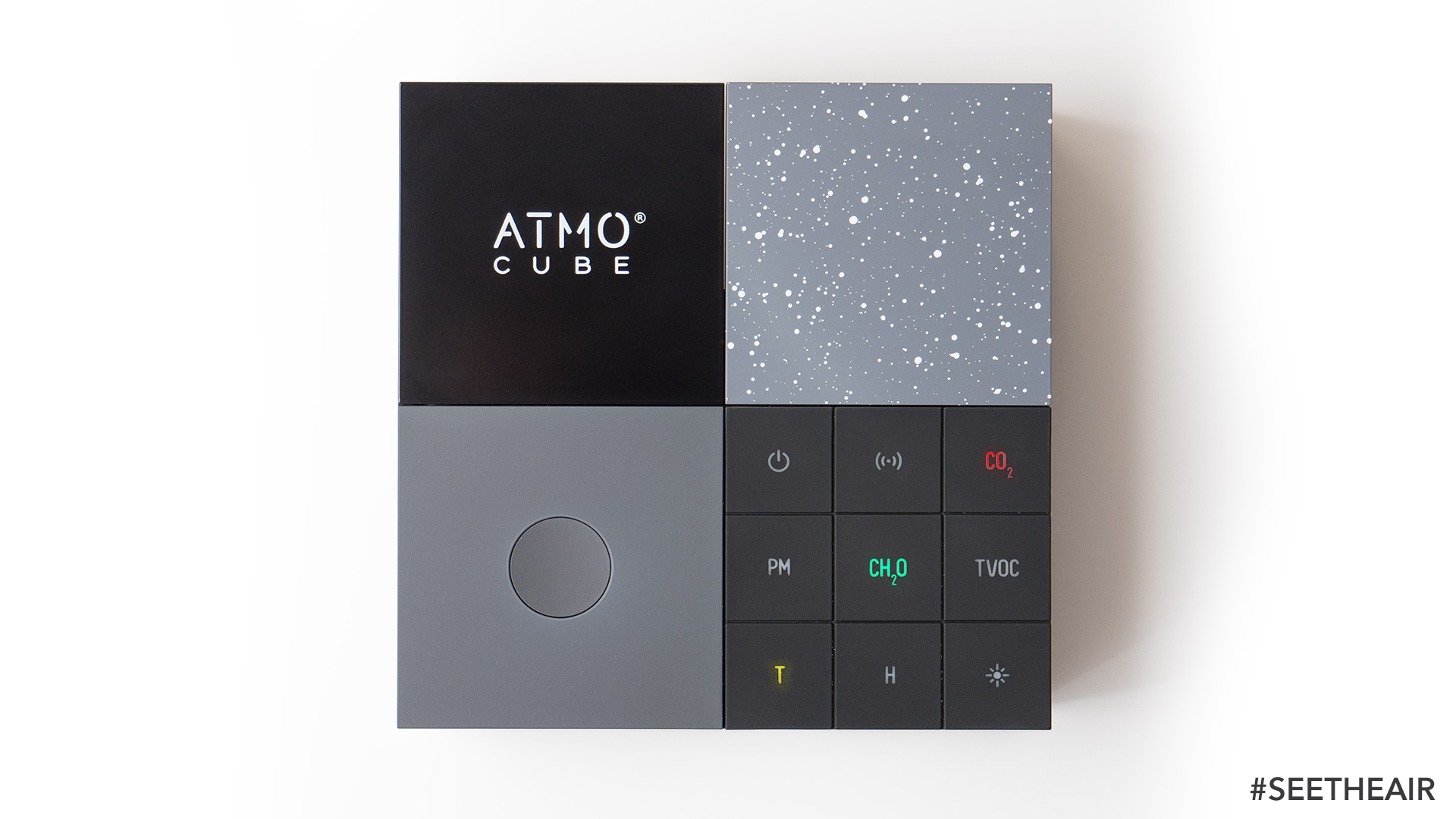
Here comes Atmocube, a new indoor air quality monitor designed entirely to meet occupants’ requirements for indoor air quality. The design language is modern and functional. I underlined functional because you don’t need to be an expert to understand what is wrong with the IAQ and which specific parameter you need to address, I will explain more about it in a minute. Finally, the monitor is full of superb sensors, nine to be exact.
Time to talk seriously about ambient air pollution and how technology can help us see and consequently mitigate it. According to a 2016 report, the annual cost of air pollution has to the global health care system has risen to US$ 176 billion from US$ 21 billion in 2015 and the number of workdays lost to air pollution-related illness bounces to 3.7 billion from 1.2 billion. According to another report, ambient air pollution kills more than 3 million people across the globe every year but more importantly causes health problems that increase the annual health care budget.
Unfortunately, air pollution is not taken very seriously by governments and society because we tend to dismiss things we can’t see or understand. Here comes Kunak which is one of the leading companies in the field of monitoring air pollution accurately. Recently, the monitor Kunak Air PRO has been rewarded at the AirLab Challenge 2021 as the most accurate multi-pollutant ambient monitor and it is made in Spain.
Experts, academics, the city, and policymakers all need air quality monitors in order to quantify the ambient air, get the right conclusions about the situation, and finally, make the right decision on how to mitigate the pollution and the health care costs. As you can understand the accuracy of the monitor is very crucial and Kunak delivers great results.
In December 2021, I introduced Particly, a mascot which I will use as a tool to educate people about air pollution through social media. What you don’t know is that Particly is available as an NFT art and collectible since then. A non-fungible token (NFT) is a unique and non-interchangeable unit of data stored on a digital ledger. NFTs can be associated with easily-reproducible items such as photos, videos, 3D models, audio, and other types of digital files as unique items. Air Quality deserves a place in the WEB3 Metaverse in an effort to raise awareness.
For those who know me, I always look ahead in time in my effort to find different ways to embrace awareness and engage people. I love new challenges.
Countless times I have mentioned that we need to monitor indoor and outdoor air quality. This is an essential step in order to have a holistic approach to air pollution that surrounds us in both environments. Unfortunately, not everybody can afford to buy two monitors but thanks to the community and AirGradient there are two DIY solutions that can help us monitor the air quality quite accurately and of course, manage the air we breathe better.
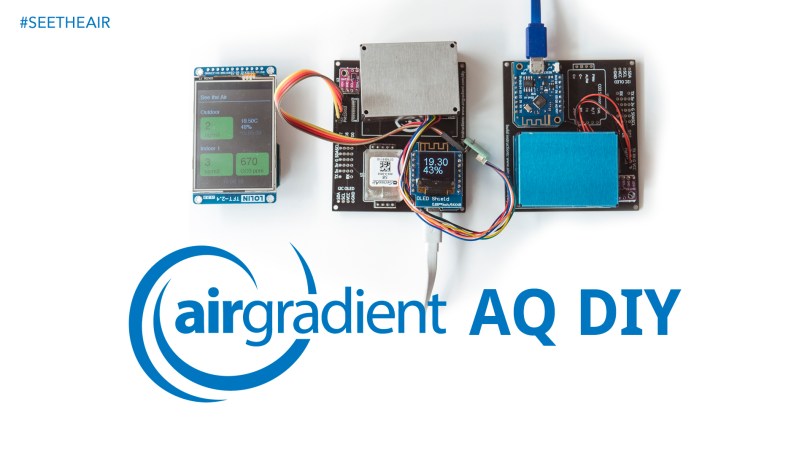
AirGradient’s DIY solution is more appealing than the competition for many reasons. First of all, you can buy directly the DIY Kit with all the electronic components from them including the PCB. The PCB is the board where we will deploy all the sensors, WiFi module, and display. That is a huge benefit because you don’t have to search on the internet and purchase the components one by one. The well-designed PCB will also help us keep the monitor neat and small without unnecessary cables. Secondly, Air Gradient’s DIY AQ Monitor is very customizable allowing us to build an indoor monitor with an NDIR CO2 sensor but another one without a CO2 sensor or display for the outdoor environment. If you don’t want temperature/humidity sensors you can easily omit them too, but I highly recommend them. Moreover, there is software support as a community of passionate people have been improving the firmware constantly. Finally, the solution comes with a web dashboard where you can manage all the monitors and take advantage of the histograms and tools like the alerts.
Additionally, the devices which are connected to the cloud and the dashboard can broadcast the measurements back to a separate display (Viewport) which allows us to see the air quality indoors and outdoors like in the example below. Isn’t that very cool?
It has been a long time since I soldered something, so I was very happy to build the monitor. I built two monitors by following the fairly easy instruction here. There is also a video with the instructions here by Jeff Geerling.
In a previous post, I presented Airthinx IAQ for Homeowners and how an advanced AQ monitor can be used for indoor environmental monitoring. In this post, we will explore how we can use the same monitor but in business environments (offices, industrial buildings, food supply chains, etc).
We will focus on the tools present in the dashboard as it is one of the best dashboards you will find in the market, and we will learn how to get the most out of it.
Let’s begin with the Dashboard – Home. Here we can create various types of widgets and arrange them according to our preference. First, you can see that I have created a column with all the current measurements with small graphs of the environmental parameters. Right next to it, I always watch for the general AQ, PM2.5, and Humidity. Below I have more widgets with other graphs and values that I want to have a glance.
Dashboard – Home
Next, we can see the Map tab. Here we can locate all the available monitors in a high precision as the monitors come with a GPS module, however, we will see later that we can manually set the location of the device.
SPEC Sensors was founded in 2012 in the USA (California) by Dr. Joseph Stetter and Ed Stetter. Their gas sensors, analog and digital, are one of a kind as the technology and hard work has allowed them to minimize the sensor size to only 20x20x3 mm in order for gas sensing to become a part of our everyday lives. The company has foreseen that sensors of all types are going to be integrated into smartphones and other wearable devices, becoming an integral part of our everyday lives and building the Internet of Things (IoT).
IoT low-cost sensors are in my DNA as I believe they will allow us to understand environmental issues otherwise, we would have dismissed or we would not be aware.
Let’s read together what they have to share with us and reach a conclusion at the end.
Interview
Tell us a bit about your motivation in developing air quality sensors?
We saw the need and opportunity for low cost electrochemical sensors with good performance – before SPEC, high performance sensors were too expensive and too big to enable new applications in wearables and distributed monitors. SPEC was born out of the research driven by Eco Sensors / KWJ Engineering, Inc. led by Dr. Joseph Stetter.We were able to build SPEC Sensors using modern technology in a new high performance plastic package.Read More »
Masks provided decent protection against the SARS-CoV-2 but if a carrier of the virus (40% of them are asymptotic) stays inside a home/business for a long time then the chances of transmitting the virus are higher because some particles may escape.
According to experts the best way to prevent the spread of the virus is to keep introducing fresh air inside a room.
Unfortunately, most rooms don’t meet the recommendation of 8 air changes an hour for a 10 square meter (107 square foot) room occupied by 4 people. A clear example is a classroom that doesn’t meet the recommended ventilation rates. This is a common mistake across all schools in the world.
In my city (Almeria, Spain) there are two stations that measure the local Air Quality.
Let’s analyze them and see if they are located in the correct places and if they feature the necessary instruments for measuring the AQI properly.
The Background
It is located in “El Boticario” a park 10km outside of the city center. The coordinates according to an official document from“Junta de Andalucía” are UTMX:554439 and UTMY:4080272, but they aren’t correct (Not so professional). The real coordinates are UTMX:554319 and UTMY:4080066. This station seems to work well although they don’t feed the data in real time to the public and quite often is down.








 See The Air