Review: BRISE C360 Air Purifier

There are a few things you can do to reduce air pollution indoors like keeping things tight and clean, not smoking, using exhaust fans when you cook, and ventilating the rooms, but at the end of the day if the air pollution comes from outside sources then you need to take drastic measures and there is only one solution, investing in an air purifier.

There are many air purifiers on the market for all types of budgets but you shouldn’t expect a cheap air purifier to offer the same features and purification results as a high-end purifier. By the way, air cleaners and air purifiers are the same things.

BRISE C360 is a high-end purifier capable of purifying up to 95 m2 or 1022 ft2 room and rated CADR at 390 m3/hr or 230CFM. It is recommended for medium size rooms and it packs a ton of features.

Read More »

Review: Airthinx IAQ for Businesses

In a previous post, I presented Airthinx IAQ for Homeowners and how an advanced AQ monitor can be used for indoor environmental monitoring. In this post, we will explore how we can use the same monitor but in business environments (offices, industrial buildings, food supply chains, etc).

We will focus on the tools present in the dashboard as it is one of the best dashboards you will find in the market, and we will learn how to get the most out of it.

Let’s begin with the Dashboard – Home. Here we can create various types of widgets and arrange them according to our preference. First, you can see that I have created a column with all the current measurements with small graphs of the environmental parameters. Right next to it, I always watch for the general AQ, PM2.5, and Humidity. Below I have more widgets with other graphs and values that I want to have a glance.

Dashboard – Home

Next, we can see the Map tab. Here we can locate all the available monitors in a high precision as the monitors come with a GPS module, however, we will see later that we can manually set the location of the device.

Read More »

Top Free Air Quality Index (AQI) Apps

Globally, climate change has driven many catastrophic events like the huge wildfires in Australia and on the USA west coast. More and more people reached my blog to collect information about which Air Quality Monitor should invest in and which app should they download to get information about the air quality in their area.

Here are the TOP 6 Air Quality Index Apps that have helped me and others see the air, and they are free.

#1 Breathe

iOS by Tobias Tiemerding | 24MB | Free
v3.0 (beta)

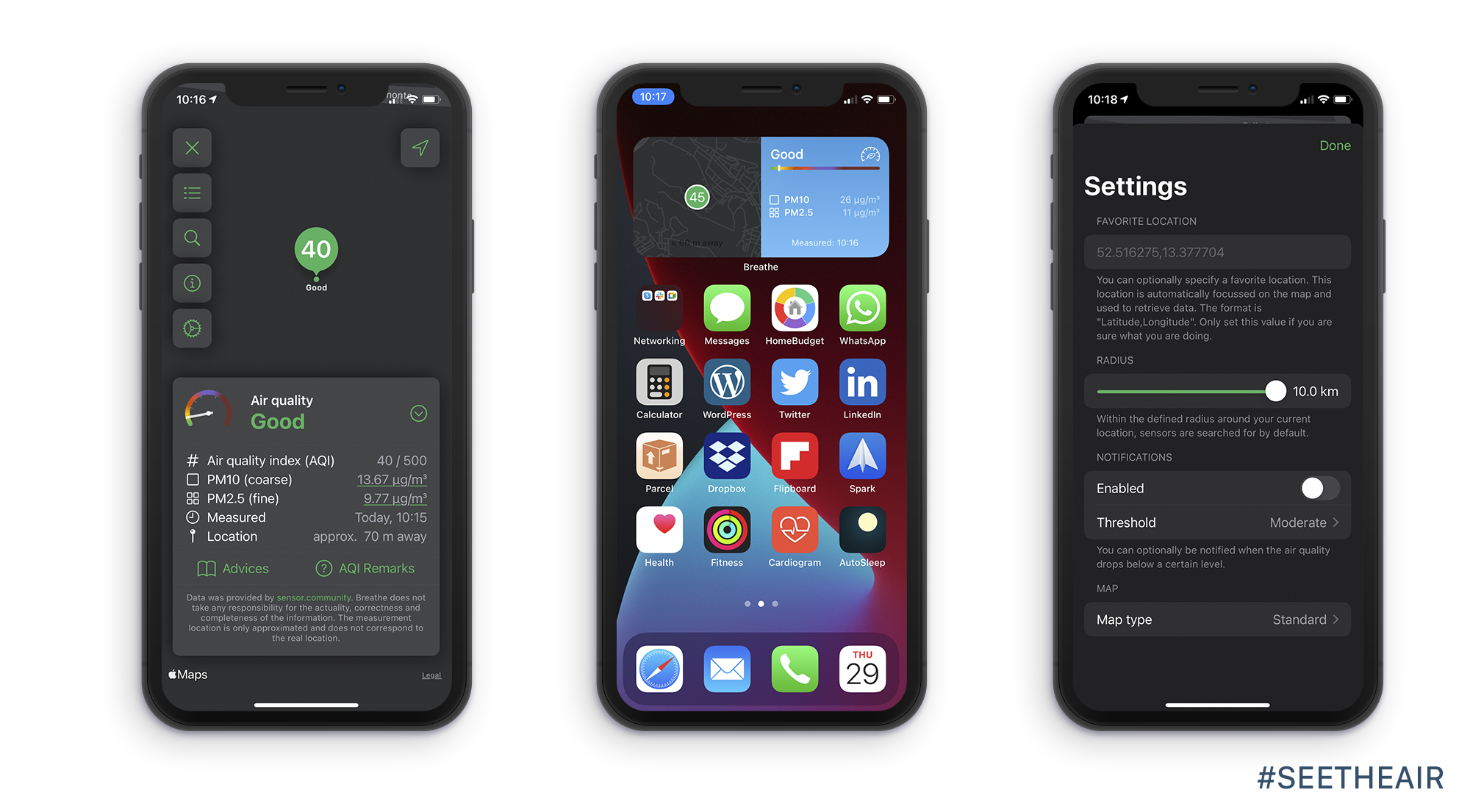
Breathe is a great app for European citizens as it will pull data from the Sensor Community (formerly known as Luftdaten) server and will inform you in an instant about the Air Quality near you. You don’t have to own a monitor as long as there is one available in a radius of 10Km, and in case there are many monitors then it will pull data from the nearest from you. Thanks to the new update, it supports iOS 14 Widgets so you don’t even need to launch the app anymore, just place a tile into your home screen and you are ready.

#2 Local Haze

iOS by HumanLogic | 20MB | Free
v1.5.0

Local Haze is another great app similar to the Breathe, but it combines information from many sources including the Sensor Community with over 12,000 sensors, PupleAir, and uRad Smoggies. Also, it is available globally. You can choose your favorite monitor, and it also provides the confidence rating, that way we know which measurement to trust more.

#3 BreezoMeter

iOS & Android by BreezoMeter | 71MB | In-App Purchases
v3.5.1

BreezoMeter is the app with the most experience in the field of air quality, as the company behind it is leading the industry. Apart from air pollution data, it offers a pollen forecast for those who suffer from seasonal allergies. It uses its propitiatory AQI algorithm called BAQI to give a better insight of the air pollution in your area. Finally, it offers an air quality forecast for up to 6 hours.

#4 Plume Labs

iOS & Android by Plume Labs | 283MB | Free
v3.2.2

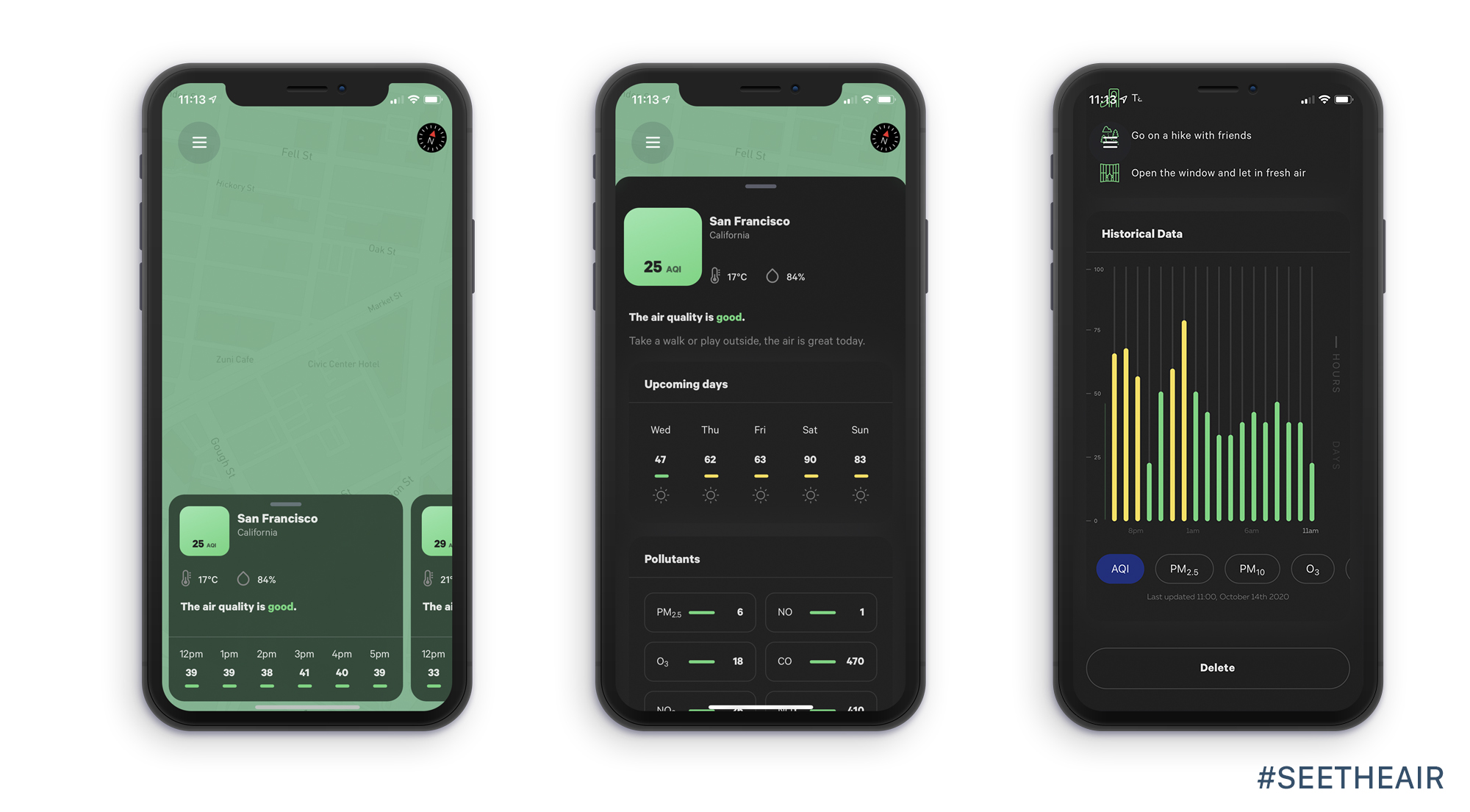
Plume Labs is another app with great experience in the field of air quality. It also uses a propitiatory AQI algorithm called PAQI but the company allows users to switch between one of the major AQI algorithms like US EPA AQI, Europe CAQI, China AQI, and Abu Dhabi ADAQI. Another feature that distinguishes Plume Labs is the air quality forecast for up to 4 days. Finally, it supports dark mode.

#5 Airly

iOS & Android by Airly | 25MB | Free
v1.13.2

Although Airly app was designed to support the Airly air quality monitors, it also supports PupleAir monitors and EPA stations and it is powered by Dark Sky service which was recently bought by Apple Inc. It supports dark mode and it is compatible with the US EPA AQI and the European AQI CAQI. Very fast responding app and visually pleasing.

#6 Live Air

iOS & Android by Origins Technology Limited | 50MB | Free
v3.1

Live Air (formerly known as Kaiterra Global Air Quality) is designed as a host app for the air quality monitors of the company (Kaiterra Laser Egg series). However, the company also focuses on ambient air quality data, and with the latest update, they have managed to combine both sources of air quality information (indoor and outdoor) elegantly.

Review: Airly PM + Gas

There is an enormous demand for air quality monitors in cities near forests that are susceptible to wildfires. Climate change has driven huge increases in wildfire area burned over the past few decades, and air quality data can help us protect public health more than ever.

Watch out! Wildfires are not the only source of air pollution in cities. Urban lifestyle with huge diesel/petrol SUVs and delivery trucks moving all around the city all day long emit huge amounts of toxic pollutants (NO2, CO, UFP, etc…) and during winter season wood stoves emit extra 12 times more PM2.5 pollution into the air we all breathe as a result they create an unhealthy environment for all.

Airly is an aspiring company that tries to empower individuals and communities with knowledge about the air they breathe by offering three different monitors that will meet the needs of a different situation. The Airly PM with is the basic version and measures particulate matter PM10, PM2.5, and PM1.0, the Airly PM + Gas (NO2 + O3), and finally, the Airly PM + Gas (SO2 + CO).

For this review, I will present to you the Airly PM + Gas (NO2 + O3) as I believe it represents better the urban environments free from industrial sites. In my city, the number one pollutant is ground level ozone as there is a huge production and transportation of vegetables and fruit all around Spain and Europe and plenty of sunlight.

Keep in mind, ground ozone forms from the interaction of nitrogen dioxide and some other pollutants with UV radiation from the sunlight.

Read More »

Outdoor Air Quality Monitors 2020Q4

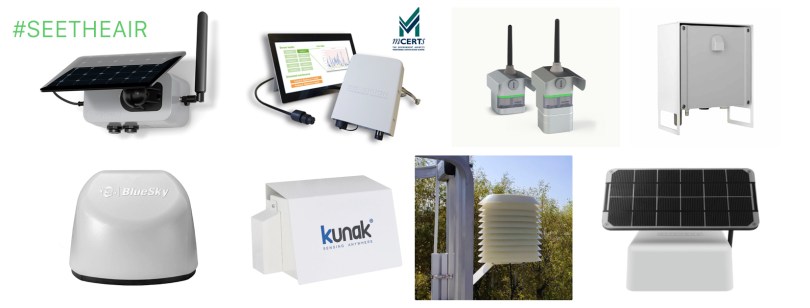
Since my last update of the outdoor (ambient) air quality monitors list back in 2018, new products have been released into the market for various purposes and different budgets. Air quality monitors for professional use in cities and industrial sites and homeowners who want to supervise the ambient air quality outside their houses/apartments.

Read More »

Fitness Air Quality Monitor, is that possible?

Over the years, I have spoken with many companies in the field of air quality and once in a while, companies will tell me that they want athletes to purchase their devices in order to improve performance. I am always skeptical about this because I haven’t seen any integration of fitness data with the AQ monitors so far that could give some possible adverts or ways for the athlete to improve their performance. You don’t expect people to make assumptions you have to give them results and guide them in the right direction.

During covid-19 lockdown, I worked out at home and as I have access to a lot of data (fitness and air quality) I decided to make some experiments and see how my body reacts to poor indoor air quality and good indoor air quality and if the whole hypothesis works.

Smartwatches are very common these day and all of them feature a heart rate monitor and many more sensors. Recently, Apple and Fitbit released pulse oximeter sensors in their latest wearables. These new sensors in the smartwatches could unlock many more potentials and provide us with data that could save lives.

Let’s continue with the argument of what current AQMs could do if they combine fitness data. First of all, there is a possible problem. In case the monitor is stationary then it won’t be able to tell if the user was near the device or not during the workout session but this could be addressed as most times fitness data come along with GPS coordinates. By allowing the device to access the location data only when the user is in the same location as the AQM (home, gym, etc.) we solve the issue. Another possible solution is if the monitor comes with a Bluetooth/Ultra Wideband chip then it can easily sense the presence of the athlete/individual.Read More »

Review: SPARROW W500

We have discussed a lot of times how air pollution can affect human health in the long-term. However, there is one pollutant that can have a severe impact on our health even in small concentrations in the short-term: Carbon Monoxide (CO).

Carbon Monoxide is a colourless, odourless toxic gas. Carbon monoxide poisoning is the most common type of fatal air poisoning in many countries around the world because it is hard to detect with our senses and it is classified as highly toxic.

About half of the carbon monoxide in Earth’s atmosphere is anthropogenic from the burning of fossil fuels (diesel and gasoline), oil, paraffin, propane, natural gas, trash, and biomass.

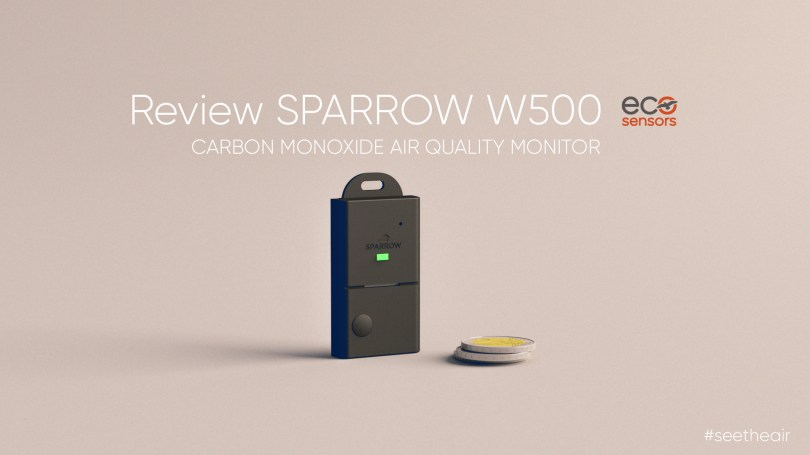
Here comes SPARROW W500 Air Quality Monitor by ECO SENSORS, a small portable monitor that can follow you anywhere. It is designed to alert you when high CO concentrations are present.

Hardware

  • Carbon Monoxide Sensor by SPEC Sensors
  • Humidity Sensor
  • Temperature Sensor
  • Alarm (audible buzzer)
  • Multicolour LED Light
  • Bluetooth Connection
  • Micro-USB port

SPARROW is super small  5.6cm x 3.3cm x 1cm and super light as it weighs 18g/0.03 lbs. You can pair it with a smartphone (iOS and Android) but also it can operate on its own as the buzzer and the Yellow/Red/Purple LED light can notify you when there are significant CO concentrations around. When the CO concentrations are safe the Green LED light will always flash once per second, except when charging, after all it can inform you about the CO concentrations without the need to launch the app or take your phone into your hands.

The battery will last 2 plus weeks, which is great for those who don’t want to charge one more device every day or so. I have set it with a 1 minute data log rate. The device has a button that you need to press every-time you want to connect it with the phone, that way the Bluetooth connection is established at the moment, otherwise the SPARROW would have to be in a mode where it was always broadcasting for Bluetooth signal, which is a huge power drain for both devices, phone and the air quality monitor.

Fortunately, my house is CO free as I don’t burn anything but we all travel and for those with a garage it is a mandatory device to have. In the picture below you can see the device inside a closed jar with smoke from a burning match as I wanted to stimulate the sensor and simulate the CO concentrations. I must say the CO sensor is a lot more stable and cross-sensitivity proof which means other gases won’t affect the measurements.

SPARROW_Jar CO

SPARROW comes with a carabiner clip but there is an option to attach it on the back of a phone case with a special mount system the case maker OtterBox has developed and they support many cases for iOS, Android phone, and tablets.
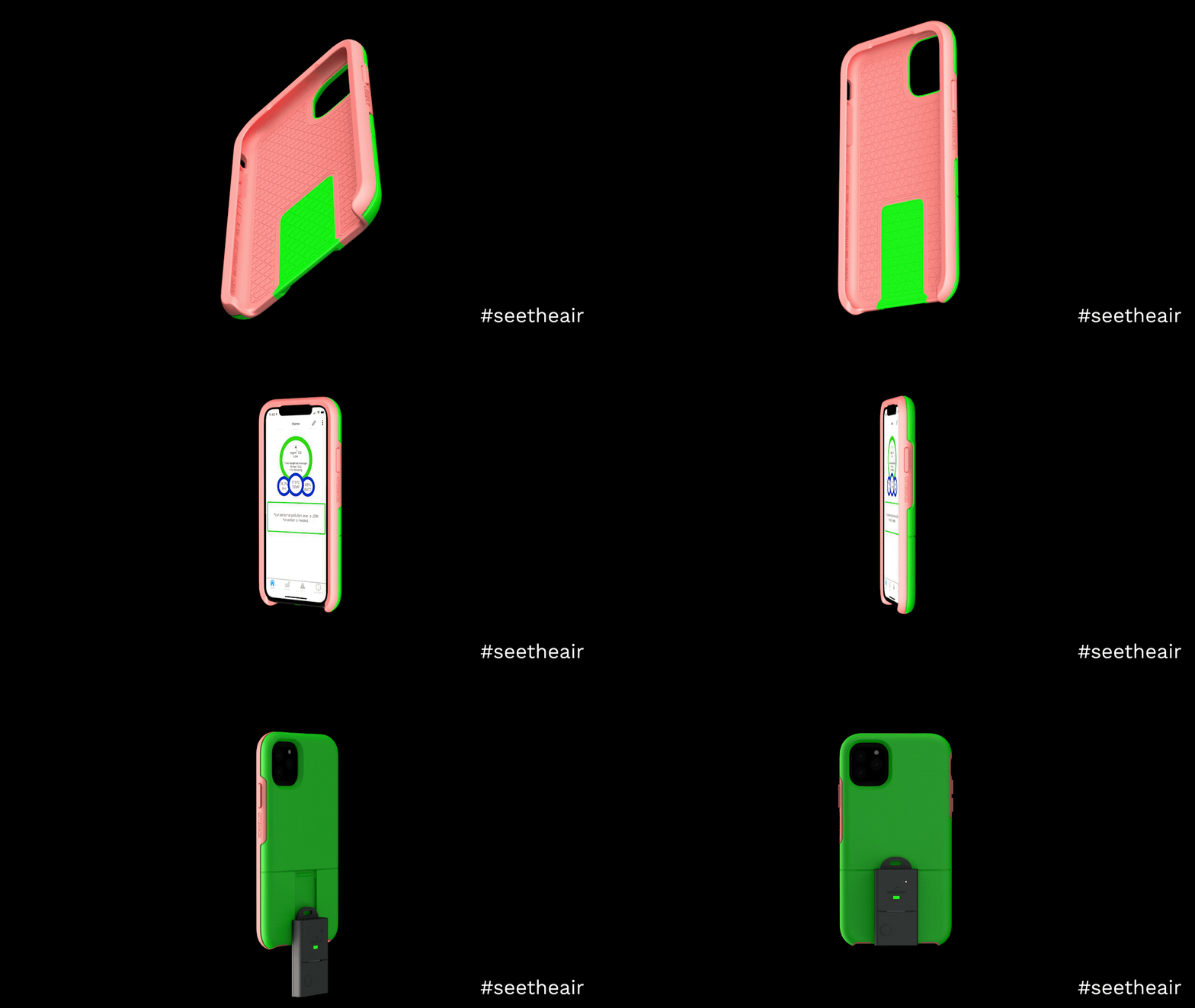
SPARROW Animation Case

The App

Visually, the app is not pretty but it does the job. There are a lot of options to tweak and to adjust the app and device to your needs but it lacks a better user experience UX though a better user interface UI. Of course, this is something that can be fixed with future app updates.

You can share the measurements (data Log file) via email which is a neat feature but they go a step further and you can connect the device with the micro-USB cable to your computer and enable direct communication, however, this is an advanced feature.

The app allows you to select different data log rates between 1 second / 10 seconds / 1 minute / 10 minutes / 1 hour / 1 day. There is another cool option to enable if you want  the device not to keep low CO concentrations in the log file, that way you don’t have a huge  amount of data entries to process later on, like in my case.

Literally, you can customise the device to your needs even by changing the Sensitivity mode for different thresholds. You can measure in parts per million (ppm) or milligrams per cubic meter (mg/m³). You can set up emergency messaging by allowing SPARROW app to send messages to emergency contacts when very high concentrations are detected.

Premium mobile phone screen mockup template


Conclusion

Breathing CO can cause a series of health issues. Unknowingly, exposure to moderate levels of CO over long periods of time has also been linked with an increased risk of heart disease. If your environment is surrounded by vehicles (suitable for #VanLife) or other sources of burning fossil fuels then having such a device that can guard your health is worth investing in. SPARROW W500 is one of them.

When is the best time to Exercise Outdoors in Athens, Greece?

Well, in winter and early spring never, period! If you are thinking of running or even walking in the center of Athens in Aristotelous street and around then prepare yourself to breathe a lot of pollution.

There is an official air quality station there and I pulled all available data for local statistical analysis from the European server (GR0003A). Unfortunately, 2019 nor 2020 measurements are available to the public yet, maybe in a decade, they will share the data for the Greeks to read. (Τι κάνεις έλληνα και δεν παραπονιέσαι για τον αέρα που αναπνέεις;).

Air Quality Station on top of the building Aristotelous street, Athens
Read More »

What should schools do to prevent the spread of SARS-CoV-2 in classrooms – Part 2

In a previous post, I mentioned how important is to monitor the environmental conditions inside a classroom in order to minimize the spread of the virus. Temperature, relative humidity, particulate matter, and carbon dioxide values can serve as indicators, and thanks to them we can have an estimation of the possible propagation of the virus in a classroom.

It seems to me that most people and governments are convinced that the virus is in the air (finally), and although masks work (in most cases), we all know that it is difficult to demand from kids to wear them 8 hours a day without touching their face or each other. Definitely, the virus will affect the psychology of the kids in the classrooms, and most importantly their social skills.

In Madrid, Spain, the authorities have decided to install 6000 cameras in schools. I am totally against this decision. Are they going to fine a kid when he/she touches his/her face? Who is going to watch the footage from 6000 cameras in real-time to determine that a breach of the protocol has occurred? A complete waste of money as later they will have to remove them because of privacy concerns, mark my word on that.

We have to realize that is important to give “some freedom” to kids for their mental sake and for them to grow. Technologically, we can achieve that by offering them the best air possible. In my previous post, a colleague of mine told me that schools in Spain and schools in the UK are not the same because the weather conditions are not the same, and he is right. In south Spain, schools don’t invest in heating, and they could rely on window ventilation, but in the UK (and north Spain) because temperatures drop low earlier, schools need to invest in mechanical ventilation that will recover heat as well.

Either way and although I love an open window for fresh air, I recognize the need for mechanical ventilation systems that will introduce fresh and clean air to a classroom keeping particulate matter and CO2 low and at the same time temperature and relative humility at optimal levels for kids to study and teachers to work.

Hypothetical simulation: Fresh air comes from the back window and stale air exits from the front window, an asymptomatic student is sitting on the front row

The SARS-CoV-2 virus travels inside the tiny droplets we exhale while speaking, sneezing, or coughing. Those droplets aka aerosols have different sizes and can travel from a few centimeters to a few meters far. Most importantly, they can float and be suspended on the air for various minutes depending on their mass, increasing the chances of infection. The conditions inside a room play an important role.

Number and size distribution of the droplets exhaled by talking, sneezing, and coughing

Keep in mind, most of the time, we can’t see the exhaled aerosols below 50μm in diameter.

Currently, there is a lot of debate on which technology should be adopted by schools, medical centers, airports, etc in the area of the ventilation and air treatment as some of them offer some drawbacks.

You see, some of these technologies like pure UVC lamps, ion generators, or similar unregulated photocatalytic oxidation (PCO) technologies may produce a large concentration of unwanted gases like Ozone (O3), which is an irritant for the respiratory tract. CO2 is another by-product that may occur during the oxidation process. Many manufactures (but not all) regulate the concentrations of ozone their purifiers produce to safe levels.

Personally, I have a few important criteria to consider when it comes to which air purification/ventilation system a school should invest. First is the price, public schools can’t afford to install expensive HVAC systems. They need to reply on affordable solutions, and most likely systems that don’t require a lot of hassle to install and maintain (old building, poor infrastructure, no staff), the same applies to some private schools.

Secondly, the performance of the system (air volume m3/h) and the energy it uses (watts/h) must be optimal to keep the energy bill down and get the most out of it in each classroom.

Depending on how air ventilators/purifiers are designed and move the airflow in a room it may increase the chances of spreading the virus before removing it from the room. Simulations have demonstrated that downflow systems are more efficient than overhead systems. In simple words, we need to suck the air from the lower level in a room and introduce fresh and clean air from the top.

Hypothetical simulation: Fresh and clean air is introduced from the ceiling and the stale air is discarded from the vents below

There are so many options right now for someone to choose from. Standalone air purifiers, window ventilators with filtration systems, light fixtures that purify the air while they illuminate the space, central HVAC with quantum plasma that kills 99.9% of the viruses and up to 1000 m3 /hour C.A.D.R, or even special designed devices that can capture all type of particles in outdoor environments like a playground. I can’t tell you which one is the best because it depends on various parameters like the available budget, the infrastructure of the building, location, the size of the classrooms, and the number of students.

An expert is very important during the decision making to plan wisely and deliver the best air for kids. There are a lot of regulations regarding the air ventilation standards in buildings, and each country has its own. For example, in Spain, the UNE-EN 13779 states that a classroom of 45 m² with a height from floor to ceiling of 2.5 meters, occupied by 25 students and a teacher in primary school should renew the air 10.4 times in an hour.

  • 45 m³/h per person (IDA 2) x 26 people = 1,170 m³/h.
  • Classroom volume: 45 m² x 2.5 m = 112.5 m³.
  • Number of air changes in a classroom: (1,170 m³/h) / 112.5 m³ = 10.4 air changes in an hour

The same regulation states that the CO2 concentrations inside a classroom shouldn’t be above 500 ppm. Here come the real-time, low-cost indoor monitors that can measure constant fluctuations and warn teachers about the air quality in a room.

Conclusion

It will be very naive of us to think that only alcohol and masks (which not all of them are equally made) will protect our kids during the course of a day in a classroom. Most importantly, we have to think about their mental health too.

Below you will find a list of companies that have developed various systems for air ventilation and air treatment and each of them offer a different technology and experience.

Many thanks to all for the information you shared with me. Special kudos to caloryfrio.com

Risk of coronavirus transmission in different settings

What should schools do to prevent the spread of SARS-CoV-2 in classrooms

Masks provided decent protection against the SARS-CoV-2 but if a carrier of the virus (40% of them are asymptotic) stays inside a home/business for a long time then the chances of transmitting the virus are higher because some particles may escape.

According to experts the best way to prevent the spread of the virus is to keep introducing fresh air inside a room.

Unfortunately, most rooms don’t meet the recommendation of 8 air changes an hour for a 10 square meter (107 square foot) room occupied by 4 people. A clear example is a classroom that doesn’t meet the recommended ventilation rates. This is a common mistake across all schools in the world.

Read More »