Lessons from a Full Year of Personal Air Quality Monitoring

We firmly embrace technology because it grants us the power to see what is otherwise invisible: the continuous, shifting dynamics of the air we breathe.

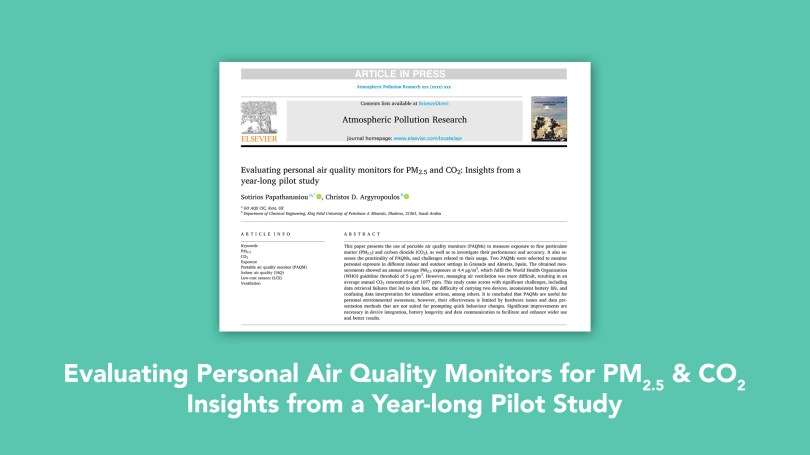
We are excited to share that our research paper, titled “Evaluating personal air quality monitors for PM2.5 and CO2: Insights from a year-long pilot study,” has been officially published in Atmospheric Pollution Research (DOI: 10.1016/j.apr.2026.103210).

Here is a brief overview of our journey and what drove this study.

The Year-Long Study

Our pilot study ran for a full 367 days, spanning from mid-summer 2024 to mid-summer 2025. We deliberately carried two portable air quality monitors with us everywhere we went to experience all seasonal changes and daily environmental challenges.

While device technology continues to evolve, carrying these monitors every day taught us a tremendous amount about human exposure and the practical realities of personal air monitoring.

Key Highlights

  • Balancing Ventilation and Filtration: We uncovered a natural tension between keeping outdoor particulate matter out through filtration and keeping indoor carbon dioxide levels low through fresh air ventilation.
  • Hardware Usability: Carrying devices continuously highlighted real-world friction points, such as battery management, data synchronization, and ergonomics.
  • Actionable Data: The study emphasized that air quality data needs to be clear and proactive so users can make immediate decisions rather than reviewing past averages.

We encourage anyone interested in low-cost sensors, personal exposure, and indoor air quality to read the full published paper for all the underlying data, methodologies, and findings.

Read the full paper at Atmospheric Pollution Research via DOI 10.1016/j.apr.2026.103210.


A big thank you to Prof. Christos D. Argyropoulos, co-author of the paper, for his guidance and commitment to advancing the air quality field.

From Rest to Rigor: How Our Air Needs Change with Activity

How much air do we breathe in a day?

We breathe without even thinking about it, but have you ever stopped to consider just how much air we actually inhale and exhale each day? The amount might surprise you. And what’s even more astonishing is the difference in air consumption between someone at rest and an athlete engaged in strenuous exercise.

At-Rest Breath

According to a paper 1, at rest, a typical adult male breathes in about 0.5 liters of air per breath and breathes 12 times per minute. This translates to roughly 6 liters of air per minute. This is because our body’s oxygen needs are lower when we are resting, so we take shallower breaths at a slower rate.

Read More »

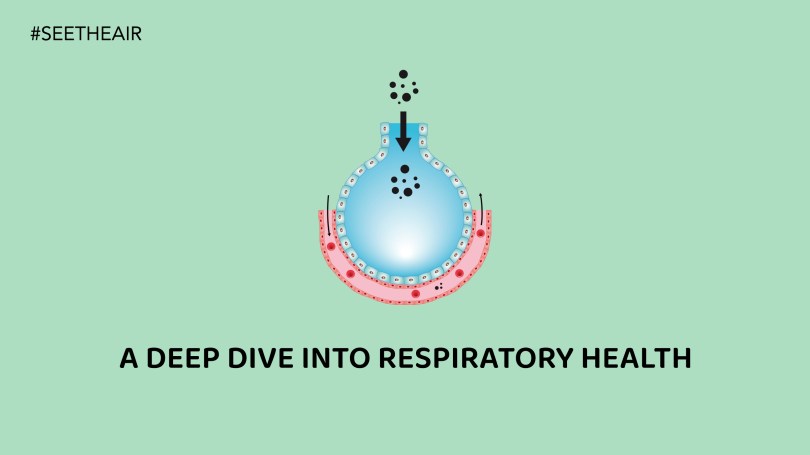
Alveolar Sacs and Particulate Matter: A Deep Dive into Respiratory Health

The respiratory system is a complex network responsible for the vital exchange of oxygen (O2) and carbon dioxide (CO2). At the heart of this system lie the alveoli, tiny air sacs where this gas exchange occurs. However, these delicate structures are also vulnerable to the intrusion of harmful particles, which can have serious health consequences.   

The Journey of Inhaled Particles

When we breathe, we inhale a variety of particles, including dust, smoke pollutants, and pathogens. The size of these particles plays a crucial role in determining how far they travel into our respiratory system. Larger particles are typically trapped in the upper airways, while smaller ones can penetrate deeper into the lungs.   

Read More »

Can an Air Expert Escape Air Pollution? A 2-Month, 6-Month, and Year-Long Experiment in Personal Air Quality

Air pollution is an invisible threat, silently impacting our health. But what if you knew exactly where it lurked, both indoors and outdoors? Could an air quality expert, armed with this knowledge and personal equipment, achieve the World Health Organization’s (WHO) air quality guidelines for extended periods?

This is the question I, Sotirios Papathanasiou, an air quality expert,  will try to figure out over the next year. Starting July 1st, 2024, I embarked on a unique experiment, tracking my personal air quality for a full year. I am monitoring two key air quality metrics: Carbon Dioxide (CO2) and PM2.5 (fine particulate matter). However, PM2.5 data will be excluded when relative humidity surpasses 70% because the limitations of low-cost sensors. I will be carrying an Atmotube Pro and an AIRVALENT everywhere I go.

I am your human guinea pig, carrying these portable air quality monitors everywhere – from my bedroom to my gym, from my kitchen while cooking to the beach on a weekend getaway. This comprehensive data will allow us to see if, despite my expertise in pollution sources and protective measures, I can consistently meet the WHO’s air quality guidelines.

Read More »

New Silica Dust Limits Aim to Better Protect Miners’ Health

On April 18th, 2024, the US Department of Labor has issued a final rule that reduces the permissible exposure limit (PEL) for crystalline silica in mines. Silica dust is a known health hazard that can cause silicosis, a debilitating lung disease. The new rule is intended to better protect miners from irreversible workplace illnesses, it will take effect on June 17th, 2024.

Health Risks of Silica Dust

Silica dust is a component of sand, rock, and quartz. When miners inhale silica dust, it can scar the lungs, leading to silicosis, which reduces their ability to take in oxygen. Silicosis can cause shortness of breath, coughing, and chest pain. In severe cases, it can be fatal.

New Exposure Limits

The final rule reduces the PEL for silica dust to to 50 μg/m3 of air for a full-shift exposure, calculated as an 8-hour time-weighted average. This is a significant reduction that will help to reduce miners’ risk of developing silicosis. The action level, or the amount warranting remedial action, is 25 μg/m3 of air. 

Read More »

Fireworks are Bad New for your Body

Fireworks or pyrotechnics are used heavily to this day in many places around the world to celebrate various events. People have them associated with fan and parties, so they are not very open on hearing that they are bad for our health. Fireworks elevate air levels of particulate matter with several metallic components and gases during their explosion. Studies show that hospital admissions with respiratory issues increase during similar events all around the world.

The color of the fireworks is subject to the metals they mix, and while these metals heat from the explosive materials, they produce various color hues.

Read More »

Tobacco has a Tremendous Impact on the Environment, Climate and our Health. How can you break free?

As a child of heavily smoking parents, I always hated tobacco. Unfortunately, my parents didn’t have an understanding of the impact tobacco had on their health when I was a child. Secondhand some also had an impact on my health, but can you blame someone that didn’t understand that smoke is smoke. A toxic combination of tiny particles and chemicals that will alter and break your DNA. Also, the mentality in Mediterranean and Balkan countries is still to this day different from the rest of the world. Some people still believe it is an enjoyable habit to smoke while taking a coffee or after a meal.

It took a great effort to teach my parents that smoking is not good for anyone. At the end, they saw plenty of examples among the family members that died due to this harmful habit, and they gave it up.

For most of us that have visited a beach, we have found a tremendous amount of cigarette butts in the sand. A disgusting habit that authorities must penalize because it is not only aesthetically unpleasing but is also harmful to the marine life and the food we end up eating.

Read More »

Op-ed: Wood-Burning Season is ON and the Zombies return!

Although some people claim that the wood-burning season doesn’t exist anymore because people never stop burning stuff (and this is true in some regions), the vast majority of the population can’t wait for cold weather to arrive in order to light the “cozy” wood stoves and unconsciously chock the village with toxic smoke.

Yes, wood-stoves even the ECO friendly or low-emissions or EPA certified or you name it, are huge polluters! They emit lots of particulate matter (commonly known as PM2.5) and a huge array of toxic chemicals that sometimes linger in the air for many days. Air pollution kills 13 people every minute worldwide and scientists at Harvard University found that dwellers who live in polluted areas are 15% more likely to die from COVID-19 than those who do not!

The atmospheric conditions and the geographical location of a village or city work in a complex way sometimes in favor of the dwellers but most of the time against the dwellers. When a city is surrounded by hills and mountains air pollution tends to stay there for a long time, like in Murcia, Spain. In that case, people’s lungs work as purifiers and trap all the pollutants, as a result, we have more hospital admissions and more chances to suffer severe health effects due to the air pollution which is deposed inside our bodies. The cost to maintain public health also increases.

By comparison, wood smoke from stoves and boilers carries the highest concentration across all pollutants. One eco-certified wood stove is rated at 3.1grams/h of particulate matter which is equal to six heavy-duty lorries which are rated at 0.5grams/h of particulate matter each.

Read More »

WHO 2021 Air Quality Guidelines – My Take!

On 22nd September 2021, the World Health Organization released the so long-awaited update of the Air Quality Guidelines (AQGs). They are bold and ambitious but will governments adopt them?

Let’s see how the updated AQGs compare to the old ones, which were released in 2005. The classical pollutants (Particulate Matter PM2.5/10, and NO2) have been reduced significantly. They have introduced additional AQG levels, such as for peak season Ozone (O3), 24-hour averaging time for Nitrogen Dioxide (NO2), and Carbon Monoxide (CO). On the contrary, they have increased the Sulfur Dioxide (SO2) levels from 20 μg/m3 to 40 μg/m3.

Read More »

Nasal hair and Air Pollution: Does nasal hair offer a filtration function?

It is unfortunate true the fact that I have encountered a lot of people who think that nasal hair will stop all air pollutants from being inhaled and reach the lungs, or as we now know, the heart and brain. They feel completely sure that they are safe irrelevant the concentration of the pollution.

people nose

The human nose is an extraordinary human organ that offers us so much, many times we don’t even appreciate its function until we lose it. It can warn us that something isn’t right, for example, food has gone bad, or the presence of toxic gases in a close/open environment but it can also offer us a pleasant sensation when we smell a rose or lavender flowers.

Read More »