In-Depth: Atmotube Pro

It will please some of you to know that I am going to compare Atmotube Pro with other Particulate Matter sensors and monitors. First with an outdoor monitor and in this case the Luftdaten DIY and second the AirVisual which is more of an indoor monitor.

Before I begin with the comparisons I want to dive a bit deeper and tell you that apart from exporting the .csv from the app directly, you can also access Atmotube’s .csv files (in case you have an iPhone) from the File Sharing service iTunes provides when you connect your phone with your computer (macOS & Win). This way you have more control over which days you upload to your computer.

Read More »

See The Air AQM v0.1 – NO2 Analysis

In my previous post I presented the version 0.1 of my DIY Air Quality Monitor which uses a Nitrogen Dioxide sensor. In this post I am going to analyse the Nitrogen Dioxide NO2 sensor which is made by Spec-Sensors DGS-NO2 968-043 .

Calibrating your sensor.

In most cases the sensor isn’t calibrated which means that we have to set a zero point in order to get more accurate measurements. The company can calibrate it for you in a special chamber but you have to pay extra. In order to calibrate it on your own you have to be in a clean environment – without the presence of NO2 or NO or O3 – and then follow the instructions below which I have taken from the datasheet.Read More »

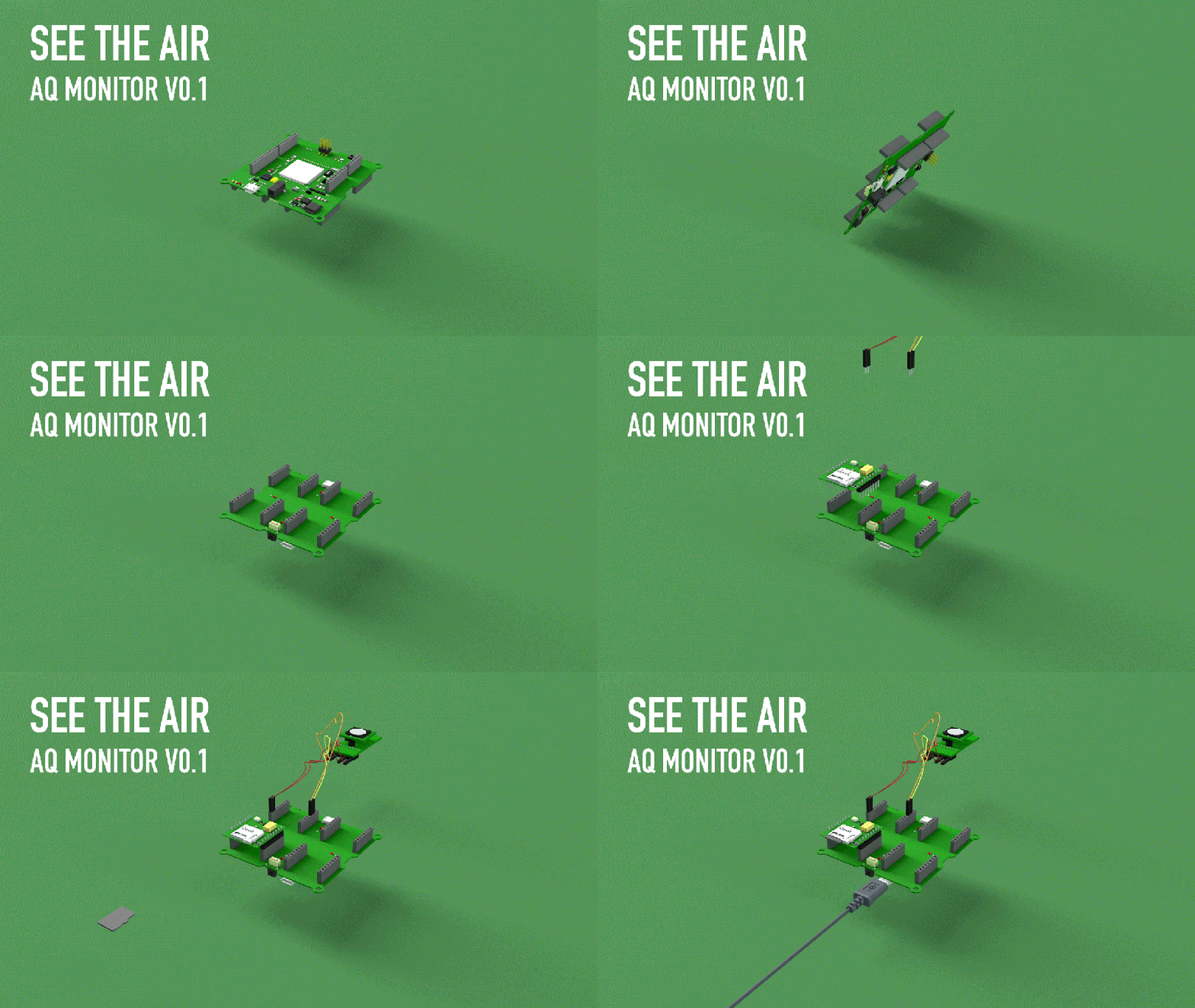
SeeTheAir AQ Monitor v0.1

Have you ever been in a situation where you wish you had had a device tailored to your needs? Over the years I have reviewed various Air Quality Monitors but each time they lack something which will make them unique to me. Don’t get me wrong each device has its features and characteristics, some of them are amazing and some of them not very useful. As a result, I decided to build my DIY AQM. I couldn’t have done it without Electronza and Teodor Costachioiu help with coding, he is a brilliant coder/engineer. I absolutely recommend you to check his blog you will find a lot of interesting projects.

Read More »

uHoo a Portable AQM?

The idea of having an Air Quality Monitor anywhere you go seems good especially when you can have 9 sensors with you. So here is a tip on how to convert a stationary IoT indoor AQ monitor to a portable one, in this case I will demonstrate it with the uHoo because I really want to measure some NO2 and O3 concentrations in some busy spots of the city.

There two ways to do that, one of which isn’t easy but bear with me.

Read More »

Cheap Face Mask, Worth it?

Over the years, I have reviewed some very good face masks on See The Air like the Cambridge Mask and Vogmask. The only backward is the price especially when you have to buy them frequently because you wash them often and you wear them a lot. There is a solution by using masks such as the AirGo which allows you to chance the filters and the neck warmer is durable and washable and the O2 Canada Respirator which allows you to change filter easily. However, I wanted to try a cheap and lightweight face mask for the summer which will cost around $3 and it will have the ability to use exchangeable filters because I want to be able to wash it once a week.

Read More »

Awair 2nd Edition vs AirVisual vs uRad A3

The battle begins, I am going to dive right into the comparison. In this comparison I am only going to compare the PM2.5 sensors because a good PM2.5 sensors says a lot about the quality of the device. The participants are:

Read More »

Formaldehyde WP6930S vs uRAD A3

Formaldehyde CH2O is a very dangerous chemical-gas that can be easily found inside a house because it off-gases from paints, carpets, furniture, etc… In this article I am going to find out how well a cheap, handheld air quality monitor WP6930S compares to a more professional solution such as the uRAD A3.

Read More »

BRISE C200 PM2.5 Efficiency Tests

On the previous article, I presented a new air purifier with an A.I. Engine called BRISE C200. In general, the best way to prove the efficiency of an air purifier is by taking measurements with a respectable 3rd party AQ monitor while there is an air quality issue ongoing inside the room and that is what I did. I used the uRAd A3 Monitor for the measurements and the device was placed near the purifier.

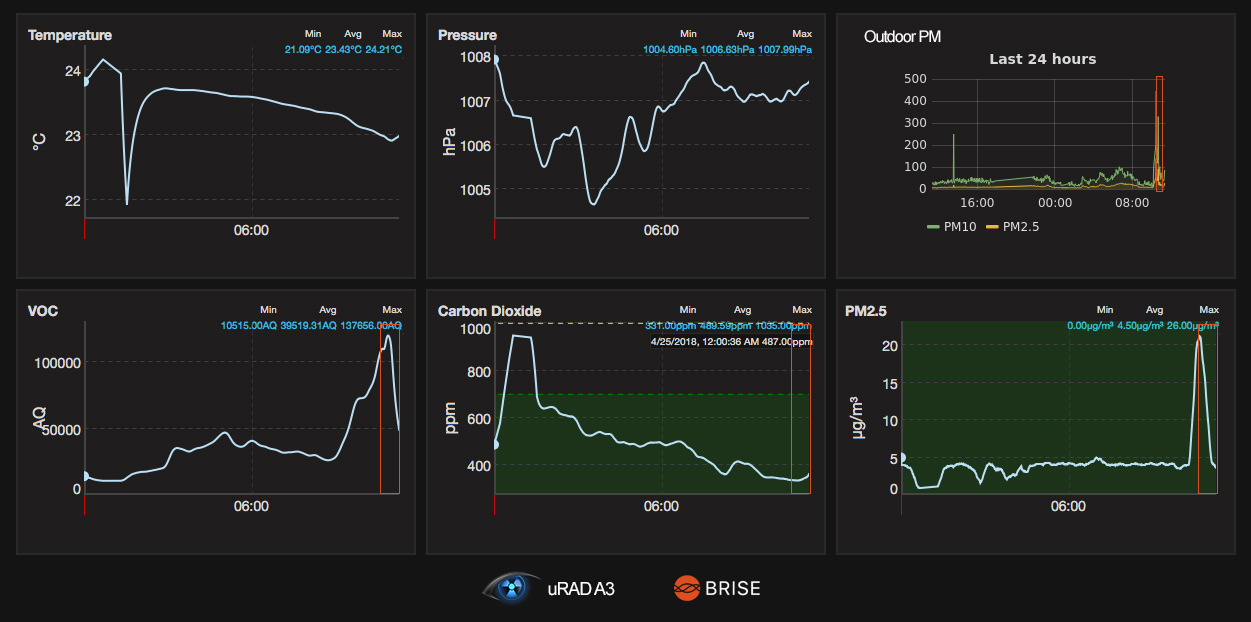
At first, I had set the purifier off on purpose because I didn’t want the A.I. engine to kick in automatically before I was able to register the event. When a PM2.5 spike was registered, as you can see on the picture below from 4μg/m3 to 26μg/m3, I turned on the purifier and the air quality inside the room immediately improved till it returned to the normal PM2.5 concentration and the purifier turned itself off automatically.
AQ-BRISEC200

In the picture below you can see the FC200 4-in-1 Combo filter after one month of usage. The carbon pre-filter has captured PM10 particles, hair, dust and even a little dead spider, which was caught by the purifier’s air flow when it was set on Turbo Mode. After that, we can see the blue anti-bacteria filter and under it the HEPA filter responsable for capturing all PM2.5 particles. Finally, the TiO2 will absorb harmful chemical vapors.

FILTERS C200 BRISE

I wanted to repeat the experiment with the BRISE C200 purifier and a different AQ Monitor in a different room and day, so with the help of the AirVisual AQM I set them up in my bedroom. This time it took 14 min into Turbo Mode to clean the air, the bedroom is a bit bigger. When the purifier achieved a concentration of ±1μg/m3, I turned it off and with the door closed the air inside the room was kept clean, but immediately after I opened the door the air quality was decreased. Below you can see the results.

airvisaul brise

VOC & Formaldehyde Correlation

Many times I have mentioned that a simple VOC sensor isn’t enough to determinate if the air quality is good or not especially in interior environments. Formaldehyde CH2O is a VOC and since I have an AQ monitor uRAD A3 that features both a Formaldehyde sensor and a VOC sensor I will try to find out if there is a correlation between them.

I have been monitoring my house for Formaldehyde for over a month now by leaving the AQM on including while I was out on a trip for 4 days and during that time the house was well closed. This kind of experiment allowed me to determinate if my furniture, paint, etc outgassing Formaldehyde.Read More »

uRAD A3 vs AirVisual

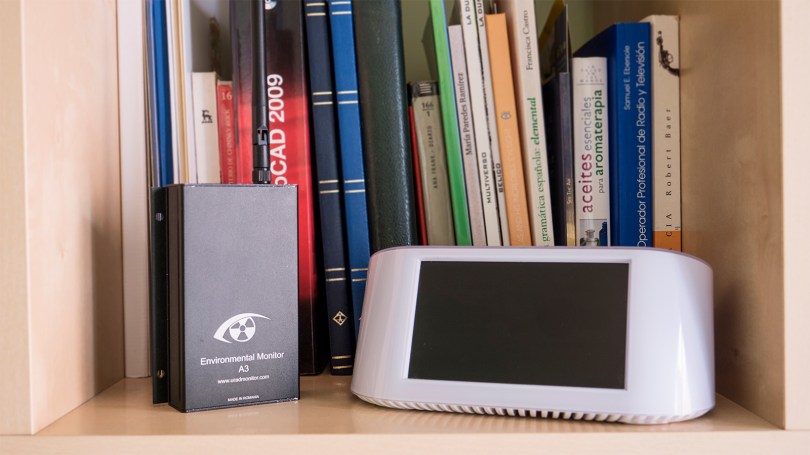
I have featured both devices on my blog uRAD A3 & AirVisual and since both devices allow the user to download a .csv/.txt file with all the registered measurements and as they both have a laser PM2.5 sensor and a CO2 sensor, I decided to compare both of them farewell.

Although I connected both devices side by side on 28/02/2018 at 10:40 am, I will compare the measurements from 5th March 2018 to 7th March 2018 because I wanted to allow the devices to adjust on the new environment, which was my bookcase.

Each device takes measurements at a different time rate. AirVisual, for example, was set to take measurements every 10-15min and uRAD every minute. Unfortunately, I couldn’t set both devices at the same time rate.

Read More »