Each year around this time I write a post about what’s next in the industry of air quality.
I have been receiving a lot of emails and I have held meetings with many companies around the world that are interested to know what it has to be done in order to succeed.
Hear me out, there are a lot of companies right now and all of them are trying to do the same thing, to build an AQ Monitor that already exists. Customers are constantly telling us what they want, you don’t listen to them, but I do.
The ingenuity and the inventiveness led DJINN Sensor — a Belarus company — to build an Air Quality monitor a bit different from the rest in the market.
Software-wise and hardware-wise the device offers some engaging features like solar panel case in order to harvest energy from the Sun and Productivity Current and Index analytics, to name a few. Let’s take a closer look at the AQ Monitor.
The Call for Volunteers was a great success and I had the chance to learn from you a little more about the problems of air pollution around the globe and the situation each one of you faces. From Canada, USA, Mexico, Australia, New Zealand, India, Romania, Italia, France, Belgium, Greece, Denmark, UK, Finland, Serbia, Spain, Ireland and many many other places. It wasn’t an easy task to select the 10 volunteers as all of you gave me good reasons. I want to THANK YOU all, it really means a lot your offer to raise awareness on such an important problem.
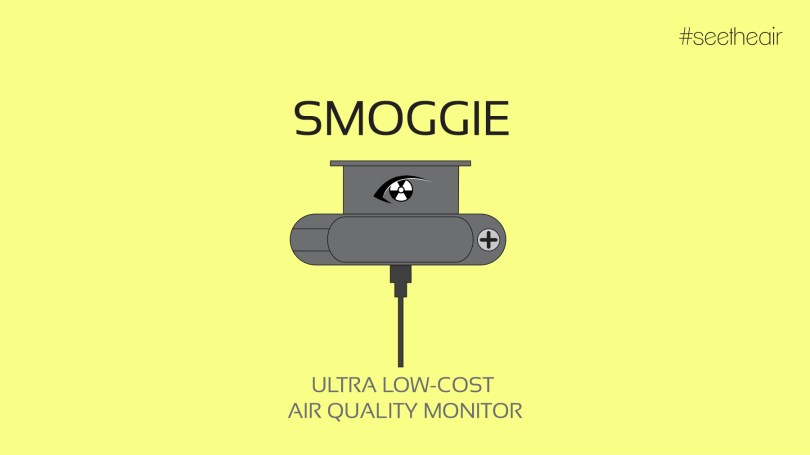
I have prepared a quick guide on how to install a SMOGGIE on an outdoor wall in 9 easy steps with images. The SMOGGIE is rainproof for this reason you just need to install them with the opening facing down.Read More »
It will please some of you to know that I am going to compare Atmotube Pro with other Particulate Matter sensors and monitors. First with an outdoor monitor and in this case the Luftdaten DIY and second the AirVisual which is more of an indoor monitor.
Before I begin with the comparisons I want to dive a bit deeper and tell you that apart from exporting the .csv from the app directly, you can also access Atmotube’s .csv files (in case you have an iPhone) from the File Sharing service iTunes provides when you connect your phone with your computer (macOS & Win). This way you have more control over which days you upload to your computer.
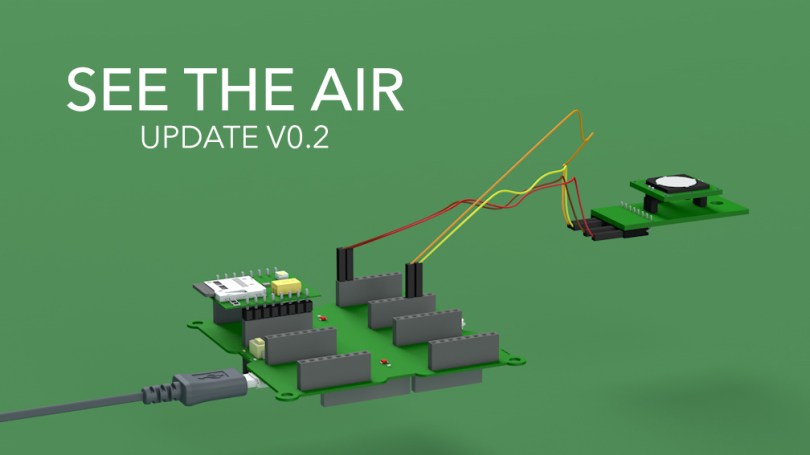
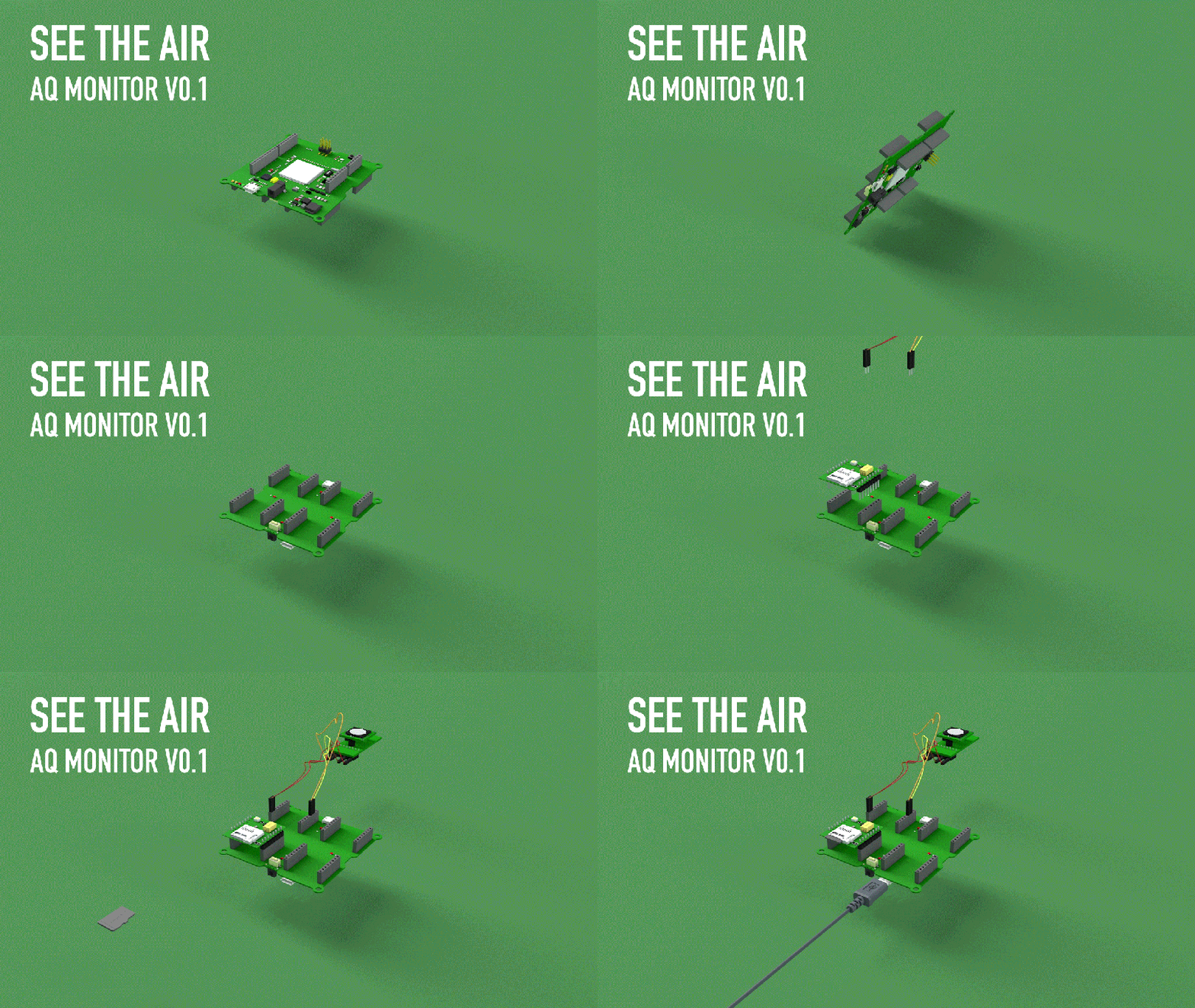
In my previous post I presented the version 0.1 of my DIY Air Quality Monitor which uses a Nitrogen Dioxide sensor. In this post I am going to analyse the Nitrogen Dioxide NO2 sensor which is made by Spec-Sensors DGS-NO2 968-043 .
Calibrating your sensor.
In most cases the sensor isn’t calibrated which means that we have to set a zero point in order to get more accurate measurements. The company can calibrate it for you in a special chamber but you have to pay extra. In order to calibrate it on your own you have to be in a clean environment – without the presence of NO2 or NO or O3 – and then follow the instructions below which I have taken from the datasheet.Read More »
Have you ever been in a situation where you wish you had had a device tailored to your needs? Over the years I have reviewed various Air Quality Monitors but each time they lack something which will make them unique to me. Don’t get me wrong each device has its features and characteristics, some of them are amazing and some of them not very useful. As a result, I decided to build my DIY AQM. I couldn’t have done it without Electronza and Teodor Costachioiu help with coding, he is a brilliant coder/engineer. I absolutely recommend you to check his blog you will find a lot of interesting projects.
Here are all the available IAQ Monitors on the market. This time and after your help I have included many more information in a Google Spreadsheet document which you are going to appreciate a lot, such as website links and whether the device has been reviewed on my blog or not yet. There are so many devices out there but they all lack innovation and they all offer exactly the same technologies. Companies had better hear users feedback!
A USA air quality monitor in comparison with a DIY German air quality monitor. How well do they perform with each other? Full disclosure, the software the monitors run is developed in the mentioned countries. The components from both devices are made mostly in China.
We already know PA-II’s correlation of coenficency R²≈0.87 with the corresponding FEM GRIMM and FEM BAM.
The SDS011 sensor which is most commonly used in the Luftdaten project has a correlation of coenficency R²≈0.84.
The PA-II features a double PMS5003 laser sensor. The PA-II module averages out the values from the two sensors, so in case one of the two sensors registers unexpected high readings, (perhaps some dust or insects etc) this technique makes the readings less questionable. The Luftdaten DIY project as we have mention above mostly uses one SDS011 laser sensor. However, the Luftdaten software supports many PM2.5 sensors including the PMS5003 series among others.
Analysis
My friend Ashley from Plume Plotter has already done a comparison between the Purple Air PA-II, the Luftdaten SDS011 and DEFRA for a complete year of data link.
First of all, by comparing PA-II’s two identical sensors we can see on the graph below that the Sensor B has the tendency to register higher concentrations over time, on my device, maybe another device has a different behavior. So the process of averaging out the concentrations from both sensors has some positive results.
Many scientific papers insist that the PMS5003 and SDS011 sensors are nephelometers and not particle counters. Which means that they are influenced by humidity. Nephelometer comes from the compound Greek word nephelo “Νέφος” which means cloud.
I live in an area with high humidity. Right now the official RH is 83%. The PA-II registers 51.6μg/m3 and Luftdaten 38.3μg/m3. The difference between them is huge. However, both devices are mistaken. Purely for your information the humidity sensor in the Luftdaten device measured RH 94% the PA-II measured RH 53% and AirVisual measured RH 72%. From my experience, I would say that the relative humidity is definitely above 80%.
From the graph below we can see the same results. The PM-II overestimates the PM2.5 concentrations most of the time in comparison with the Lufdaten sensor. Both devices seem to measure the same fluctuations over time so there is some correlation. The humidity that day started low at RH 30% and climbed up to 60% at the end of the day. There is an influence between humidity and how the sensors and especially the PA-II measure PM2.5 concentrations without any doubt.
SeeTheAir: 24h PA-II & Luftdaten side by side
Conclusion
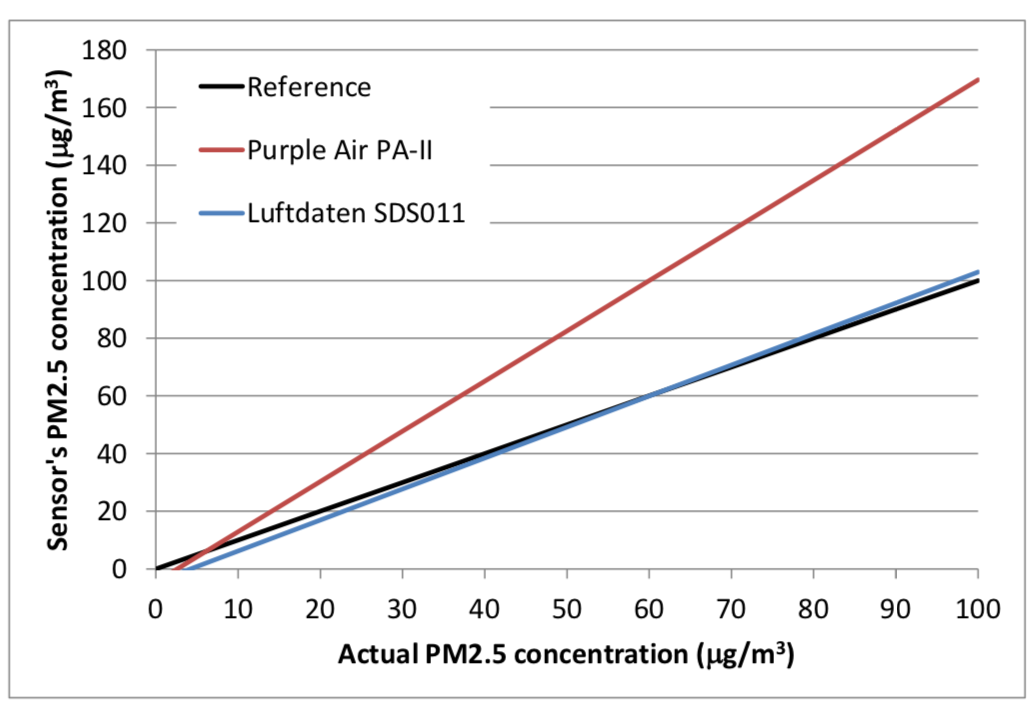
The conclusion that I get from my everyday readings having the two devices side by side and from Plume Plotter’s analysis is that the PA-II overestimates the PM2.5 concentrations especially when relative humidity is above ~55% while the Luftdaten’s readings are more adjacent to the official readings.
Plume Plotte: Regression lines for Luftdaten sensor and Purple Air PA-II sensor readings vs. actual (reference instrument) concentrations.
A reader of the blog took the initiative to establish a contact between PurpleAir and me, as a result the PurpleAir II outdoor Particulate Matter monitor is here for a review. Thank you Daniel.
The monitor is very compact and it can be easily distinguished from the rest because it has 2 Particulate Matter sensors. Both of them work together to establish better results and a coefficient of determination (R²).Read More »







 See The Air