I left for vacations (New Year) and I had to let my house fully closed during 4 days, so I took a close look on how fast the house alone would be able to recover from the CO2 gas.
As a result it took more than 38 hours to recover from 1276ppm to 450ppm. Normal, but alarming as well. Inside the house there isn’t only CO2 gas but other gasses and VOCs too, as a conclusion gases in general get trapped inside our houses and they don’t “disappear” fast. We have to ventilate our houses frequently.
Been inside the car doesn’t keep you safe from the air pollutants of the street and traffic at least if you don’t own a Tesla Car with Bioweapon Defense Mode activated.
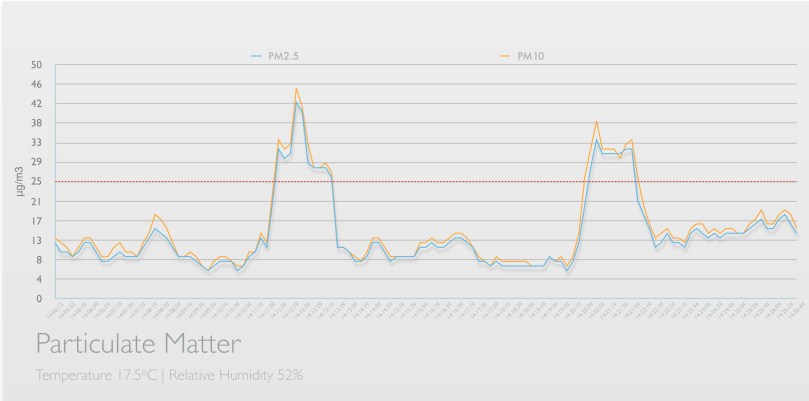
I made a trip from my city Almeria to Malaga and back. The journey was approximately 4h long in total via the highway. The graphs are divided into two pieces. The first one is the trip from Almeria to Malaga and the second piece is the way back. On my way to Malaga the weather was rainy throughout the whole trip which I think worked as an air cleaner because the rain droplets trap PMs and don’t allow them to flow freely in the air. On my way back to Almeria there wasn’t any traffic at all on the road due to late hour of the trip (01:00am-03:00am), so there wasn’t any particular pollution in the air either.
Now let’s see what happens when you drive a car at pick hours at the city center and without raining to settle down air pollutants.
There were two spikes over the recommended limit of 25μg/m3 and both times the car was still waiting behind a conventional bus on the traffic lights and some other cars were around as well.
In conclusion the air quality inside the car will decrease when you drive in busy streets due to Particulate Matter emissions by tyres, burning of fossil fuels in vehicles, asphalt rubber friction etc… Your car has got an air filter remember that you have to replace it and ask your mechanic if there is a better quality filter that you can install.
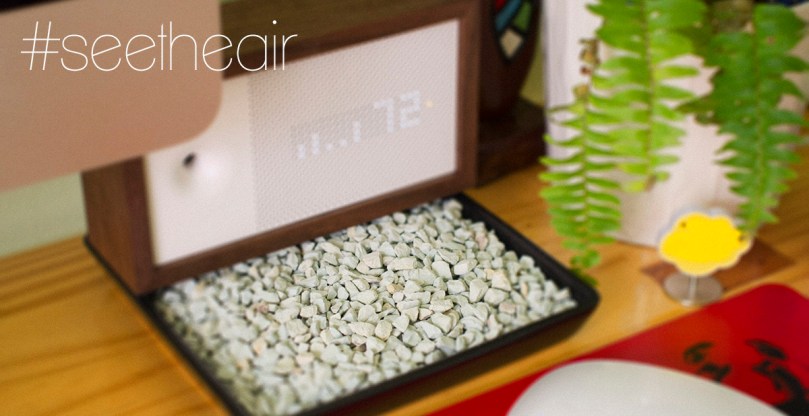
I was doing a research for ways to remove VOCs from the atmosphere without using electronic devices like air purifiers but through passive material. As a result I found about Zeolite Rocks which are claimed that can absorb formaldehyde, ammonia and other VOCs from the air or water passively.
As you may expect I purchased 500gr of small Zeolite Rocks to conduct an experiment. I want to mention here that is hard to find these rocks because they aren’t commercialized, it’s easier to find them as filters for aquarium because in general are used to remove ammonia from the water.
They also claim that the rocks are “rechargeable” by heating them in the oven in 200°C/400°F for 30min they can be used again and again.
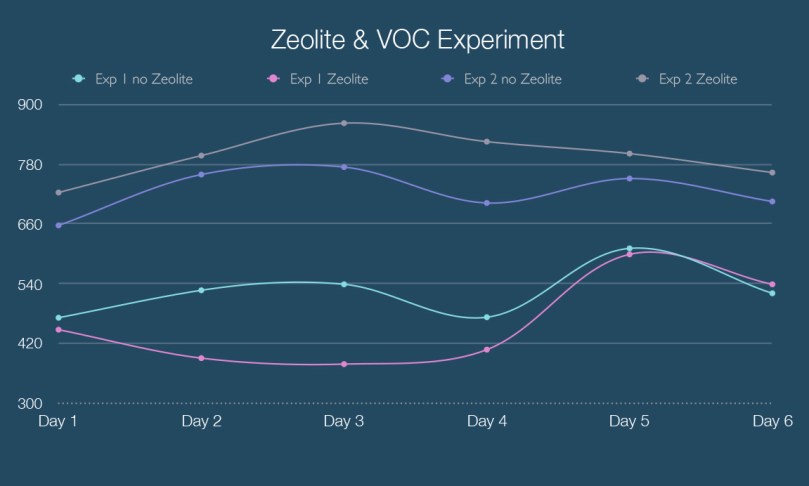
I took daily measurements for 6 days without having the rocks anywhere near the sensor and the average result for the VOCs was 524ppb. After a week I placed under the AQI monitor 400gr of Zeolite Rocks and again I logged the measurements for a week. The average result for a week of VOCs with the rocks is 461ppd. A difference of 63ppb less VOCs.
After that I repeated the experiment, 6 days without rocks and 6 days with rocks but this time I isolated the room and I kept it without ventilation. The values were higher in this case and the rocks seemed like they couldn’t absorb VOCs any more.
In conclusion the rocks may absorb gases but you need a great quantity of rocks to achieve a good result, for example 100ppd less VOCs something which make it hard. Remember by opening the windows for a few minutes you can refresh the air quality immediately in case the outdoor air is in better conditions than the indoor.
On my complete review for AirVisual Node I expressed my gratefulness about the device’s ability to function off-the-grid which allows me to move it around places without any problem. In this article I will talk about my experience with the device in the Gym.
Gym
The last three months I am practising crossfit which is an intense workout and it does require a lot of deep and fast breaths, so I decided to check the air quality at the crossfit facility with the permission of the owner. The facility is quite big with an area of 105m²/1130,21ft² and a height of 4m/13ft. At the moment of the measurements there were 18 people working out in the facility. The results were very good, the CO2 didn’t pass the 466ppm during the whole workout session and there was only one big spike of Particulate Matter due to the use of powdered chalk. If you check the graphs you will notice some similarities between the CO2 and PMs, when the intension of the exercises were high the CO2 went up and the PMs as well.
There is a red part on the beginning of each graph, don’t pay attention in that area, I had my face close to the device as I was setting it up and the CO2 is normally high.
Stay tuned for the next article about the AirVisual Node in the car.
It was impossible not writing a review about AirVisual Node as it has some unique features that I constantly complaint about the other AQI Monitors. In the past I have written an article about the app AirVisual which doesn’t require the Node device to function and it shows you the outdoor air quality in your area. As a result it’s time to analyze the Node device.
At first, before even consider purchasing it I thought that its size will be big but I was wrong, its size is just fine. It seems bigger on pictures than in real life thanks to the clever futuristic design.
Features:
5-inch Colour LED display
CO2 Sensor 400 to 10,000 ppm
PM2.5 Sensor 0.3 to 2.5µm
Temperature -10 to +40°C or 14 to +104°F
Humidity 0 ~ 100%
WiFi 802.11 b/g/n 2.4GHz
Rechargeable Li-Ion battery
Micro USB power input
• What I love the most about this device is the ability to function without internet connection (off-the-grid). This ability gives an enormous advantage to the user. It incorporates 3GB of internal memory and a battery of 1,850mAh that can hold up to 5 hours. Hypothetical situations: You live in an inaccessible place without internet or electricity or you just want to turn off all the WiFi connections at home during night and continue measuring the air quality, with AirVisual Node this is possible because the device doesn’t depend on any external server to do its job, it even has a SMB server inside which allows you to access the data from any MacOS or Windows or Linux machine.
• The huge 5-inch wide 800 x 480 display is an other great advantage for the productive users because it gives you independency from your phone in case you want to check the air quality instantly while you are working or studying at home/work. The brightness is adjustable with 5 levels but I wish I could turn the brightness down even more. You can turn off the display but you can also set a schedule when the display should be on or off based on your needs.
4 different screens that change automatically or manually
• The device can be used as an indoor monitor or as an outdoor monitor and if you give it permission, it will share the measurements on a collaboration world air pollution map. The Micro-USB allows the usage of an external power pack or solar panel in case you want the device to operate for a long time outside.
• There are 4 buttons on the top of the device that very easily guide you inside the menu so you can adjust the device on your needs. There are 3 ways to changes the setting of the device, obviously from the device itself, then from the phone app and finally from the website on http://airvisual.com .
• The measurements are displayed very clearly on the app′s layout as well on the device′s display. You can choose to see the history between hours or days or months. If you click one of the graphic bars, then you see the exact value and time of the measurement. Recommendations on the display and on the app will guide less experienced users.
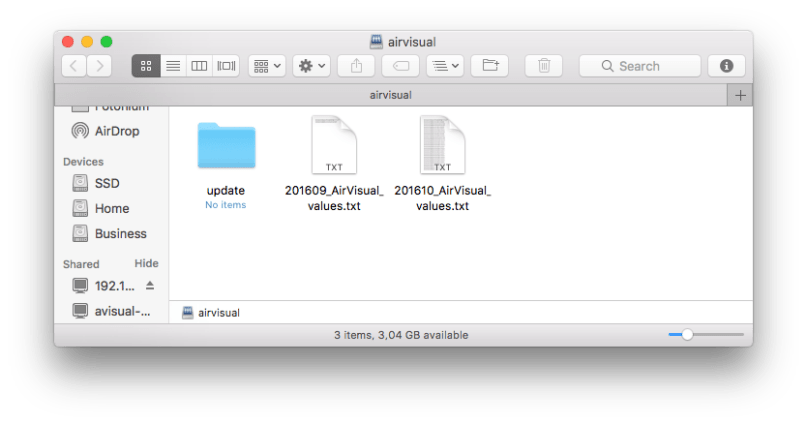
• It turns out that the device can also measure PM10 and on the log file it registers everything. Exact time and date of Indoor and Outdoor (if your area is supported) AQI(US), AQI(China), PM2.5, PM10, Temp/Humidity and CO2.
Sensors:
• They use the SenseAir S8 Sensor for the CO2 measurements. This is a miniature, non-dispersive infrared (NDIR) and individually calibratedABC sensor with an accuracy of ±0.02% volume CO2 ±3% of reading. It has a life expectancy of 15 years. High quality and expensive sensor made in Sweden.
• The PM2.5 sensor is AirVisual own co-developed sensor called AVPM25b.It can detect particles from 0.3μm to 2.5μm. The accuracy range is ±8% of reading. It uses a small fan to draw air inside the laser and throughlight scattering phenomenon the sensor can calculate the quantity concentration of particles. The light refraction is analyzed by the photo-sensor algorithm to output PM2.5 and PM10 values.It has a life expectancy of a minimum of 3 years. AirVisual uses a combination of dust reduction and power saving techniques to preserve the life of the sensor. (The company has put a lot of effort and money into this sensor).
• Unfortunately the Temperature and Humidity sensors are unknown to me for the moment.
Conclusion:
All in all it is a well thought out product with many advantages and some high quality materials which are going to last for a long time. Friendly user interface and with some advance features for the power users.
P.S. Stay tuned because I will write a second article about AirVisual Node with measurements and impressions while I am using it at home, car and gym.
Nephrolepis exaltata aka Boston fern is the best plant for removing Formaldehyde from the air and removed significantly more per hour than the rest of plants examined. Apart from Formaldehyde it can aslo remove xylene and toluene. It is an non toxic plant, so it’s baby and pet friendly.
It requires moisture and humidity to thrive, so the first thing you need to do is to make sure that it is in the right kind of environment. Boston fern needs a cool place with high humidity. If your house is dry add some extra humidity by setting your pant’s pot on a tray of pebbles filled with water. The best light conditions to provide is indirect sunlight, also filtered sunlight through net curtains works well too.
The Boston fern will grow fast in temperatures of 16-30°C (60- 86°F). No lower than 13ºC (55ºF).
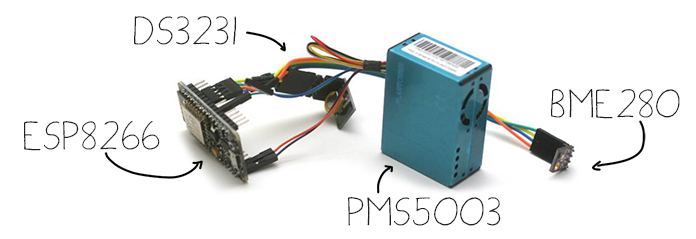
Low cost and quite precise DIY Particulate Matter Monitor. This DIY device will allow to measure PMs, Temperature, Humidity and Barometric Pressure for less than US $30.
I am not going to describe the whole process of building the device because it is well explained by the author at ourairquality.org. You can find a ton of information about the sensors and the electronics on his article.
It uses the PlantowerPMS5003 which is a low cost laser particle counter ∼US $18.5
ESP8266 Nodemcu is a WiFi enabled computer board∼US $3.2
BME280 is a Temperature, Humidity and Barometric Pressure Sensor ∼US $4.9
DS3231 is a Precision RTC Clock Module Memory ∼US $2
One more time I had the opportunity of getting a half face mask this time by Vogmask and of course I couldn’t resist not writing a review on my blog.
As I have already mentioned in my preview article effectiveness and elegance are the key points of my evaluation.
Many people are spending a lot of time during the day travelling from one destination to an other on foot or by bike or by car/public transportation. There are 1.25 Billion Vehicles on World’s Roads right now and they increase steadily. (There is an estimation of 2 Billion Vehicles by 2035).
What kind of pollutants do we face everyday: Particulate matter (PM), Hydrocarbons (HC), Nitrogen oxides (NOx), Carbon monoxide (CO), Carbon dioxide (CO2), Sulfur dioxide (SO2) and other air pollutants/toxics such as Benzene, acetaldehyde, and 1,3-butadiene.
Characteristics
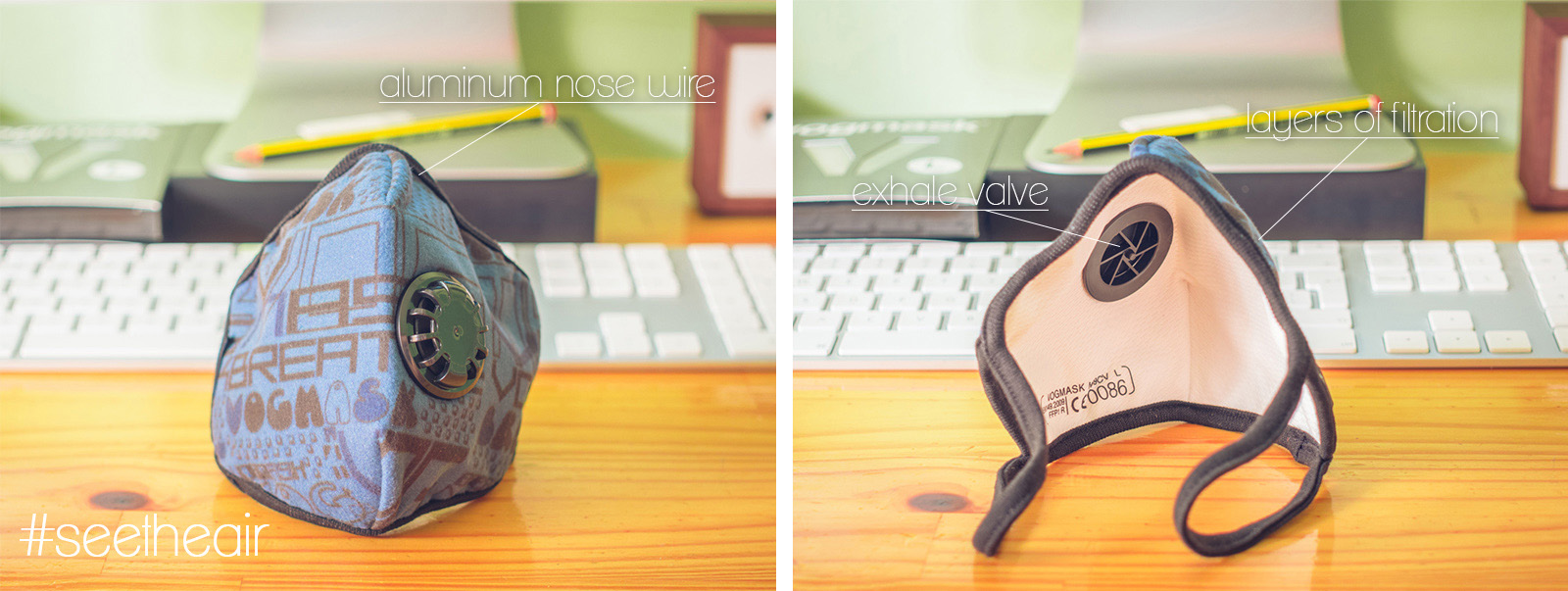
Vogmask offers the N99 respirators (Not oil resistant), with options of a carbon filter layer (C), and an exhale valve (V). I have the N99CV. These respirators are made to seal tightly around the mouth and nose and they are made of material certified to block 99% of particles 0.3 μm or larger in diameter including PM2.5.
Outer layer Faceblank of non woven microfiber
Filter media of Nanofiber PP Filtering Textile middle layer
Filter layer of Active Carbon coconut shell derived charcoal bonded to textile
Exhalation Valve of ABS Resin with silicone stopper
Nosebridge of coated aluminum wire
Trim and ear loops of latex-free spandex
Inner layer Faceblank (comfort inner layer closest to lips) of woven microfiber
Design
They have a huge collection of print designs which meet everyone’s taste. Of course all face masks are noticeable. The materials are soft to the touch and face. The mask doesn’t touch your lips and mouth.
Effectiveness
The exhale valve is quite big and helps a lot with the moist that may build while you are breathing, in my case I will rate the valve at 85% efficient. I have a beard and facial hair is enough to break the seal and let in particles and gases. They have a solution for that. The Head Strap Accessory which snaps onto the ear loops of the Vogmask for a tighter seal and more security. I have been wearing the mask during three weeks now while I am riding my bike or motorcycle and I have noticed that I don’t smell anymore some of the gasses that come out of the cars or buses.
The mask is CE Certified reusable which means that you can rinse it with water and liquid soap. Although it may work with the Nanofiber PP Filtering, I think the Active Charcoal filter won’t work as well as a new one, because a lot of the nano pores that trap gases will clog up by the impurities and minerals of the water.
It is designed to last up to 3 years but it is recommended to replaced it after 4 months when a sudden increase in inhalation resistance is noticeable. In this case the middle filtering layer is saturated with particles and the mask needs to be replaced.
Conclusions
All in all it doesn’t require extra effort to breathe with the mask and the exhale valve helps a lot with the moist. The maintenance is minimum but recommended after a while. Good filtration against street air pollutants.
This is what happens when you cook without extractor hood. In the graph below you can see a huge spike on the PM sensor, this is because my extractor hood in the kitchen has broken and I had to cook without it. Immediately the air quality went down.
The air quality monitor was 2 rooms away from the kitchen, so always ventilate the kitchen by using an extractor hood. Tipby closing the lid of the pot/pan you decrease dramatically the release of PMs into the atmosphere.
When indoor relative humidity is higher than RH:65% this will allow bacteria and mold to grow. You can always purchase a dehumidifier and it works like charm but it will cost you a lot on electricity, so plants come to the rescue. Some plants are capable of absorbing indoor humidity and use this kind of moist for their own good.
Tropical plants called epiphytes like Tillandsia, Boston Fern, English Ivy and Peace Lily are plants that get some or all their water from the air instead their roots.
Tillandsia: A plant that can survive without roots, so it can absorb water from the air.
English Ivy: It can remove the airborne mold typically found in humid areas.
Boston Fern:Thrives in more moist climates, so it will naturally absorb some of the humidity in your home.
Peace Lily: The least potent plant for humidity because it is a watered plant, but it will also absorb moisture from the air through its leaves.
A few plants won’t solve the problem of too much humidity in your house, but they can help and alleviate some. Please don’t over do it on the other hand, and try to find a balance between them.











 See The Air