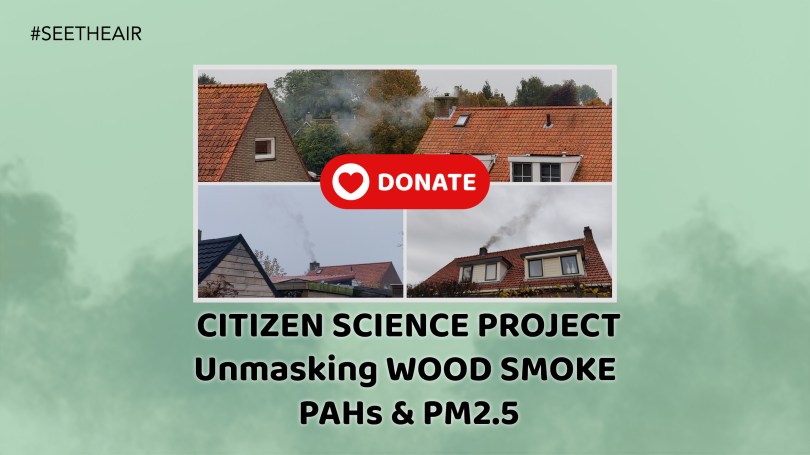
Help Us Breathe Cleaner Air: Citizen Science Project Seeks Donations for Wood Smoke Research

I won’t write a long introduction because this is of urgent matter for people to understand and support. While wood-burning stoves offer a tempting escape from soaring energy costs, they also release harmful substances into our homes and communities. These include fine particulate matter (PM2.5) and Polycyclic Aromatic Hydrocarbons (PAHs), both of which have been linked to serious health issues, including cancer.

Unveiling the Hidden Danger

Despite the known risks, we still lack sufficient data on PAHs concentrations in residential areas where wood burning is common. The location of investigation will be chosen in the Netherlands or Belgium. This is where your help is crucial.

By supporting this citizen science project, you’ll help us gather vital information about the impact of wood smoke on our air quality. The project will measure PAHs and PM2.5 levels in a residential area heavily reliant on wood burning for heating. This data will be invaluable for raising awareness among policymakers and advocating for stronger air quality regulations.

How Your Donation Makes a Difference

Analyzing air for PAHs is a complex process requiring specialized equipment and laboratory analysis. With your support, the project will:

  • Purchase air pumps and ten (10) absorption tubes to collect air samples.
  • Conduct laboratory analysis to identify and quantify PAHs.
  • Measure PM2.5 levels using advanced sensors.
  • Compare PAHs levels in wood-burning areas to background levels.

Join the Fight for Clean Air

Your donation will directly contribute to a healthier community. Together, we can uncover the hidden dangers of wood smoke and work towards cleaner air for everyone. Finally, I want to thank Dieter Pientka for his passion to investigate this crucial subject.

Help us make a difference. Donate today!

Funding Alert: Air Pollution Research – EU, UK, US, Thailand, Senegal, and Panama

Originally posted on LinkedIn

The European Commission is offering up to €73 million in funding for research projects aimed at improving air quality under its LIFE program. Successful projects can receive between €2 million and €10 million to support initiatives that restore and enhance the environment. Applications are open until September 19th, 2024.

Link: https://ec.europa.eu/info/funding-tenders/opportunities/portal/screen/opportunities/topic-details/life-2024-sap-env-environment

The European Commission’s Climate, Infrastructure and Environment Executive Agency has issued a second Life call with a focus on air quality and pollution. Projects can secure between €10 million and €30 million in funding. The deadline for applications is September 5. 2024.

Link: https://cinea.ec.europa.eu/funding-opportunities/calls-proposals/strategic-integrated-projects-sip-environment_en

Horizon Europe is launching a call for proposals on September 17 to fund projects developing zero-pollution solutions for cities and regions. Successful projects will share a €20 million pot. Applications close on February 11th, 2025.

Link: https://ec.europa.eu/info/funding-tenders/opportunities/portal/screen/opportunities/topic-details/horizon-miss-2024-cit-01-02

Read More »

Can an Air Expert Escape Air Pollution? A 2-Month, 6-Month, and Year-Long Experiment in Personal Air Quality

Air pollution is an invisible threat, silently impacting our health. But what if you knew exactly where it lurked, both indoors and outdoors? Could an air quality expert, armed with this knowledge and personal equipment, achieve the World Health Organization’s (WHO) air quality guidelines for extended periods?

This is the question I, Sotirios Papathanasiou, an air quality expert,  will try to figure out over the next year. Starting July 1st, 2024, I embarked on a unique experiment, tracking my personal air quality for a full year. I am monitoring two key air quality metrics: Carbon Dioxide (CO2) and PM2.5 (fine particulate matter). However, PM2.5 data will be excluded when relative humidity surpasses 70% because the limitations of low-cost sensors. I will be carrying an Atmotube Pro and an AIRVALENT everywhere I go.

I am your human guinea pig, carrying these portable air quality monitors everywhere – from my bedroom to my gym, from my kitchen while cooking to the beach on a weekend getaway. This comprehensive data will allow us to see if, despite my expertise in pollution sources and protective measures, I can consistently meet the WHO’s air quality guidelines.

Read More »

Masked and Misunderstood: The Silent Struggle of Chronically Ill in a Challenging World

For many, face masks became a symbol of the pandemic – a temporary inconvenience in the fight against COVID-19. But for those with chronic illnesses, masks are a lifeline, a shield against a world teeming with invisible threats. These individuals wage a silent battle, one breath at a time, often unseen and misunderstood.

Imagine living with a compromised respiratory system, a weakened immune response, or a condition that makes you extra susceptible to infections. Every outing becomes a calculated risk. A simple cough from a stranger or a waft of car exhaust can trigger a flare-up, landing you in the hospital. Face masks, then, aren’t just a recommendation; they’re a necessity.

Read More »

Over-the-Range Hood Microwaves: Addressing Indoor Air Quality Concerns

Over-the-range hood microwaves offer the convenience of a combined microwave and “ventilation” system. However, a common misconception is that they effectively remove cooking fumes and pollutants from the kitchen. While they do have a fan system, it’s crucial to understand their limitations.

Recirculation vs. True Ventilation:

Unlike range hoods that vent exhaust outdoors, most over-the-range microwaves utilize a recirculation system. This means they draw in cooking fumes, grease, and moisture through a metallic mesh filter with holes bigger than a Swiss cheese, then release the “treated” air back into the kitchen.

Read More »

Elevating the Topic of Healthy Air | The Air Exchange S2 E1

H&V’s Air Exchange host, Bruce Lorange, kicks off Season 2 by sitting down with IAQ “Influencer”, Sotirios Papathanasiou of the weblog @ Seetheair.org to discuss the importance of healthy air.

Sotirios discusses the importance of air quality, clean air initiatives, and healthy buildings as he shares his background and passion for merging technology and the environment. Sotirios and Bruce also discuss the need for education and legislation to improve indoor air quality.

Read More »

Beyond the Pleasant Smell: The Hidden Dangers of Air Fresheners in Your Home

We all like our homes to smell fresh (not possible) and inviting. But that seemingly harmless air freshener, scented candle, or electric perfume dispenser might be doing more harm than good. In fact they do and you will understand in detail below. These common household items can release a surprising number of chemicals that negatively impact indoor air quality and potentially our health.

The Culprit: Volatile Organic Compounds (VOCs)

All air fresheners, regardless of form (spray, plug-in, candle), rely on volatile organic compounds (VOCs) to create their signature scents. VOCs are chemicals that easily become gases at room temperature. While some VOCs occur naturally, those found in air fresheners are often synthetic and can irritate the eyes, nose, and throat.

Read More »

The European Union Agreed on New Rules & PM2.5/NO2 Limits for Cleaner Air

On February 20, 2024, the Council of the EU released a press release that discusses the agreement reached by the Council and Parliament to strengthen air quality standards in the EU. The new standards are expected to improve air quality and reduce premature deaths. They will be reviewed regularly and could be further strengthened in the future.

EU lawmakers have joined forces to strengthen air quality standards by 2030. These new, stricter limits and targets align more closely with World Health Organization (WHO) recommendations and will be subject to regular review. The updated directive tackles a range of air pollutants, including fine particles (PM2.5 and PM10), nitrogen dioxide (NO2), sulphur dioxide (SO2), and even toxic metals like arsenic and lead. Each pollutant has its own specific standard, with the most significant reductions targeting those posing the greatest health risks. For example, annual limits for PM2.5 and NO2 will be more than halved, dropping from 25 µg/m³ to 10 µg/m³ and 40 µg/m³ to 20 µg/m³, respectively.

Read More »

UNE 171380:2024 − Continuous Measurement of CO2 Indoors to Improve the Health and Well-being of Users

The Spanish Association for Standardization presented the new UNE 171380 standard on CO2 monitoring for health prevention. The University of Seville has played a significant role in the development of these regulations through the Architecture, Heritage and Sustainability Research Group: Acoustics, Lighting, Optics and Energy, represented by researchers Samuel Domínguez and Miguel Ángel Campano.

This standard is a great achievement in the prevention of airborne disease transmission, based on everything learned after the SARS-CoV-2 health emergency, and transparent information to the public about the air quality of establishments.

Read More »

Air Pollution Chronicle (Granada, Spain Edition)

They say that good air quality is a fundamental right for all, and at the same time, they say that 99% of the population worldwide is exposed to air pollution above WHO Air Quality Guidelines. Mixed messages here. Even though I have already shared the story on a Tweet thread, I decided to write an article as well because of the permanence of the article and because it is easier to share.

December 17th, 2023

I arrived in Granada, Spain for the holidays. A blanket of smoke was covering Granada and the small towns around with a total area of over 100 km2. Although I was super tired, the intense smell of smoke inside the apartment and the fact that I knew that there was a lot of particulate pollution indoors didn’t permit me to sleep well.

Read More »