
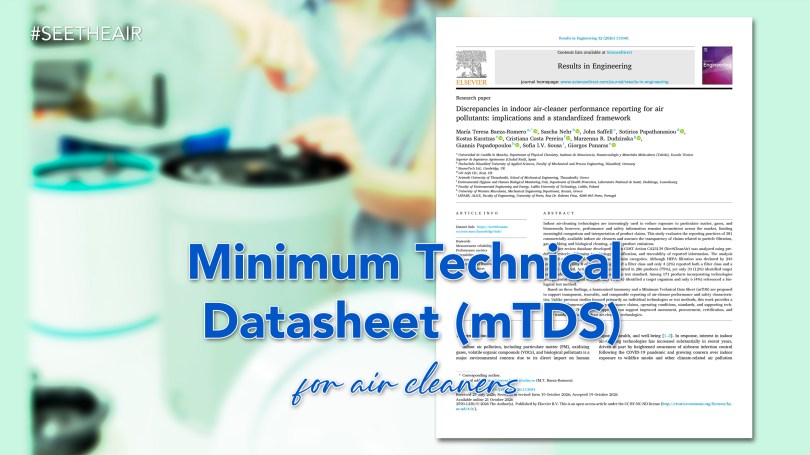
By Sotirios Papathanasiou and María Teresa Baeza Romero
Co-authors of “Discrepancies in indoor air-cleaner performance reporting for air pollutants: implications and a standardized framework” (Results in Engineering, 2026)
When shopping for a refrigerator or a car, spec sheets make life simple: you compare storage capacity or fuel economy knowing that manufacturers measured their products against uniform engineering benchmarks. Yet when shopping for an indoor air cleaner, that certainty evaporates. Every box displays reassuring slogans like “True HEPA,” “Whisper Quiet,” and “Removes 99.9% of Pollutants,” giving the impression that comparing two models is as simple as reading the numbers on the packaging.
In our peer-reviewed study published in Results in Engineering, conducted with an international team of researchers, we evaluated those claims by examining 381 commercially available air cleaners from across the global market. Our primary finding was that in most cases, everyday consumers cannot meaningfully compare performance specs across brands. The issue is not an absence of scientific testing methods; rather, manufacturers routinely omit the critical testing conditions, methodologies, and standards behind numbers like CADR, energy use, noise, and filtration efficiency.
The “HEPA” Illusion: Media Ratings vs. Device Reality
“HEPA” is the single most common marketing claim in the industry, appearing on 64% of the devices in our dataset. However, only 3% of those HEPA products specified an official filter class, such as H13 or H14, and just 2% reported both a recognized class and an established testing standard, such as EN 1822 or ISO 29463. Instead, the market is filled with ambiguous designations like “HEPA-type,” which carry no standardized technical meaning.
More importantly, a certified filter element does not guarantee a high-performing air cleaner. Filter testing evaluates filter media in an airtight test duct, whereas actual devices face issues like casing leakage, internal bypass, and fan interaction. A unit can contain genuine H13 material, but if air escapes around an unsealed frame, its real-world room cleaning performance will drop significantly.
The CADR Blind Spot: Numbers Without Operating Context
Clean Air Delivery Rate (CADR) measures the volume of clean air a machine supplies each hour, making it the most practical indicator of device-level performance. While 85% of reviewed products reported airflow or CADR, only 9% cited a recognized measurement standard, such as ANSI/AHAM AC-1 or GB/T 18801.
This lack of transparency undermines side-by-side comparisons. First, CADR depends heavily on the challenge aerosol tested—a unit’s ability to clear large pollen can differ substantially from fine wildfire smoke or dust. If a single number is reported without identifying the target aerosol, the metric is incomplete. Second, across all 381 models analysed, not a single manufacturer reported CADR across every individual fan-speed setting. Brands almost universally advertise the CADR achieved at maximum turbo speed. If that high setting generates unbearable noise, you will inevitably run the unit on lower speeds where the delivered clean air rate is completely undisclosed.
Incomplete Specs on Noise, Energy, and Room Coverage
Evaluating daily running costs and comfort is equally frustrating. Although 82% of units claimed noise ratings, only 17% specified standard human-ear A-weighting [dB(A)], and virtually none described microphone placement or acoustic test environments. Energy consumption was reported by 83% of devices, but figures were rarely mapped to specific operating modes or standby states. Similarly, room coverage claims such as “Cleans up to 80 m²” often hide arbitrary assumptions regarding ceiling heights or air change rates, making room-size marketing claims largely incomparable.
Empty Promises on Gases, Odors, and Microbes
Three out of four purifiers (75%) advertised activated carbon for capturing odours and volatile organic compounds (VOCs). Yet only 12% identified specific chemical compounds targeted, only 2% cited an established gas-phase test standard, and only 12% disclosed the mass of sorbent media inside. A few grams of carbon dust sprinkled over a mesh will saturate in days, whereas hundreds of grams are necessary for sustained chemical capture.
Biological claims showed the greatest discrepancy of all. Among the 171 products using technologies like ultraviolet radiation, ionization, or photocatalytic oxidation, 87% relied on generic phrases such as “kills viruses and bacteria” without identifying target organisms or citing verified test protocols. Furthermore, active technologies can generate secondary by-products such as ozone. Of 168 products featuring active systems, only 4% provided quantified emission test data and only six cited compliance with zero-ozone standards like UL 2998.
The Solution: A Harmonized Framework and the mTDS
The air-cleaning market does not suffer from a lack of engineering standards; it suffers from fragmented, voluntary, and non-traceable disclosure. To establish a level playing field, our paper outlines a standardized framework consisting of two components:
First, we propose a Harmonized 3-Axis Taxonomy that classifies every cleaner by its operational mechanism (mechanical, sorbent, active), its target pollutant family (fine particles, gases, bioaerosols), and its installation form factor (portable, floor-standing, wall-mounted).
Second, we operationalize this through the Minimum Technical Data Sheet (mTDS). Rather than relying on unstructured promotional blurbs, the mTDS establishes a standardized technical template where manufacturers report filter class at the most penetrating particle size, CADR mapped across distinct fan speeds and aerosols, exact carbon mass, weighted sound pressure and power levels, and verified secondary-emission test data.
Adopting this uniform framework empowers consumers, health professionals, and building managers to evaluate air purifiers based on verifiable engineering facts rather than selective marketing claims.
What to Look for Right Now
Until standardized data sheets become the industry norm, you can protect yourself by checking for verifiable details before buying:
- Insist on an explicit filter grade, such as H13 or H14 tested to EN 1822 or ISO 29463, rather than uncertified “HEPA-type” claims.
- Check that CADR ratings are backed by third-party testing programs like AHAM Verifide or GB/T 18801, and verify performance for fine particles or smoke rather than generic airflow.
- Inquire about the clean air delivery and noise level at low or medium settings where the unit will realistically run during work or sleep.
- For odour or chemical removal, check the actual weight of the activated carbon; thicker, heavier carbon beds offer significantly greater adsorption capacity and lifespan.
- When purchasing devices with ionizers or UV elements, look for certified zero-ozone emissions tested against UL 2998.
This research was conducted under the framework of COST Action CA23139 (Net4CleanAir), supported by COST (European Cooperation in Science and Technology). The full paper, “Discrepancies in indoor air-cleaner performance reporting for air pollutants: implications and a standardized framework,” is published open-access in Elsevier’s Results in Engineering (2026), and curated product data can be accessed through the Net4CleanAir Knowledge Hub.
Reference
Baeza-Romero, M. T., Nehr, S., Saffell, J., Papathanasiou, S., Karatzas, K., Pereira, C. C., Dudzinska, M. R., Papadopoulos, G., Sousa, S. I., & Panaras, G. (2026). Discrepancies in indoor air-cleaner performance reporting for air pollutants: implications and a standardized framework. Results in Engineering, 32, 113681. https://doi.org/10.1016/j.rineng.2026.113681
Discover more from See The Air
Subscribe to get the latest posts sent to your email.

