
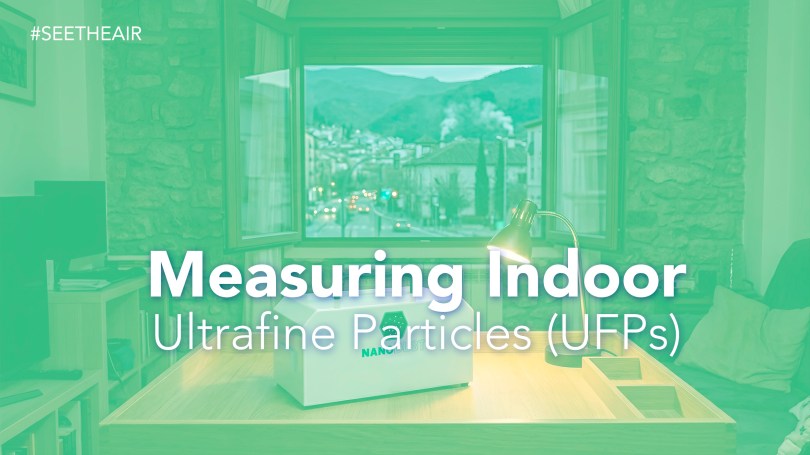
We have spent decades obsessing over PM2.5 —the fine particulate matter small enough to lodge itself in our lungs. We draft laws around it, track it on our phones, and buy home monitors to avoid it. But while our regulatory gaze has been fixed on particle mass, an invisible, almost weightless army of much smaller particles has been slipping through the cracks: Ultrafine Particles (UFPs).
Known technically as PNC0.1, these aerosols have an aerodynamic diameter of 100 nanometers or less. To put that in perspective, they represent a negligible fraction of total ambient mass, yet they often make up over 90% of the total particle number concentration (PNC) in our atmosphere. Because they are so unbelievably small, they don’t just settle in the lungs—they have the unique physical ability to cross into the bloodstream, posing distinct and severe health risks.
Yet, when we step inside our homes, we enter a measurement blind spot. In our current study across two Spanish cities—Granada and Almeria—we exposed a frustrating reality: meeting current PM2.5 standards provides a completely false sense of security when it comes to UFP exposure, and our current measurement tools and guidelines make it nearly impossible to tell if the air we breathe inside is actually safe.
The Non-Linear Disconnect
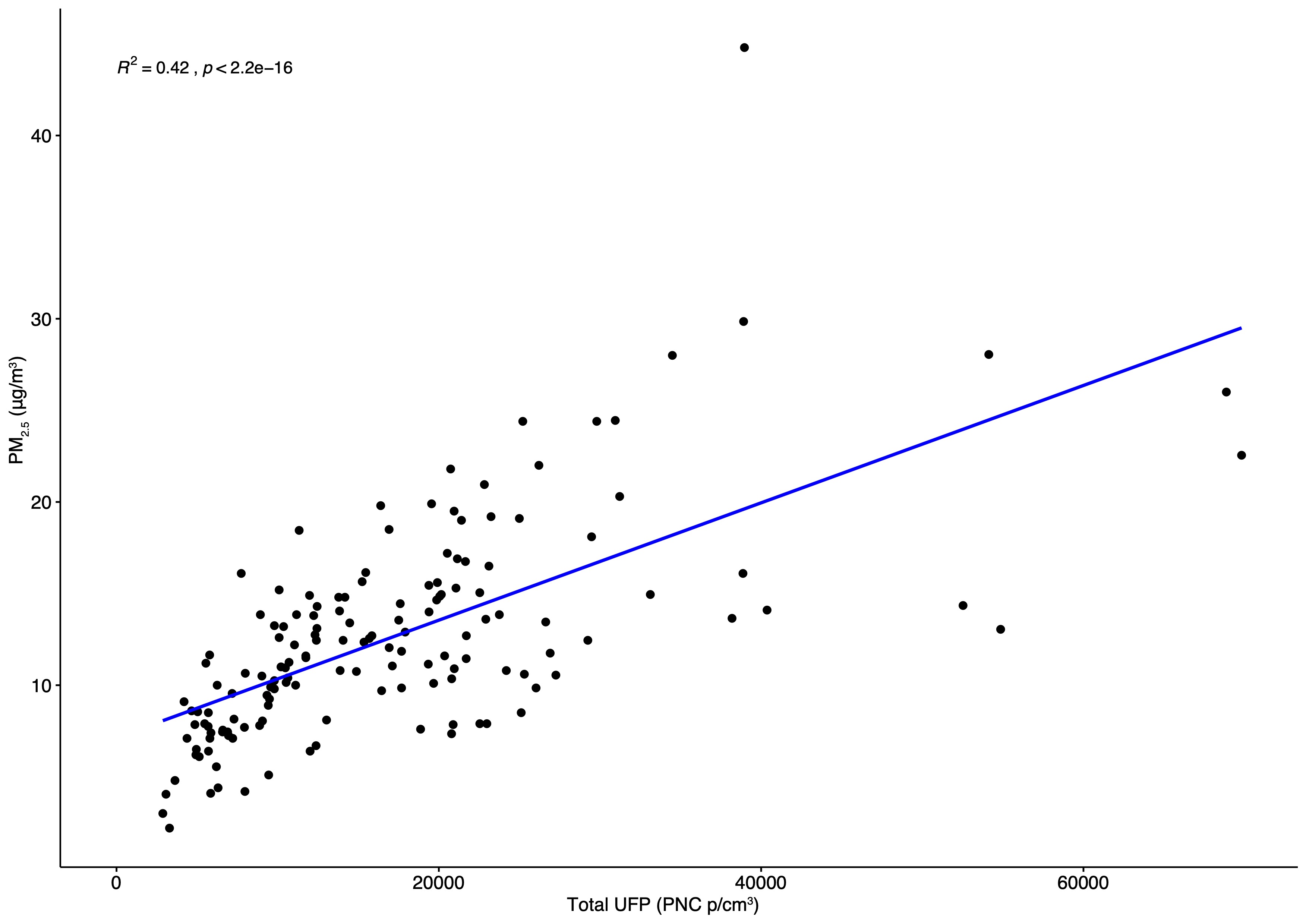
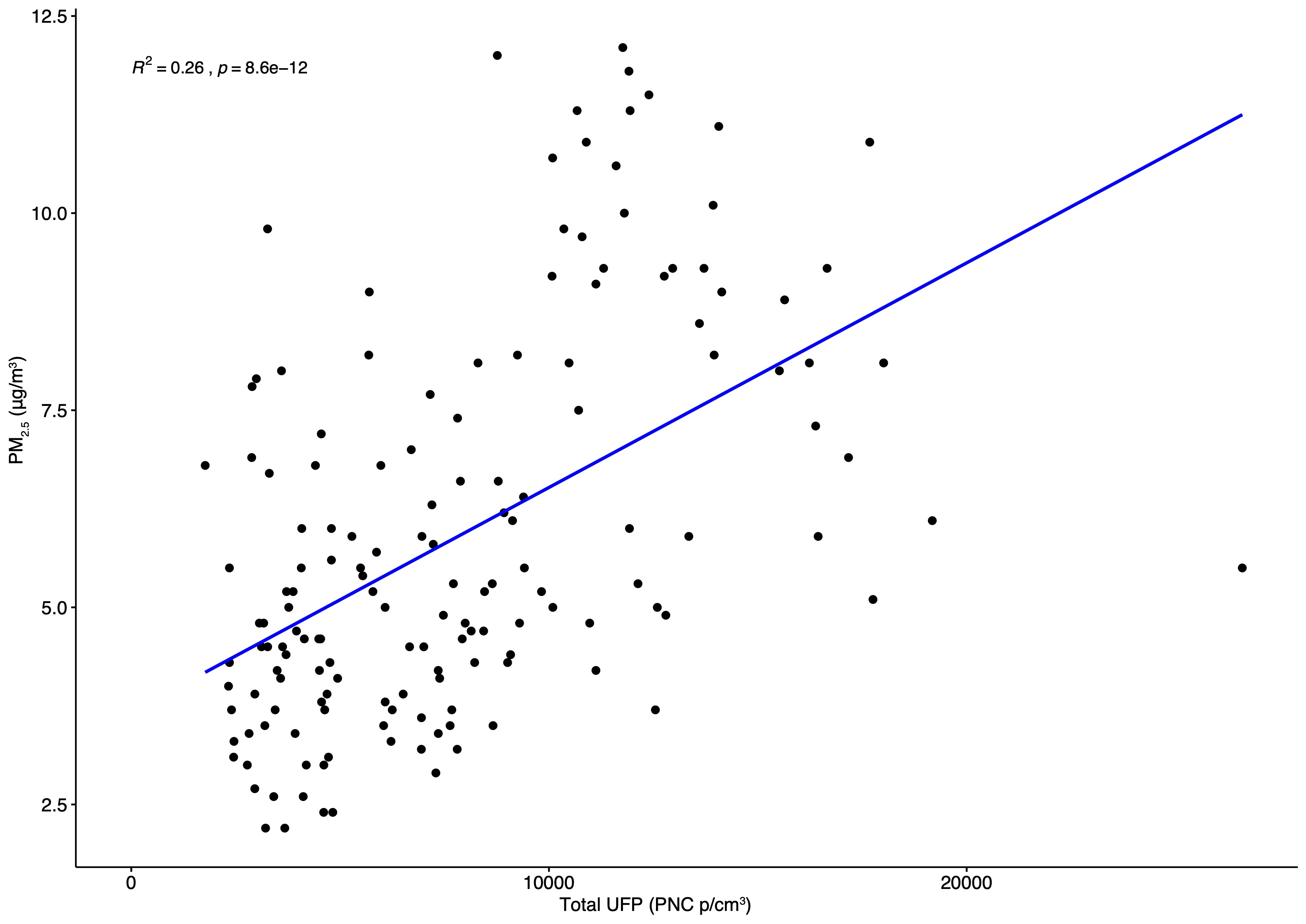
The most alarming takeaway from our research is that PM2.5 mass and UFP counts rarely talk to each other linearly.
In winter, Granada experiences a heavy “bowl effect” due to its surrounding mountains, trapping emissions from vehicle traffic and residential biomass-burning stoves. Outdoors, the 24-hour average UFP count spiked to a staggering 17,000 p/cm3—solidly shattering the World Health Organization’s (WHO) “High” threshold of 10,000 p/cm3.
However, look at what happened to the metrics side-by-side:
| Environment (Outdoor) | 24h Avg. PM2.5 | 24h Avg. UFP Count | WHO Status |
| Granada | 12.6 μg/m3 | ~17,000 p/cm3 | PM2.5: Safe (Under 15 μg/m3 limit) UFP: Exceeded High Threshold |
| Almeria | 5.7 μg/m3 | ~7,800 p/cm3 | PM2.5: Safe UFP: Exceeded Low Threshold by 7.8x |
If your city council or home monitor only checks PM2.5 both environments look perfectly pristine. In reality, the air was teeming with an excessive concentration of ultrafine hazards.
The Complexity of Measuring UFPs Indoors
Why aren’t we tracking this inside our homes? Because measuring UFPs indoors is a logistical and economic nightmare for researchers and homeowners alike.
Traditionally, tracking these particles requires heavy, complex, and extraordinarily expensive laboratory equipment, such as Mobility Particle Size Spectrometers (MPSS) or Condensation Particle Counters (CPC). These instruments are not designed to sit quietly in someone’s living room for weeks at a time; they are loud, require constant maintenance, and cost thousands of dollars.
While newer, lower-cost “diffusion charging” sensors (like the nanoDUST AirPN10 used in our study) are bridging the gap by offering more practical, long-term stability, they still present some challenges. In our controlled testing, these portable sensors showed a strong correlation (R2 = 0.88) with reference instruments, but they consistently underestimated the total particle count, requiring correction factors to get an accurate reading.
For the average citizen, tracking the true quantity of particles in their indoor air is currently out of reach.
The Time Paradox
If the equipment hurdle wasn’t high enough, the guidelines create a massive loophole regarding timeframes.
The WHO’s “good practice statements” offer two benchmarks for high UFP exposure: a 24-hour mean (>10,000 p/cm3) and a 1-hour mean (>20,000 p/cm3). When we look at indoor environments, this dual-standard creates profound confusion.
Under Consideration
Indoor spaces are fundamentally dynamic. We don’t stand still in our houses for a perfectly uniform 24-hour cycle. We cook a meal (frying and toasting launch massive UFP peaks), we open a window, or we turn on a printer. At the same time measuring UPF indoors is quite challenging as the instruments are quite noisy and occupants complain about their operation after a while.
- In our outdoor data for Granada, even though the overall 24-hour levels were high, there were multiple short windows in the 1-hour data where levels looked completely safe.
- In Granada, we monitored an entirely unoccupied apartment with all windows and ventilation off for 48 hours. Even with zero human activity, the indoor air maintained a steady UFP average of 2,900 p/cm3—exceeding the WHO “Low” threshold simply because outdoor pollution slowly bled through the building’s envelope.
- In Almeria, opening the windows for natural ventilation caused indoor UFP levels to instantly match the outdoors, averaging between 4,000 and 5,000 p/cm3.
The Path Forward: True Filtration
If natural ventilation simply invites outdoor traffic and biomass smoke inside, how do we protect ourselves?
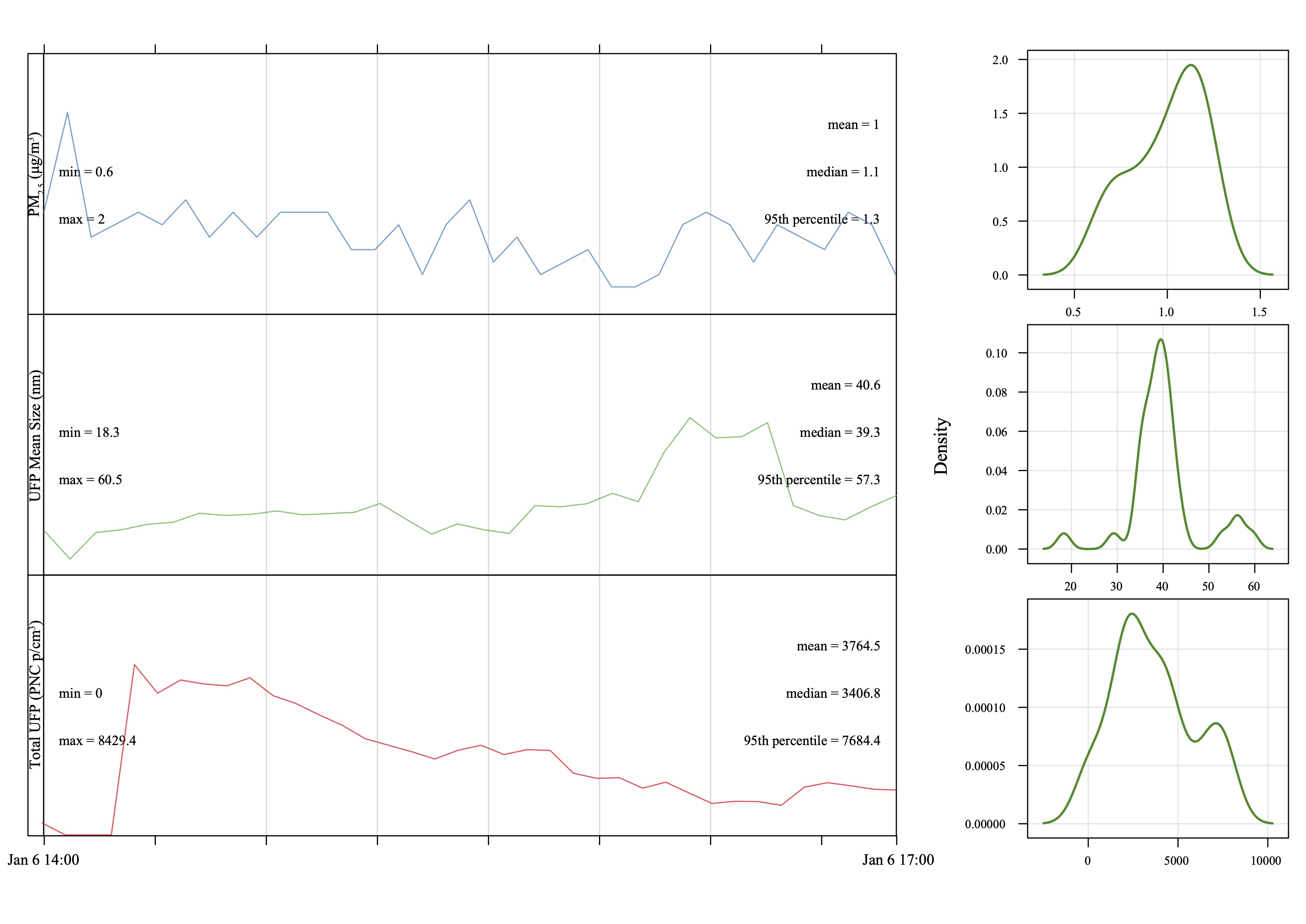
Our study verified that mechanical HEPA filtration (Healthy Air 500 (HA500)) is one of the only reliably effective interventions we have. When we introduced a HEPA 13 purifier into the naturally ventilated Almeria home, the results were swift: 1-hour UFP concentrations plummeted from 5,000 p/cm3 down to a baseline of roughly 700 p/cm3, shifting the indoor environment into the strict WHO safety targets. Interestingly, it also altered the aerosol profile, dropping the average indoor particle size from 40 nm to a microscopic 16 nm by successfully capturing the larger fractions.
Ultimately, the World Health Organization should move away from ambiguous “good practice statements” and institute definitive, clear indoor UFP tracking protocols. We must stop treating PM2.5 compliance as a clean bill of health. Total safety cannot be measured in mass alone; we have to start counting the particles that are small enough to slip into our veins.
What are your thoughts on this? Do you track the air quality in your home using a mass-based monitor, or have you already transitioned to looking at particle numbers? Let’s discuss in the comments below!
Discover more from See The Air
Subscribe to get the latest posts sent to your email.


An important article — and one that raises a question the indoor-air industry needs to take seriously:
If we know that ultrafine particles (UFPs) can be present indoors, but we don’t routinely measure them, how can we effectively manage them?
UFPs are particularly interesting because they sit below the particle sizes normally captured by conventional IAQ metrics such as PM2.5.
That creates a potential blind spot.
And it raises an equally important question:
What technologies can actually help control them?
This is where advanced air-cleaning technologies, including DBD bipolar ionisation, deserve closer attention.
The principle is interesting. By introducing positive and negative ions into the air stream, particles can become electrically charged and interact with one another and with filtration media. Research has shown that bipolar ionisation can enhance the removal efficiency of mechanical filters for fine and ultrafine particles, particularly in the most penetrating particle-size range.
But this is where we need to be scientifically disciplined.
Not all ionisation systems perform the same way. Published studies have produced different results depending on the technology, ion concentration, filter characteristics, airflow, particle size and operating conditions.
So perhaps the bigger opportunity isn’t simply “install an ioniser.”
It is:
Measure. Understand. Control. Verify.
If UFPs are going to become an increasingly important part of the IAQ conversation, we need to start measuring them — particularly in environments where people spend long periods indoors.
And then we need to evaluate which combination of ventilation, filtration and active air-cleaning technologies actually reduces them under real operating conditions.
That could take IAQ management to a much more sophisticated level.
You can’t manage what you don’t measure.
And perhaps UFPs are one of the next big areas where indoor air needs to move from assumption to evidence.
LikeLiked by 1 person