
By Sotirios Papathanasiou and María Teresa Baeza Romero
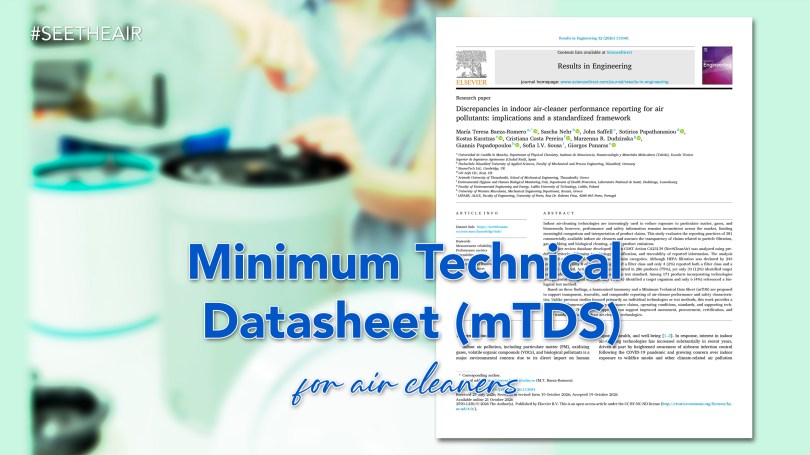
Co-authors of “Discrepancies in indoor air-cleaner performance reporting for air pollutants: implications and a standardized framework” (Results in Engineering, 2026)
When shopping for a refrigerator or a car, spec sheets make life simple: you compare storage capacity or fuel economy knowing that manufacturers measured their products against uniform engineering benchmarks. Yet when shopping for an indoor air cleaner, that certainty evaporates. Every box displays reassuring slogans like “True HEPA,” “Whisper Quiet,” and “Removes 99.9% of Pollutants,” giving the impression that comparing two models is as simple as reading the numbers on the packaging.
In our peer-reviewed study published in Results in Engineering, conducted with an international team of researchers, we evaluated those claims by examining 381 commercially available air cleaners from across the global market. Our primary finding was that in most cases, everyday consumers cannot meaningfully compare performance specs across brands. The issue is not an absence of scientific testing methods; rather, manufacturers routinely omit the critical testing conditions, methodologies, and standards behind numbers like CADR, energy use, noise, and filtration efficiency.
Read More »
