Low-Cost Sensors, Do They Hold Up To The Hype?

Low-cost sensors have helped communities see the air quality, but experts are still debating whether data are accurate or not. In many cases, monitor manufacturers have to turn to data manipulation in order to get accurate results, but it is time to step up by deploying better sensor technology.

The technology exists and we should take advantage of it as soon as possible. Almost always, the first thing I am asked about sensors is how accurate they are. Well, this question has a very tricky answer. In many cases, we measure accuracy by comparing a low-cost sensor with a reference monitor, which worths thousands of dollars. However, the comparison is not always fair. For example, if the XYZ company sends their monitor for evaluation during a high humidity season then unless they have a heater or dryer at the inlet to remove humid droplets of water from the samples before measurement then the results from the correlation would be catastrophic.

Read More »

Fireworks are Bad New for your Body

Fireworks or pyrotechnics are used heavily to this day in many places around the world to celebrate various events. People have them associated with fan and parties, so they are not very open on hearing that they are bad for our health. Fireworks elevate air levels of particulate matter with several metallic components and gases during their explosion. Studies show that hospital admissions with respiratory issues increase during similar events all around the world.

The color of the fireworks is subject to the metals they mix, and while these metals heat from the explosive materials, they produce various color hues.

Read More »

Cars vs People in the USA – Air Quality

Last week was CleanAirDay. I love days like this when a collective effort is made to raise awareness of such an important problem in modern society. Most importantly the new generation of citizens is taught about the importance of excellent air quality and the dangers of air pollution.

For the past few weeks, I have been living in the US near Boston and I am still trying to wrap my head around those super monstrous vehicles people use to commute from one place to another and how towns are designed to force people to drive everywhere.

I am the only person that walks to work or to the grocery store. Literally, I don’t see other people walking here. It’s tremendous!

Read More »

Particulate Matter (PM2.5) Mega Guide

In this article, you will find information about everything related to particulate matter. I will focus on PM2.5 as I believe it is the most universal indicator of air quality. Almost all scientific studies concentrate their attention to PM2.5 because there is a substantial availability of monitors/sensors. Some extracts were taken from my book See The Air – PROOF THAT AIR POLLUTION KILLS.

1) What is PM2.5?

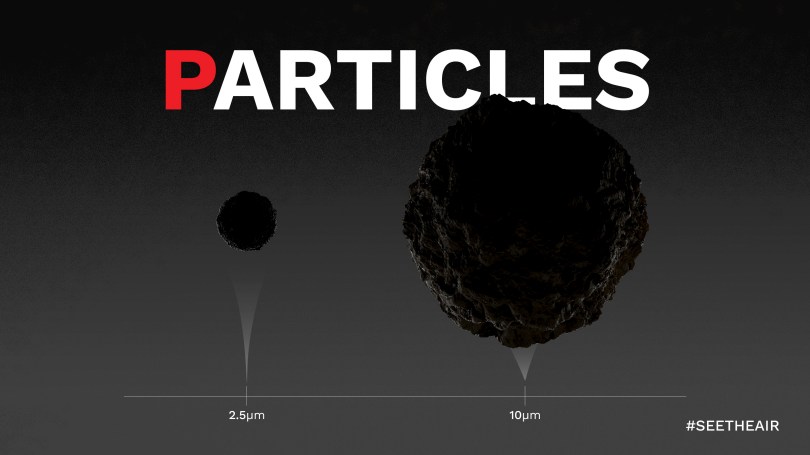
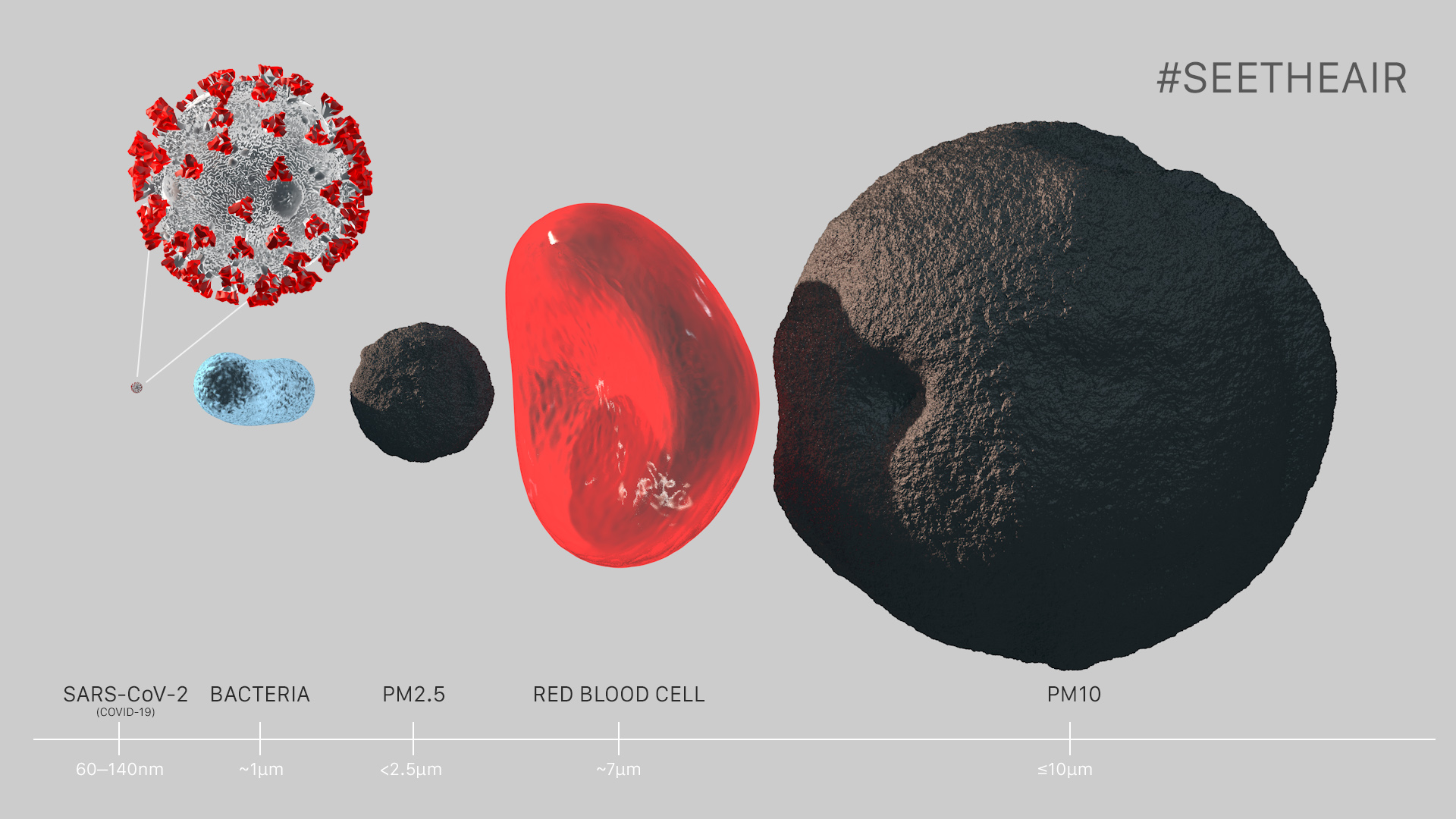
Scientific explanation: PM2.5 is a mass concentration on basis of a separation curve, where the 50% value is at 2.5μm aerodynamic diameter. More precisely, the weighting function is much steeper (100% weighting <0.5μm, to 0% weighting> 3.5μm and 50% weighting at approximately 2.5μm). PM2.5 pollution can only be seen with an electron microscope.

Plain English explanation: PM2.5 referees to fine particles with a size of or less than 2.5μm (aka micron). By the way, soot, aerosols, dust, BC are other common terms to call particle pollution.

2) What is PM2.5 made of?

It is hard to determine a specific chemical composition, however, here is a list of all the chemicals that might be found in a single particle. Polycyclic aromatic hydrocarbons (naphthalene, acenaphthylene acenaphthene, fluorene, phenanthrene, anthracene, fluoranthene, pyrene, benzo(a)anthracene, chrysene, benzo(b)fluoranthene, benzo(k)fluoranthene, benzo(a) pyrene, dibenzo(a,h)anthracene, benzo(g,h,i)perylene, and indene), metals (Al, Si, P, S, CI, K, Ti, Cr, Mn, Fe, Ni, Cu, Zn, Pb, Ca), others.

Read More »

Tobacco has a Tremendous Impact on the Environment, Climate and our Health. How can you break free?

As a child of heavily smoking parents, I always hated tobacco. Unfortunately, my parents didn’t have an understanding of the impact tobacco had on their health when I was a child. Secondhand some also had an impact on my health, but can you blame someone that didn’t understand that smoke is smoke. A toxic combination of tiny particles and chemicals that will alter and break your DNA. Also, the mentality in Mediterranean and Balkan countries is still to this day different from the rest of the world. Some people still believe it is an enjoyable habit to smoke while taking a coffee or after a meal.

It took a great effort to teach my parents that smoking is not good for anyone. At the end, they saw plenty of examples among the family members that died due to this harmful habit, and they gave it up.

For most of us that have visited a beach, we have found a tremendous amount of cigarette butts in the sand. A disgusting habit that authorities must penalize because it is not only aesthetically unpleasing but is also harmful to the marine life and the food we end up eating.

Read More »

What is a Healthy Building? Why Indoor Air Quality is the Key?

Don’t be fooled, even the most outdoorsy person spends a great deal indoors. Apart from the fact that we spend a lot of time indoors because we are safe from the elements and other external threats, indoor environments are designed to meet other occupants’ needs like resting, being productive, or even having fun. A rule of thumb is to take your age and multiply it by 0.9. Vualá, that’s the time you have spent indoors so far.

Nowadays buildings are fully equipped with all sorts of things in an effort to make occupants’ life better, healthier, or even more creative. If we take as an example a modern house, we will find modern gym equipment, connected lights to create an atmosphere, smart vacuum cleaners, etc. If we take as an example an office building, we will find automation in the entrance with automated doors, fire alarms, elevators, etc.

Read More »

Review: Mila Air Purifier by Mila Cares

Indoor air purification made affordable!? If you see the competition out there, you will notice that some air purifiers are crazy expensive. Sometimes justified, but most of the time not so much. The problem is that in a modern household we want smart devices that will manage stuff for us automatically and intelligently. Here comes Mila Air, an air purifier for the modern ages in an affordable package.

Mila Air by Mila Cares uses proven techniques to remove air pollutants from your indoor environment such as filters with HEPA H12 or H13 or H14, among others. You choose which one is the best for you. There are many other filter combinations that are ingenuously described by the company in order to make the product more accessible to the everyday folks that want to improve indoor air quality and aren’t experts in the field.

Read More »

Los Libros de Nicholas ahora están disponible en Español – Nicholas’ books are available in Spanish

Los libros de Nicholas ahora están disponible en Español gracias a la colaboración con el Instituto Universitario de Medio Ambiente y Grupo de investigación Química Analítica Aplicada de la Universidade da Coruña. 

La educación ambiental de los niños es muy importante para poder promover la conciencia ecológica y el cuidado del ambiente en la ciudadanía. El aire puro que necesitamos para respirar y vivir es un derecho humano. La ONU calcula que aproximadamente 7 millones de personas mueren cada año de forma prematura debido a la contaminación del aire. Ademas un 90% de la población mundial respira aire contaminado.

Los libros van a estar disponibles en varias bibliotecas en Galicia (España) pero también están disponible en Amazon.

OPEN Ambient Air Quality DATA

There is some serious competition in the market of environmental monitoring and particularly in air quality. There are a lot of ambient air quality monitors available with great features and great sensors, the problem is that society doesn’t benefit from the variability of monitors because AQ data are scattered in different platforms/maps. It is hard for end-users and citizens to find which monitor is active and where (especially if you move). Someone needs to gather low-cost AQ data from everywhere and offer it to users in easy service.

Last year, on my trip across Europe, I monitored air quality with a portable monitor, but I wanted to compare the data I got against the official or other low-cost monitors out there. It was impossible!

The openaq team is doing just that. They are gathering data from official and low-cost sensors (stationary and mobile). Unfortunately, even today I cannot access data from specific low-cost monitors that take advantage of the API and their open map.

This are the brands that collaborate and they provide data to openaq:

Read More »

Spring Is Around the Corner & Allergies too

I love spring as it marks the return of warm weather, outdoor activities, the blossom of flowers, and life in general. However, pollen becomes abundant everywhere there are plants and trees, as a result, the flare of allergy-related health issues too. I am allergic to some kind of pollen and although I can manage it without medication, some people are suffering to a greater extend and they need better ways to mitigate pollen out of their immediate environment.

Unfortunately, on earth, there are only a few special Air Quality monitors that can measure and classify pollen. Satellites also track the progress of pollen but do you know where to find this kind of information? I bet no, for this reason, I will tell you in a bit.

Remember, the first step is always quantifying the pollutants/allergens (pollen in this case) before mitigating them from indoor spaces. The reason is simple, once we have the proper information, we can take better decisions. For example, should I exercise outdoors today or go outside for some errands or is this the right moment to ventilate my house?

Read More »