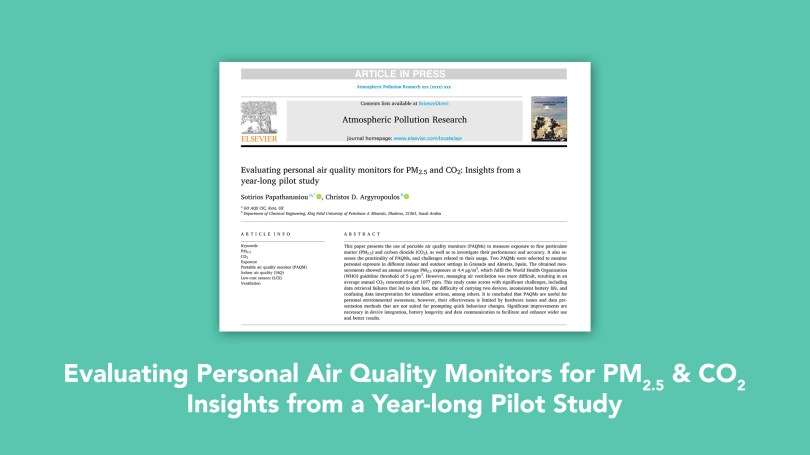
Lessons from a Full Year of Personal Air Quality Monitoring

We firmly embrace technology because it grants us the power to see what is otherwise invisible: the continuous, shifting dynamics of the air we breathe.

We are excited to share that our research paper, titled “Evaluating personal air quality monitors for PM2.5 and CO2: Insights from a year-long pilot study,” has been officially published in Atmospheric Pollution Research (DOI: 10.1016/j.apr.2026.103210).

Here is a brief overview of our journey and what drove this study.

The Year-Long Study

Our pilot study ran for a full 367 days, spanning from mid-summer 2024 to mid-summer 2025. We deliberately carried two portable air quality monitors with us everywhere we went to experience all seasonal changes and daily environmental challenges.

While device technology continues to evolve, carrying these monitors every day taught us a tremendous amount about human exposure and the practical realities of personal air monitoring.

Read More »

Key Insights from ASIC 2025 in Thailand: Bridging the Indoor-Outdoor Divide

The recent Air Sensors International Conference (ASIC) 2025, held in the vibrant backdrop of Thailand, offered a profound opportunity to delve into the evolving landscape of air quality monitoring. As an attendee, several key themes emerged that highlight both the progress made and the remaining challenges in our quest to understand the air we breathe.

The Indoor-Outdoor Air Quality Discrepancy

One striking observation from the conference was the apparent disparity in research emphasis between indoor and outdoor air quality monitoring. While outdoor environments have benefited immensely from the widespread adoption and scrutiny of low-cost air quality monitors, indoor spaces appear to lag in comparison. The primary reason for this imbalance lies in the availability of robust reference instrumentation. Governments worldwide have invested in publicly air quality stations equipped with reference-grade instruments, providing invaluable benchmarks for normalization and validating low-cost sensors in a variety of outdoor conditions. This has not only accelerated the development of accurate low-cost monitors but also fostered the creation of sophisticated correction algorithms.

Read More »