Podcast Ep1: See The Air | Real Life Stories

I am very happy to announce that I am launching a new series of Podcast episodes where people from all around the world will be able to share their experience with air pollution and how it affects their lives.

The episodes will be available in all big Podcast distributional channels like Apple Podcast, Google Podcast, Spotify, and Spreaker.

Episode 1 : London, UK – Traffic Pollution and LTNs

In the first episode, we will hear Ediz from London, UK. Ediz is a clean air campaigner and he and his family members have to breathe lots of traffic-related air pollution as his neighborhood is jammed by hundreds of cars every day.

Read More »

Smoggie-PM + Thank you

Choosing the 5 volunteers was a very difficult task because I had to take into consideration many factors. I wish I had as many monitors as the people (+150) that emailed me. The finalists are from Belgium, Uganda, Azerbaijan, the USA, and Spain.

The second Call for Volunteers was even more successful than the first one and I had the chance to learn from you a little more about the problems of air pollution around the globe and the situation each one of you faces. From Nepal, Poland, Netherlands, Australia, Azerbaijan, India, Romania, Italy, France, Kenya, Belgium, Greece, Denmark, UK, the USA, Finland, Serbia, Mexico, Spain, Israel, Ireland, and many many other places.

I want to THANK YOU all, it really means a lot your offer to raise awareness on such an important problem. I will follow closely the measurements from all 5 locations in order to understand better the impact air pollution has in the communities.

Remember, you can always purchase the inexpensive Smoggie-PM here.

Read More »

Review: XT Mini by Ethera Labs

Managing air quality monitors (AQM) in buildings is not always an easy task especially if you have deployed a lot of them. When there are many rooms that you have to take into consideration it can become very costly, very fast to equip all those rooms. Is there a way to monitor rooms without an AQM?

Well, it turns out there is a way to monitor the environmental and air quality conditions in rooms that do not have physical monitors nowadays. How?

Ethera Labs, which is a French company, with over 10 years of experience in professional IAQ solutions has integrated powerful Machine Learning (ML) algorithms that predict the conditions in rooms where air quality monitors are not installed, yes that’s right, you have read correctly. They have trained special neural networks by taking a lot of parameters into consideration in order to predict accurately the conditions and alerts users in case they need to take actions or even address an AQ/Environmental incident automatically.

By connecting the station to BMS, they manage to achieve energy efficiency while directly managing the ventilation system, as well as portable air purifiers or giving building operator the right information in advance so they can take action at the right time. They achieve two goals, great air quality and energy efficiency.

Hardware-wise Ethera Labs offers an arrange of monitors that can address different building specifications and needs. In this article, I will review the Mini XT Basic (MX-KIT020) and the NEMo Cloud/Supervision Cloud platforms.

Read More »

Review: Aether Air HA30 an in-Vehicle Air Purifier

Commuting to work is proved to contribute the biggest daily exposure to air pollutants according to the University of California. Car filters are not very good at filtering out PM1, PM2.5, and PM10 particles from vehicle emissions as they were originally designed to catch large particles like dust and pollen. Gas filtration is non-existence even today in any vehicle, as a result, drivers and vehicle passengers breathe notorious toxic fumes.

Although I believe that if you live in a city and you work in the same city, you should find a better way to commute, for some people this is not an option. Consequently, they need to find a way to protect themselves and mitigate their exposure to air pollution.

Aether Air HA30 is an in-vehicle air purifier capable of filtering particulate matter and eliminating nitrogen dioxide (NO2) among other chemicals.

It uses the same technology as the HA500 domestic purifier but in a smaller package. The D-Orbital Nano Oxide (DNO) filter, which is an innovative filtration system invented by the founding CTO of Oxford Catalyst plc (a leader in novel industrial catalysts)” and a HEPA 13 filter.

Read More »

uRADMonitor SMOGGIE-PM | Call for Volunteers Take 2 [Ended]

Back in 2019 uRADMonitor and I organized a “Call for Volunteers” where we gave away 10 monitors all around the world.

Once more we are looking for five volunteers who want to receive a Smoggie-PM monitor. The new version comes with new transparent icy look case and visual indication of the pollution concentration thanks to the LED light.

Volunteers all around the world who are willing to install an Air Quality Monitor in their backyard or balcony or window or any other outdoor environment in order to build a better air quality network and to help you raise awareness in your neighborhood/community.

The only requirement from your side is to have a good Wi-Fi internet connection 24/7 and keep the device on constantly in order to broadcast the measurements to an open map. The WiFi signal must reach the monitor outdoors.

Just email or tweet or DM me on any social media platform, tell me where are you planning to install the monitor and why should I choose you.

What is SMOGGIE-PM?

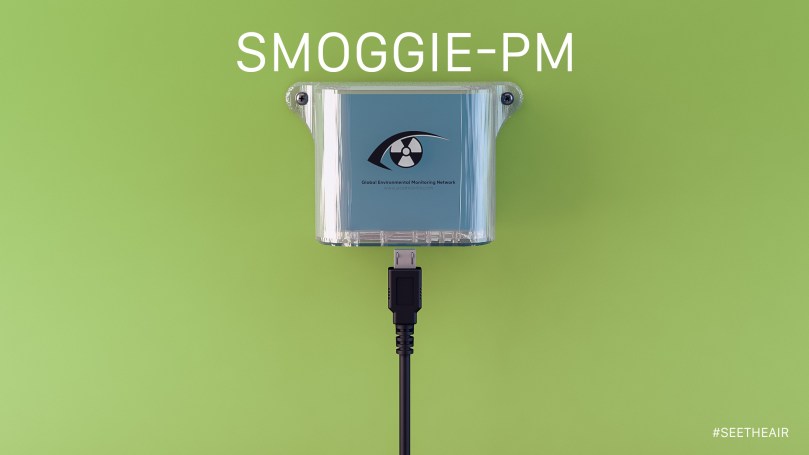
Smoggie-PM is an ultra low-cost high performance Air Quality Monitor, with Wi-Fi connectivity and a laser scattering sensor (Plantower PMS5003) that measures Particulate Matter PM1, PM2.5 and PM10 and makes it available on your phone or laptop in real time. Also, it is equipped with a Temperature/Humidity/Pressure sensor (Bosch BME280).

Smoggie is an automated, fixed, Air Quality monitoring station. It has WiFi connectivity to send the air quality measurements to the uRADMonitor Cloud in real time. It needs 5V to run, powered by a standard micro-USB cable (the same your smartphone uses in order to charge it). The new versions have a color LED light that reflect the pollution levels in real-time.

Let’s talk: IoT Wireless Network Protocols for Air Quality Monitors

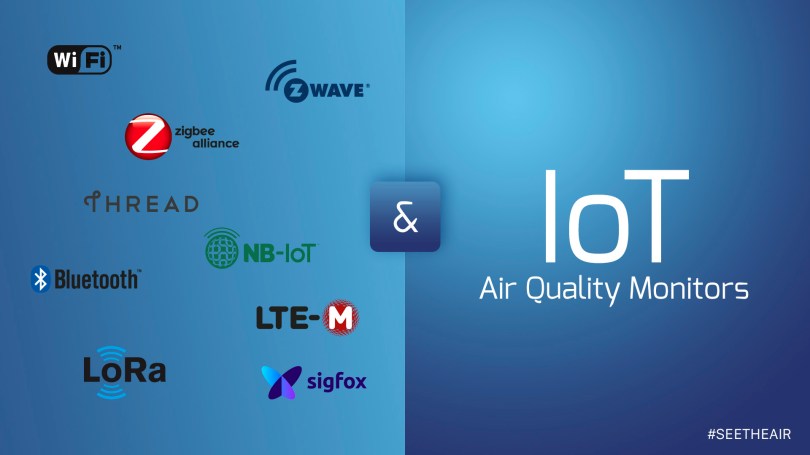
The Internet of Things (IoT) describes the network of electronic devices (air quality monitors, purifiers, motion detectors, cameras, etc.) that are embedded with sensors, software, and other technologies for the purpose of connecting and exchanging data with other devices over the Internet.

In this article, I am going to describe some of the available networks and physical layers that are used by Air Quality Monitors (AQM), mainly for consumer-based products, and discuss which technologies make more sense in 2021+ for Smart Homes/Buildings and Businesses.

Wi-Fi IEEE 802.11

IEEE 802.11 is part of the IEEE 802 set of local area network (LAN) protocols and specifies the set of media access control (MAC) and physical layer (PHY) protocols for implementing wireless local area network (WLAN) Wi-Fi computer communication in various frequencies including 2.4 GHz, 5 GHz, and 6GHz.

IEEE 802.11a/b/g/n

This standard wireless network protocol is among the most common protocols for communication between the devices and the internet/cloud. Most devices even today use the ~20 years old 802.11b or 802.11g with a linkrate between 1 to 54 Mbit/s and a frequency of 2.4 GHz for power conservation reasons and good wall penetration. The 802.11n transmits the highest data throughput, but at the cost of high-power consumption at 5GHz.

IoT AQMs do not need a high-speed data throughput because the information they transfer is very little and in the range of a few kilobytes. So protocols like the IEEE 802.11ac and IEEE 802.11ax don’t make a lot of sense because they demand energy and they don’t offer good wall penetration in order to cover an entry house/apartment.

IEEE 802.11ax aka WiFi 6 or 6e

There are some claims that IoT devices will adopt the new WiFi 6e (e stands for enhanced) but I don’t think we will see that happening as bandwidth isn’t relevant for AQMs but the range is more essential and the WiFi 6e is designed to cover approximately 30m/98ft indoors. The 6e operates at 6Ghz, as a result, the highest the frequency the shortest the distance a signal can travel within walls. A positive feature of this protocol is that it supports a Low Power Indoor (LPI) mode. In the multi-user scenario, the WiFi 6 module consumes only one-third of that of the Wi-Fi 4 (802.11n) module and they achieve that by shortening wake-up time.

Read More »

Review: HA500 Air Purifier by Healthy Air Technology

It is not always an easy task to keep indoor air free from pollutants, especially, when Nitrogen Dioxide (NO2) is present in indoor environments. In most cases, there is little you can do to eliminate NO2 and other gases like Sulphur Dioxide (SO2), Formaldehyde (TVOC), or even pathogens like H1N1 Influenza A virus (pandemic flu), and Staphylococcus aureus (or similar bacteria).

Here comes the HA500 Air Purifier by Healthy Air Technology which is able to eliminate all of these pollutants/pathogens from indoor environments. It does that thanks to the triple-layered system with a primary filter, HEPA 13 filter, and Pollution Eraser DNO filter. DNO means D-Orbital Nano Oxide which is made of two parts. 

1st part: The Carrier – Activated charcoal. The material that is used in military gas masks, and captures pollutants within the pores of the charcoal.
2nd part: The Transition metal oxides – Transition metal oxides are coated in the activated charcoal to form catalysts, and these catalysts break down pollutants and toxic gases into harmless chemicals and then release these harmless materials back into the atmosphere like water, oxygen, carbon dioxide, etc. The DNO is invented by the founding CTO of Oxford Catalyst plc (a leader in novel industrial catalysts).

HA500 Control Panel and Display
Read More »

Penetration of Particles into the Human Body

How deep can pollution particles go into the human body?

Poll: Results Discussion – Air Pollution

Last week I started a brief poll on Twitter because I wanted to obtain feedback from the community. The subject was simple “Which source of #AirPollution affects you the most?”

263 people responded and unfortunately, I can’t say that the results surprise me. Vehicle traffic was voted as number #1 source of air pollution with a massive 53% and it was followed by 32% wood burning for heating like wood-burning stoves, fireplaces, etc. 7% of the users voted that agriculture is the source of air pollution in their communities and an 8% voted other.

I would like to comment about each category individually, but first of all, I would like to make something clear. All sources are equally important, I don’t rank them from most to least important but I classify them based on what people think is the source in their community, and it varies a lot.

Read More »

Clarity Node-S Remote Calibration Process

When you use low-cost monitors for professional reasons, you need to calibrate them in order to obtain the best possible measurements. This process makes data less vulnerable to environmental conditions and more valuable to scientists and policymakers.

Clarity takes this process really seriously, and they dedicate a lot of resources to making sure their devices will measure accurate data (for more on how to assess air quality sensor accuracy, see this blog). I ask Clarity to perform a remote calibration on my Node-S and guide me through the entire the process.

I have discovered something interesting during that process about the local air quality station.

As you may already know from my previous articles, my local air quality station ES1393A is placed inside a park and it is almost surrounded by trees. Trees act as a barrier, and they block pollutants from reaching the monitors. The Clarity team told me that this was an especially complicated calibration. I suspect it has to do with the location of the station and how trees may interact with low-cost sensors.

The type of trees in my city is a variation of a ficus called ficus retusa l. var nitida. These trees release a resin from their leaves which can create interference to the low-cost sensors that do not have a filter to keep them out as the scientific-grade monitors do. Most outdoor scientific-grade monitors come with a debris screen inlet or an Inlet Heater which may capture the resin from the trees.

The problem is not the trees but the location of the air quality station that shouldn’t have been there.

Read More »